

Shown: · With its frame:
 Переглянути в інтер'єрі
 Надіслати як листівку
 Поділитися
 Деталі витвору
 Посібник

 Завантажити
 Схожі екземпляри
 Рентгенівське дослідження
 Слайд-шоу
 Q&A
Q&A Статистика


₴ 12092
Олійная репродукція ручної роботи
Написана вручну олією на полотні у вашому розмірі та рамі, виготовлена на замовлення нашими художниками. ( Перейти до друку Перейти до цифрових зображень)
Size
·Стандартний розмір
індивідуальний розмір
CM
INCH
Обирайте з наших стандартних розмірів, що відповідають оригінальним пропорціям твору мистецтва.
Loading sizes...

ширина
висота
Введіть необхідну ширину та висоту, щоб картина підійшла до вашої рами або стіни. Оскільки це ручний розпис, для зміни пропорцій художник може дописати трохи більше по краях або дещо обрізати композицію — вибір за вами. Перед початком роботи ми надішлемо вам цифровий макет для затвердження. Зображення, показане на цій сторінці, не є реальним результатом — лише макет відображає майбутній вигляд.
 Читати далі
Finish
·
White ₴1

Blurside ₴1

Extended ₴1

P118B ₴10

P118H ₴10

P118W ₴10

P438Z ₴10

P508JH ₴12

P508YH ₴12

P805H ₴10

P805Z ₴10

P919BZ ₴10

P919G ₴10

P919XJ ₴10

P959ZH ₴10

P968JZ ₴12

W106C ₴8

W218G ₴10

W218JH ₴8

W218Y ₴10

W307PJ ₴10

W316G ₴10

W316PJ ₴8

W316Y ₴10

W398PJ ₴8

W4111J ₴10

W500HY ₴15

W500JH ₴15

W692G ₴12

W849H ₴8

W940BG ₴15

W953PJ ₴8

H24-GOLD ₴30

H24-SILVER ₴30

H36-GOLD ₴45

H36-SILVER ₴45
Shipped in a protective tube, ready for your own framer.
Above 105 cm the frame is shipped as a kit for a professional framer — read the details.
Extras
optionalWhat do the extras include?
Examples of what can be changed: Replace face with customer photo; Add pet (e.g., replace cat with dog); Include hidden message in background; Change background landscape or elements.
After order, TopImpressionists.com team will email client for instructions and provide a mockup preview
After order, TopImpressionists.com team will email client for instructions and provide a mockup preview
Доставка по всьому світу () за 3–4 тижні замість стандартних 5 тижнів. (1 Листопад). Без жодних компромісів у якості.
Захисний лак
Етикетка експоната
Деталі гравірування на бронзовій табличці
This elegant plaque features the artist's name and the title of the artwork, finely engraved for a timeless presentation.
It is made from bronze with a refined, elegant finish. The text is precisely laser-engraved for a sharp and permanent result. Measuring 9x2 cm, the plaque is compact yet easy to read. It's built to be durable and scratch-resistant, offering a professional, museum-quality look. Mounting is simple thanks to the included adhesive backing.
Деталі прозорої акрилової таблички
The plaque includes essential engraved details such as the artist's name, the title of the artwork, the date it was created, the type of media used-like oil on canvas or watercolor-a brief description of the piece, and a QR code that links to the complete artwork information.
It is crafted from clear acrylic, offering a sleek, modern appearance. The text is UV-engraved in black to ensure strong visual contrast. With a size of 10x15 cm, it ensures optimal readability. It comes equipped with two metal hooks for secure wall mounting. The plaque is designed to be weather-resistant, making it suitable for various environments, and it includes interactive features that work seamlessly with smartphone scanning.
Деталі чорної акрилової таблички
This elegant plaque includes engraved information such as the artist's name, the title of the artwork, the date it was created, the type of media used (like oil on canvas or watercolor), a short description of the artwork, and a QR code for quick access to more information.
The plaque itself is made from refined black acrylic with a premium finish. The text is laser-engraved in white for high contrast and readability. Its size is 10x15 cm, designed to be easy to read. It comes with two metal hooks for professional mounting. The design is sleek and fits any interior style. It is also weather-resistant and durable, with built-in digital integration for mobile compatibility.
Скляний варіант доступний лише для розмірів до 110 см
 Скляний варіант доступний лише для розмірів до 110 см
- Безкоштовна експрес-доставка по всьому світу
- Високоякісне лляне полотно
- Повне страхове покриття доставки
- Гарантія повернення митних зборів
- Гарантія точного відтворення кольорів
- Політика повернення протягом 100 днів (лише у разі виявлення дефектів)
- Гарантія повернення 100% коштів
- Пропозиція на оптові замовлення


Опис експоната
Experience the divine grace of Lorenzo Monaco's Gothic Annunciation (c. 1410), featuring radiant light and serene figures; discover this Renaissance masterpiece today.
Біографія митця
Дослідіть творчість Лоренцо Монкацца — фіолетового митця епохи пізнього готичного та ранньої ренесансної культури Флоренції! Його духовна картина, мініатюри та унікальний стиль заслуговують уваги.
About the painting
A Divine Encounter in Gold and Grace
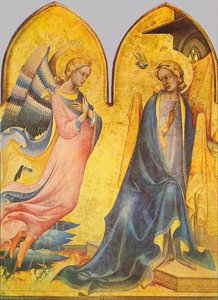
In the quiet sanctity of the Galleria dell'Accademia in Florence, there exists a moment frozen in time, a celestial intersection between heaven and earth captured by the hand of Lorenzo Monaco. His The Annunciation, painted around 1410, is far more than a mere religious illustration; it is a profound meditation on the arrival of divine grace. As one gazes upon this masterpiece, the viewer is transported to the dawn of the Italian Renaissance, a period where the ethereal elegance of the Gothic tradition began to breathe with the burgeoning realism of a new era. The scene depicts the pivotal instant when the Archangel Gabriel descends to deliver his transformative message to the Virgin Mary, an event rendered with such spiritual intensity that it feels as though the air around the panel is still vibrating with the weight of the divine word.
The composition is a masterclass in balanced tension and sacred geometry. On one side, the Angel Gabriel appears in dynamic motion, his wings spread wide to suggest a sudden, celestial arrival. His presence is marked by a serene focus, embodying the gravity of his mission. Opposite him, the Virgin Mary kneels in a posture of profound humility and contemplative prayer, her hands clasped in reverence. This symmetry is framed by an architectural backdrop—a Gothic archway that evokes the hallowed halls of Florentine churches—which provides a sense of structural depth and anchors the supernatural event within a recognizable, sacred space. The use of tempera on panel allows for an exquisite level of detail, from the delicate folds of Mary’s drapery to the intricate patterns that dance across her garments, inviting the eye to linger on the meticulous craftsmanship of the monk-artist.
The Radiance of Symbolism and Light
Lorenzo Monaco, often remembered as “Lawrence the Monk” due to his devotion to the Camaldolese order, infused this work with a unique spiritual luminosity. The color palette is dominated by warm, radiant hues—vibrant yellows and deep reds—that seem to emanate from Mary herself. This chromatic choice is deeply symbolic, representing the divine light of grace descending upon the earthly realm. High above the central figures, a dove descends, a subtle yet powerful emblem of the Holy Spirit, signaling that this encounter is orchestrated by the hand of God. Through these symbols, Monaco weaves a narrative that transcends language, speaking directly to the soul through the universal vocabulary of light and color.
For the discerning collector or interior designer, The Annunciation offers an unparalleled opportunity to introduce a sense of historical depth and spiritual tranquility into a space. The painting’s dramatic use of light and shadow—a precursor to the more intense chiaroscuro of later centuries—creates a focal point that commands attention without overwhelming its surroundings. Whether placed in a curated gallery setting or as a centerpiece in a sophisticated study, a high-quality reproduction of this work brings with it the prestige of Florentine heritage and the timeless beauty of the Gothic spirit. It is an invitation to contemplate the intersection of human devotion and divine mystery, making it a profound addition to any collection dedicated to the enduring power of fine art.
Питання та відповіді
До якого художнього напряму належить «The Annunciation» роботи Лоренцо Монакко?
Мистецький напрям, до якого належить «The Annunciation» роботи Лоренцо Монакко, — це Early Renaissance. Така класифікація дозволяє розмістити цей твір у контексті суміжних митців та творів мистецтва.
У якому році було створено "The Annunciation"?
«The Annunciation» роботи Лоренцо Монакко було створено у 1410 році.
Який інтер'єр найкраще підкреслить кольори твору «The Annunciation» роботи Лоренцо Монакко?
Кольорова палітра Earthy у творі «The Annunciation» роботи Лоренцо Монакко ідеально підходить для рекомендованого інтер'єру: це Living Room.
Quick facts and art quiz
About Лоренцо Монакко

Лоренцо Монакко
1370 - 1425, Італія
Біографія митця
Lorenzo Monaco, c.1370–1425 | Art UK
Lorenzo Monaco (c.1370–1425) stands as a singular figure in the artistic landscape of late Gothic Florence—a beacon illuminating the twilight years before the full blaze of the Renaissance. Despite the scarcity of biographical data, his oeuvre speaks volumes about an artist deeply rooted in tradition yet subtly attuned to emerging stylistic currents, securing him a place among the most revered masters of his era. His journey began in Siena, where he was born around 1370—a birthplace that would later become synonymous with artistic excellence and innovation. Precise details regarding his upbringing remain elusive, but scholarly consensus points to Florence as his formative environment, where he absorbed the lessons imparted by luminaries like Giotto, Spinello Aretino, and Agnolo Gaddi – artists who established a bedrock of narrative clarity and emotional resonance that would define Monaco’s artistic trajectory.Early Training and Influences: The Gothic Legacy
Lorenzo Monaco's formative years were spent honing his craft in the *bottega* of Agnolo Gaddi—a workshop renowned for its patronage of Giottoesque painting and its commitment to upholding the stylistic conventions of the International Gothic style. This exposure undoubtedly instilled in him a profound appreciation for meticulous detail, elegant linearism, and restrained chromatic palettes—characteristics that would permeate his early works. The influence of Giotto is palpable in Monaco’s approach to portraying human figures, particularly in his depiction of drapery folds and facial expressions—a stylistic hallmark that distinguishes him from many of his contemporaries. Furthermore, he absorbed insights from Ghiberti and Starnina, artists who championed sophisticated compositional techniques and a heightened awareness of visual space—elements that would contribute to the distinctive aesthetic of his artistic output. The International Gothic style itself—characterized by shimmering gold leaf, elongated figures draped in flowing garments, and an ethereal luminescence—provided Monaco with a framework for exploring themes of piety and transcendence.The Camaldolese Order and Artistic Transformation
A pivotal moment in Lorenzo Monaco’s life occurred in 1390 when he embraced monastic vows at Santa Maria degli Angeli in Florence—joining the Camaldolese order, a movement dedicated to contemplative prayer and scholarly pursuits. This decision profoundly shaped his artistic identity, imbuing it with an introspective quality and directing him toward subjects of spiritual significance. The monastery’s scriptorium became his studio, where he diligently illuminated manuscripts—a practice that demanded precision, patience, and a mastery of color and texture—further refining his technical skills and deepening his understanding of visual symbolism. It was during this period that Monaco adopted the name Lorenzo Monaco—a moniker signifying “Lawrence the Monk”—reflecting his unwavering devotion to God and his commitment to upholding monastic traditions. This dedication would become an enduring hallmark of his artistic vision, distinguishing him from many artists of his time who prioritized worldly pursuits over spiritual contemplation.Stylistic Evolution: From Gothic Grace to Renaissance Light
As Monaco’s artistic career progressed, he subtly adapted the stylistic conventions of the International Gothic style—embracing elongated figures draped in sinuous garments and favoring sharp edges and brilliant colors—particularly gold leaf and lapis lazuli—to convey emotion and spiritual depth. However, unlike many artists of his era who wholeheartedly embraced Renaissance humanism—characterized by anatomical accuracy and perspectival illusion—Monaco remained steadfastly committed to the expressive power of Gothic tradition. His later works demonstrate a remarkable sensitivity to light—a technique that anticipates the innovations championed by Masaccio and Filippo Brunelleschi—creating an ethereal luminescence that elevates his paintings beyond mere representation, transforming them into vehicles for conveying profound theological ideas. The *Pietà*, housed in Florence’s Galleria dell'Accademia, exemplifies this stylistic evolution—capturing the sorrowful dignity of Mary mourning Jesus with a nervous energy in its lines and a palpable sense of emotional tension. Similarly, *The Coronation of the Virgin*—now gracing the Uffizi Gallery—displays Monaco’s masterful command of color and composition—creating a vibrant tapestry of saints rendered with sinuous forms and dazzling hues.Legacy: A Singular Voice Amidst Changing Times
Lorenzo Monaco's artistic legacy endures as a testament to his singular vision—a synthesis of Gothic elegance and nascent Renaissance sensibilities that distinguishes him from many of his contemporaries. Giorgio Vasari, writing in *Lives of the Artists*, acknowledged Monaco’s talent while noting his untimely death around 1425—a loss that deprived Florence of one of its most distinguished painters. Despite the brevity of his life, Monaco left an indelible mark on art history—establishing himself as the final significant exponent of Giotto's style and paving the way for subsequent generations of artists who embraced Renaissance humanism. His paintings continue to inspire admiration for their refined technique, spiritual depth, and evocative beauty—serving as enduring reminders of a pivotal moment in Florentine artistic culture—a time when tradition and innovation converged to produce masterpieces that resonate with viewers centuries later.Quick facts about Лоренцо Монакко
- Artistic Movement Or Style: Пізня готична / Ранній ренесанс
- Artists Or Movements Influenced By This Artist:
- Фра Анжеліко
- Мазаччо
- Artists Who Influenced This Artist:
- Джото
- Спіньоло Аретіно
- Агноло Гадді
- Date Of Birth: Сiena, Італія (бл. 1370)
- Date Of Death: Італія (бл. 1425)
- Full Name: Lorenzo Monaco
- Nationality: Італійський
- Notable Artworks:
- П'єта
- Коронація Діви Марії
- Поклоніння Magi
- Place Of Birth: Сiena
Досліджуйте твори мистецтва, впорядковані за темами, стилями та характеристиками.


Лоренцо Монакко
The Annunciation
() ·
With its frame: · Hand-painted in oil on linen
Total