

Shown: · With its frame:
 Переглянути в інтер'єрі
 Надіслати як листівку
 Поділитися
 Деталі витвору
 Посібник

 Завантажити
 Схожі екземпляри
 Рентгенівське дослідження
 Слайд-шоу
 Q&A
Q&A Статистика
 М'яка крейда
- Northern Renaissance
 1520
1520 316.0 x 215.0 cm
 Державні музеї Берліна
₴ 12034
Олійная репродукція ручної роботи
Написана вручну олією на полотні у вашому розмірі та рамі, виготовлена на замовлення нашими художниками. ( Перейти до друку Перейти до цифрових зображень)
Size
·Стандартний розмір
індивідуальний розмір
CM
INCH
Обирайте з наших стандартних розмірів, що відповідають оригінальним пропорціям твору мистецтва.
Loading sizes...

ширина
висота
Введіть необхідну ширину та висоту, щоб картина підійшла до вашої рами або стіни. Оскільки це ручний розпис, для зміни пропорцій художник може дописати трохи більше по краях або дещо обрізати композицію — вибір за вами. Перед початком роботи ми надішлемо вам цифровий макет для затвердження. Зображення, показане на цій сторінці, не є реальним результатом — лише макет відображає майбутній вигляд.
 Читати далі
Finish
·
White ₴1

Blurside ₴1

Extended ₴1

P118B ₴10

P118H ₴10

P118W ₴10

P438Z ₴10

P508JH ₴12

P508YH ₴12

P805H ₴10

P805Z ₴10

P919BZ ₴10

P919G ₴10

P919XJ ₴10

P959ZH ₴10

P968JZ ₴12

W106C ₴8

W218G ₴10

W218JH ₴8

W218Y ₴10

W307PJ ₴10

W316G ₴10

W316PJ ₴8

W316Y ₴10

W398PJ ₴8

W4111J ₴10

W500HY ₴15

W500JH ₴15

W692G ₴12

W849H ₴8

W940BG ₴15

W953PJ ₴8

H24-GOLD ₴30

H24-SILVER ₴30

H36-GOLD ₴45

H36-SILVER ₴45
Shipped in a protective tube, ready for your own framer.
Above 105 cm the frame is shipped as a kit for a professional framer — read the details.
Extras
optionalWhat do the extras include?
Examples of what can be changed: Replace face with customer photo; Add pet (e.g., replace cat with dog); Include hidden message in background; Change background landscape or elements.
After order, TopImpressionists.com team will email client for instructions and provide a mockup preview
After order, TopImpressionists.com team will email client for instructions and provide a mockup preview
Доставка по всьому світу () за 3–4 тижні замість стандартних 5 тижнів. (29 Жовтень). Без жодних компромісів у якості.
Захисний лак
Етикетка експоната
Деталі гравірування на бронзовій табличці
This elegant plaque features the artist's name and the title of the artwork, finely engraved for a timeless presentation.
It is made from bronze with a refined, elegant finish. The text is precisely laser-engraved for a sharp and permanent result. Measuring 9x2 cm, the plaque is compact yet easy to read. It's built to be durable and scratch-resistant, offering a professional, museum-quality look. Mounting is simple thanks to the included adhesive backing.
Деталі прозорої акрилової таблички
The plaque includes essential engraved details such as the artist's name, the title of the artwork, the date it was created, the type of media used-like oil on canvas or watercolor-a brief description of the piece, and a QR code that links to the complete artwork information.
It is crafted from clear acrylic, offering a sleek, modern appearance. The text is UV-engraved in black to ensure strong visual contrast. With a size of 10x15 cm, it ensures optimal readability. It comes equipped with two metal hooks for secure wall mounting. The plaque is designed to be weather-resistant, making it suitable for various environments, and it includes interactive features that work seamlessly with smartphone scanning.
Деталі чорної акрилової таблички
This elegant plaque includes engraved information such as the artist's name, the title of the artwork, the date it was created, the type of media used (like oil on canvas or watercolor), a short description of the artwork, and a QR code for quick access to more information.
The plaque itself is made from refined black acrylic with a premium finish. The text is laser-engraved in white for high contrast and readability. Its size is 10x15 cm, designed to be easy to read. It comes with two metal hooks for professional mounting. The design is sleek and fits any interior style. It is also weather-resistant and durable, with built-in digital integration for mobile compatibility.
Скляний варіант доступний лише для розмірів до 110 см
 Скляний варіант доступний лише для розмірів до 110 см
- Безкоштовна експрес-доставка по всьому світу
- Високоякісне лляне полотно
- Повне страхове покриття доставки
- Гарантія повернення митних зборів
- Гарантія точного відтворення кольорів
- Політика повернення протягом 100 днів (лише у разі виявлення дефектів)
- Гарантія повернення 100% коштів
- Пропозиція на оптові замовлення


Опис експоната
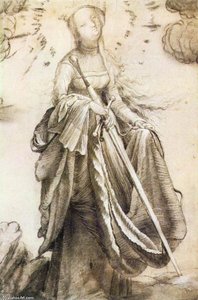
Admire Matthias Grünewald's 'St Catherine,' a captivating chalk drawing from 1520. Explore the Northern Renaissance master’s unique style, featuring a serene saint and symbolic details – available as a hand-painted replica.
Біографія митця
Відкрийте світ творчості Маттіаса Груневальда – німецького ренесансного живописця, відомого Ізнімським альтерп'єсом та драматичними полотнами середньовічної Республіки Гессен. Дізнайтесь більше про його стиль!
About the painting
The Enigmatic Saint: Matthias Grünewald’s St Catherine
Matthias Grünewald's 1520 chalk drawing, “St Catherine,” is more than just a portrait; it’s a profound meditation on faith, scholarship, and the enduring power of medieval symbolism. This remarkable work, currently residing in the Staatliche Museen zu Berlin, offers a captivating glimpse into the artist’s unique vision – a synthesis of late Gothic sensibilities with nascent Renaissance influences. Grünewald, a pivotal figure in German art, deliberately eschewed the prevailing Italian humanist trends, instead drawing deeply from the rich traditions of Central European religious painting, resulting in an intensely personal and emotionally resonant style.
The image depicts St Catherine from the waist up, her head tilted slightly downwards as if lost in contemplation. Her posture exudes a quiet dignity, while the subtle turn of her neck invites us into her inner world. She’s dressed in a gown with voluminous sleeves – a detail that speaks to both the formality of her status and the luxurious fabrics favored by wealthy patrons during the period. Crucially, she holds two objects: an open book or manuscript, symbolizing her role as a learned scholar, and a sword raised upright, representing her martyrdom and unwavering faith. These symbols aren’t merely decorative; they are potent visual statements about Catherine's life and devotion.
A Study in Northern Renaissance Technique
Grünewald’s masterful technique is immediately apparent. The drawing is executed with exquisite detail using chalk on paper, a medium that allowed for the delicate shading and fine lines characteristic of his work. Notice the subtle gradations of tone – the way light catches on her dress, the modeling of her face, and the atmospheric haze in the background. This meticulous attention to texture and form creates a remarkable sense of depth and realism, despite the relatively small scale of the piece. The artist’s use of chalk also lends a slightly ethereal quality to the image, contributing to its contemplative mood.
Furthermore, Grünewald's style deviates significantly from the prevailing Renaissance aesthetic. Unlike the idealized figures favored by artists like Albrecht Dürer, Catherine is rendered with a certain distortion – her proportions aren’t perfectly symmetrical, and her features possess an expressive intensity. This deliberate departure from classical ideals reflects Grünewald’s commitment to conveying emotional truth rather than purely visual accuracy. The background, deliberately minimalistic, consists of only a few suggestive lines—perhaps hinting at a cloudy sky or an abstract representation of the heavens – further emphasizing the saint's presence and drawing our focus entirely onto her.
Historical Context and Symbolic Resonance
Created in 1520, “St Catherine” exists within a fascinating transitional period in art history. Grünewald was working at a time when the influence of Italian Renaissance humanism was beginning to spread across Europe, yet he remained firmly rooted in the traditions of late medieval Central European painting. The saint herself holds significant religious importance – she is venerated as a martyr and patron saint of scholars, librarians, and translators. Her story, recounted in early Christian hagiographies, details her conversion after being saved from execution by St Peter, who recognized her divine calling.
Interestingly, the figure of Catherine has been associated with intellectual pursuits for centuries. Her association with learning stems from her devotion to scripture and her role as a translator of the Bible. The book she holds in the drawing symbolizes this scholarly dedication, while the sword represents her willingness to defend her faith against persecution. The combination of these symbols creates a powerful image of a woman who embodies both spiritual strength and intellectual prowess.
A Legacy of Emotion and Innovation
“St Catherine” is a testament to Matthias Grünewald’s artistic genius – a work that seamlessly blends technical skill with profound emotional depth. It's a poignant reminder of the artist’s ability to capture not just the likeness of his subject, but also her inner world. The drawing’s enduring appeal lies in its ability to evoke a sense of quiet contemplation and spiritual yearning. As a significant example of Northern Renaissance art, it continues to inspire artists and scholars alike, offering a valuable window into the artistic and intellectual landscape of 16th-century Germany.
Питання та відповіді
Як я можу переглянути репродукцію твору «St Catherine» роботи Матіас Груневальд?
Попередній перегляд «St Catherine» роботи Матіас Груневальд доступний на сторінці Перегляд у інтер'єрі твору.
Де я можу знайти гід до «St Catherine»?
Сторінка Довідка для студентів для твору «St Catherine» роботи Матіас Груневальд пропонує двосторінковий інформаційний лист для друку: зображення твору з таблицею ідентифікації, часову шкалу, що розміщує його в межах життя митця, інші роботи автора, виміряну палітру кольорів та готові до копіювання цитати у чотирьох стилях.
Як у творі «St Catherine» збалансовано світло та тінь?
Загальна яскравість твору "St Catherine" становить блискучий, а його світловий показник — Яскравий баланс.
Quick facts and art quiz
About Матіас Груневальд

Матіас Груневальд
1480 - 1528, Німеччина
Біографія митця
Маттіас Груневальд: Життя та спадщина
Ранні роки та мистецькі витоки
Маттіас Груневальд, народився як Матіс Готтард Нейхардт приблизно в 1470–1а75 роках у Вюрцбурзі, Німеччина, і став ключовою постаттю німецького Відродження. Попри те, що він жив у епоху, яка перебувала під дедалі більшим впливом ідеалів італійського Ренесансу, Груневальд залишався глибоко вкоріненим у художніх традиціях пізнього середньовіччя Центральної Європи. Деталі його раннього життя є досить скупими, проте відомо, що він здобув художню освіту, ймовірно, у місцевих майстернях.
Мистецький розвиток та впливи
Мистецький шлях Груневальда формувався під впливом панівних північноєвропейських традицій реалізму, емоційної інтенсивності та прискіпливої уваги до деталей. У його роботах простежується вплив таких майстрів, як Альбрехт Дюрер та Мартін Шонгауер, проте він проклав власний унікальний шлях, що вирізнявся драматичною експресією та яскравим колоритом. Він не був безпосередньо пов'язаний із гуманістичними колами, які панували в Італії; натомість його мистецтво слугувало переважно релігійним цілям, відображаючи духовні тривоги його часу.
Головні твори та художній стиль
- Ізнімський вівтар (1512–1516): Цей шедевр, що зберігається в Музеї Унтерлінден у Кольмарі, вважається magnum opus Груневальда. Він з жахом реалістично зображує сцени з життя Христа, зосереджуючись на темах страждання та спокути. <лі>Розп'яття (бл. 1502–1503): Рання робота, що демонструє його стиль у процесі становлення, виявляючи глибоку емоційність та анатомічну точність.
- Дівчина Благовіщення (1512–14): Етюд до Ізнімського вівтаря, який розкриває його ретельний процес планування композиції.
- Мойсей (1511): Графіка, що підкреслює майстерність Груневальда у відтворенні експресивних постатей та драматичних поз.
Мистецький стиль Груневальда вирізняється такими рисами:
- Драматична композиція: Він використовував динамічні побудови для посилення емоційного впливу на глядача.
- Яскрава палітра кольорів: Використання насичених, часто контрастних кольорів створювало потужний візуальний досвід.
- Реалістичне зображення страждань: Груневальд не уникав зображення фізичного та душевного болю, притаманного релігійним сюжетам. la
- Експресивні постаті: Його персонажі сповнені сильних емоцій та психологічної глибини.
Історичне значення та спадщина
Творчість Груневальда є свідченням незламної сили середньовічних художніх традицій Німеччини в епоху Відродження. Він став містком між стилем пізньої готики та новою ерою Ренесансу, створивши унікальну візуальну мову, яка знаходила відгук у серцях сучасників. Його вплив можна побачити в роботах пізніших німецьких художників, які продовжували досліджувати теми релігійного запалу та емоційної напруги. Хоча після його смерті в 1528 році про нього майже забули на кілька століть, у XIX столітті відбулося відродження інтересу до його постаті, і сьогодні він визнаний одним із найважливіших живописців німецького Відродження. Його мистецтво продовжує захоплювати глядачів своєю щирою емоційністю, технічною досконалістю та глибокою духовною глибиною.
Для подальшого дослідження
Дізнайтеся більше про життя та творчість Маттіаса Груневальда на: TopImpressionists
Quick facts about Матіас Груневальд
- Artistic Movement Or Style: Ренессанс Северной Европы
- Artists Or Movements Influenced By This Artist: ['Альбрехт Дюрер']
- Artists Who Influenced This Artist:
- Альбрехт Дюрер
- Мартин Шонгауэр
- Date Of Birth: Прибл. 1470 г.
- Date Of Death: 31 августа 1528 г.
- Full Name: Матиас Груневальд
- Nationality: Германия
- Notable Artworks:
- Альтерпис Изехайм
- Крестусьон
- Place Of Birth: Вюрцбург, Германия
Досліджуйте твори мистецтва, впорядковані за темами, стилями та характеристиками.


Матіас Груневальд
St Catherine
() ·
With its frame: · Hand-painted in oil on linen
Total