
На зображенні: · Разом із рамою:
 Переглянути в інтер'єрі
 Надіслати як листівку
 Поділитися
 Деталі витвору
 Посібник

 Завантажити
 Схожі екземпляри
 Рентгенівське дослідження
 Слайд-шоу
 Питання та відповіді
 Статистика
₴ 12065
Олійная репродукція ручної роботи
Написана вручну олією на полотні у вашому розмірі та рамі, виготовлена на замовлення нашими художниками. ( Перейти до друку Перейти до цифрових зображень)
Розмір
·Стандартний розмір
індивідуальний розмір
CM
INCH
Обирайте з наших стандартних розмірів, що відповідають оригінальним пропорціям твору мистецтва.
Завантаження розмірів...

ширина
висота
Введіть необхідну ширину та висоту, щоб картина підійшла до вашої рами або стіни. Оскільки це ручний розпис, для зміни пропорцій художник може дописати трохи більше по краях або дещо обрізати композицію — вибір за вами. Перед початком роботи ми надішлемо вам цифровий макет для затвердження. Зображення, показане на цій сторінці, не є реальним результатом — лише макет відображає майбутній вигляд.
 Читати далі
Завершити
·
Білий край ₴1

Розмитий край ₴1

З розширенням ₴1

P118B ₴10

P118H ₴10

P118W ₴10

P438Z ₴10

P508JH ₴12

P508YH ₴12

P805H ₴10

P805Z ₴10

P919BZ ₴10

P919G ₴10

P919XJ ₴10

P959ZH ₴10

P968JZ ₴12

W106C ₴8

W218G ₴10

W218JH ₴8

W218Y ₴10

W307PJ ₴10

W316G ₴10

W316PJ ₴8

W316Y ₴10

W398PJ ₴8

W4111J ₴10

W500HY ₴15

W500JH ₴15

W692G ₴12

W849H ₴8

W940BG ₴15

W953PJ ₴8

H24-GOLD ₴30

H24-SILVER ₴30

H36-GOLD ₴45

H36-SILVER ₴45
Доставляється в захисному тубусі, готовий для оформлення у вашій багетній майстерні.
Додаткові послуги
необов'язковоЩо саме входять до додатків?
Приклади того, що можна змінити: замінити обличчя на фото клієнта; додати домашню тварину (наприклад, замінити кота на собаку); додати приховане повідомлення на фоні; змінити пейзаж або елементи фону.
Після оформлення замовлення команда TopImpressionists.com надішле клієнту електронний лист із запитом інструкцій та надасть попередній макет для перегляду
Після оформлення замовлення команда TopImpressionists.com надішле клієнту електронний лист із запитом інструкцій та надасть попередній макет для перегляду
Доставка по всьому світу () за 3–4 тижні замість стандартних 5 тижнів. (6 Листопад). Без жодних компромісів у якості.
Захисний лак
Етикетка експоната
Деталі гравірування на бронзовій табличці
This elegant plaque features the artist's name and the title of the artwork, finely engraved for a timeless presentation.
It is made from bronze with a refined, elegant finish. The text is precisely laser-engraved for a sharp and permanent result. Measuring 9x2 cm, the plaque is compact yet easy to read. It's built to be durable and scratch-resistant, offering a professional, museum-quality look. Mounting is simple thanks to the included adhesive backing.
Деталі прозорої акрилової таблички
The plaque includes essential engraved details such as the artist's name, the title of the artwork, the date it was created, the type of media used-like oil on canvas or watercolor-a brief description of the piece, and a QR code that links to the complete artwork information.
It is crafted from clear acrylic, offering a sleek, modern appearance. The text is UV-engraved in black to ensure strong visual contrast. With a size of 10x15 cm, it ensures optimal readability. It comes equipped with two metal hooks for secure wall mounting. The plaque is designed to be weather-resistant, making it suitable for various environments, and it includes interactive features that work seamlessly with smartphone scanning.
Деталі чорної акрилової таблички
This elegant plaque includes engraved information such as the artist's name, the title of the artwork, the date it was created, the type of media used (like oil on canvas or watercolor), a short description of the artwork, and a QR code for quick access to more information.
The plaque itself is made from refined black acrylic with a premium finish. The text is laser-engraved in white for high contrast and readability. Its size is 10x15 cm, designed to be easy to read. It comes with two metal hooks for professional mounting. The design is sleek and fits any interior style. It is also weather-resistant and durable, with built-in digital integration for mobile compatibility.
Скляний варіант доступний лише для розмірів до 110 см
 Скляний варіант доступний лише для розмірів до 110 см
- Безкоштовна експрес-доставка по всьому світу
- Високоякісне лляне полотно
- Повне страхове покриття доставки
- Гарантія повернення митних зборів
- Гарантія точного відтворення кольорів
- Політика повернення протягом 100 днів (лише у разі виявлення дефектів)
- Гарантія повернення 100% коштів
- Пропозиція на оптові замовлення


Опис експоната
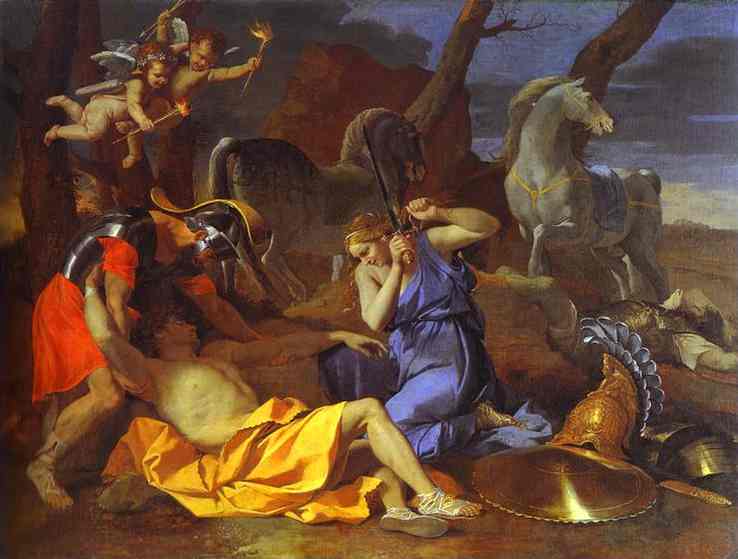
Nicolas Poussin's 'Tancred and Erminia' captures a dramatic mythological scene with intense emotion & classical precision. Explore the masterpiece’s narrative, composition, and artistic legacy at TopImpressionists.
Про картину
A Vision of Myth and Romance
Nicolas Poussin’s “Tancred and Erminia” is not merely a depiction of a classical tale; it's an immersive experience, a carefully constructed tableau vivant that invites the viewer into a world of heightened emotion and profound contemplation. Painted around 1631-1634, during his most productive period in Rome, this work exemplifies Poussin’s mastery of capturing both the grandeur of antiquity and the delicate nuances of human feeling. The scene, drawn from Torquato Tasso's epic poem *Gerusalemme Illustre*, unfolds with a deliberate grace – a moment suspended between action and reflection, brimming with unspoken longing and impending conflict.
At first glance, the composition appears deceptively simple: a man, Tancred, holding his sword poised in readiness, stands beside a woman, Erminia, who clutches her bow. They are surrounded by a small group of figures – soldiers, attendants, and perhaps even a watchful shepherd – all rendered with an exquisite attention to detail that speaks volumes about Poussin’s meticulous technique. However, the painting's power lies not just in its subject matter but in the way Poussin orchestrates light, color, and spatial depth to create a deeply atmospheric effect. The use of *chiaroscuro*, the dramatic contrast between light and shadow, is particularly striking, drawing our eye to the central figures while subtly suggesting the turmoil beneath the surface.
The Classical Narrative and its Baroque Execution
The story itself is one of tragic romance. Tancred, a valiant warrior, has been wounded by Erminia’s father, the formidable King Anghiar. Erminia, deeply in love with Tancred, bravely offers to sacrifice herself to save his life, but he refuses her offer, fearing it would bring shame upon her family. The painting captures this pivotal moment – the hesitation before a potentially devastating choice, the unspoken sorrow and the resolute determination etched on their faces. Poussin skillfully employs classical motifs—the heroic posture of Tancred, the vulnerable beauty of Erminia—to elevate the narrative beyond a simple love story into a meditation on honor, duty, and sacrifice.
Despite its rootedness in classical mythology, “Tancred and Erminia” is undeniably a Baroque painting. Poussin’s use of rich, saturated colors – particularly the deep reds and blues – reflects the dramatic intensity characteristic of the era. Furthermore, his emphasis on line and form, combined with his masterful rendering of textures (the sheen of armor, the softness of fabric), creates a sense of visual dynamism that is both captivating and emotionally resonant. The figures are not simply depicted; they are sculpted into being, imbued with a palpable sense of life and movement.
Symbolism and Emotional Resonance
Beyond the immediate narrative, “Tancred and Erminia” is laden with symbolic meaning. The setting – a rugged, mountainous landscape bathed in golden light – evokes a sense of timelessness and spiritual significance. The presence of the shepherd suggests a connection to pastoral ideals, representing innocence and simplicity amidst the complexities of human affairs. Erminia’s bow and arrow are not merely weapons; they symbolize her willingness to defend Tancred, even at the cost of her own life. The shield on the ground hints at past battles and the enduring scars of conflict.
Ultimately, “Tancred and Erminia” is a painting that speaks to the universal themes of love, loss, and courage. It’s a poignant reminder of the choices we face in life and the sacrifices we make for those we cherish. Poussin's ability to capture these profound emotions with such exquisite beauty and technical skill ensures that this masterpiece continues to resonate with viewers centuries after its creation. A reproduction by TopImpressionists offers a remarkable opportunity to experience the full impact of this extraordinary work, bringing its timeless elegance into your home or studio.
Питання та відповіді
Який домінантний відтінок у «Tancrede and Erminia» роботи Нікола Пуссен?
Переважаючий відтінок твору «Tancrede and Erminia» роботи Нікола Пуссен — Amber to Saffron. Цей колір є основою всієї палітри.
Для якої кімнати рекомендується «Tancrede and Erminia» роботи Нікола Пуссен, враховуючи її кольорову гаму?
Враховуючи його кольорову гаму Earthy, роботу «Tancrede and Erminia» рекомендується розміщувати в Living Room.
«Tancrede and Erminia» роботи Нікола Пуссен — це портретна, пейзажна чи квадратна композиція?
Формат твору "Tancrede and Erminia" — Landscape. Це допоможе вам під час планування місця розміщення репродукції.
Короткі факти та вікторина про мистецтво
Про Нікола Пуссен

Нікола Пуссен
1594 - 1665, Франція
Біографія митця
Nicolas Poussin: A Life Steeped in Classical Reverie
Nicolas Poussin, a name synonymous with the grandeur of French Baroque painting, was nonetheless a soul deeply rooted in Italian soil for much of his artistic life. Born in Le Havre, Normandy, in June 1594, his early years remain somewhat veiled in mystery, yet they undoubtedly laid the foundation for a career that would become pivotal in shaping the classical tradition within French art. Though he briefly studied in Paris during the early 1610s, absorbing influences from lesser-known artists of the time, it was his journey to Rome in 1624 that truly ignited his artistic destiny. This wasn’t merely a geographical relocation; it was an immersion into the heart of antiquity, a pilgrimage to the very source of inspiration that would define his aesthetic vision. Poussin's initial forays into painting were marked by a sensuous quality reminiscent of Venetian masters like Titian, yet even in these early works, a nascent sense of order and intellectual rigor began to emerge—a foreshadowing of the style he would so masterfully refine.Early Artistic Development & Parisian Influences
Nicolas Poussin’s formative years were spent honing his craft in Le Havre, where he studied with Quentin Varin, a respected artist who instilled in him an appreciation for meticulous observation and skillful execution. His early paintings demonstrated a fascination with Venetian color palettes and techniques—a stylistic echo of the artistic fervor that characterized Venice at the time. However, even amidst this initial exuberance, Poussin’s burgeoning intellect recognized the limitations of purely decorative pursuits. He sought to elevate his art beyond mere visual spectacle, striving for a deeper engagement with philosophical concepts and historical narratives. His Parisian studies provided exposure to emerging trends in artistic thought, fostering connections with fellow artists who championed humanist ideals—a crucial step toward shaping his distinctive worldview.The Roman Years: Forging a Classical Ideal
Rome proved to be more than just a studio for Poussin; it became his intellectual crucible. He found himself amidst a vibrant circle of scholars, archaeologists, and fellow artists, notably Cassiano dal Pozzo, whose profound understanding of classical antiquity profoundly influenced the artist’s approach. Dal Pozzo's dedication to meticulously documenting ancient remains instilled in Poussin a deep respect for historical accuracy and a desire to imbue his paintings with a sense of timelessness. This period saw Poussin move away from the flamboyant exuberance of some of his contemporaries, instead embracing a style characterized by clarity, balance, and a deliberate emphasis on linear composition. He meticulously studied Raphael’s works, absorbing their harmonious arrangements and graceful forms—a formative experience that would shape his artistic sensibilities for decades to come. Simultaneously, he drew inspiration from ancient sculptures and literary sources like Ovid's *Metamorphoses*, recognizing the power of myth and allegory to convey profound truths about human existence.A Style Defined by Order & Harmony
Poussin’s distinctive style—a hallmark of French Classicism—was characterized by a remarkable restraint and precision. He eschewed dramatic gestures and emotional displays, favoring instead carefully constructed landscapes populated with idealized figures rendered in luminous colors. His compositions were governed by strict geometric principles—often employing pyramidal structures to convey stability and grandeur—reflecting the influence of Renaissance humanist thought. Unlike many Baroque painters who prioritized spectacle, Poussin sought to capture not merely what he saw but what he believed—a testament to his unwavering commitment to intellectual rigor and artistic integrity. His meticulous attention to detail—particularly in depicting drapery folds and architectural elements—demonstrated an unparalleled mastery of technique.Legacy & Influence: Shaping French Art
Despite spending the majority of his career abroad, Nicolas Poussin’s impact on French art was undeniable. He briefly returned to Paris in 1640 at the behest of Cardinal Richelieu, appointed as First Painter to the King—a position that afforded him considerable prestige and patronage but also imposed constraints upon his creative freedom. However, he soon retreated to Rome, where he continued to paint until his death in 1665—a final pilgrimage to the birthplace of Western art. His dedication to classical ideals served as a beacon for subsequent generations of French artists—influencing figures like Jacques-Louis David and Paul Cézanne who championed a similar aesthetic vision. Artists recognized Poussin’s profound understanding of humanist philosophy and his unwavering commitment to artistic excellence, securing his place as one of the most revered masters of French Baroque painting and establishing him as an enduring symbol of classical beauty and intellectual contemplation.Короткі факти про Нікола Пуссен
- Artistic Movement Or Style: Бароко, Класицизм
- Artists Or Movements Influenced By This Artist:
- Жак-Луї Давид
- П’єр Сезан
- Artists Who Influenced This Artist:
- Рафаель
- Тіціан
- Date Of Birth: 1594
- Date Of Death: 1665
- Full Name: Nicolas Poussin
- Nationality: Француз
- Notable Artworks:
- Зруйновання Єрусалимського Храму
- Веніс подає зброю Енейсу
- Хрещення Ісуса Христа
- Place Of Birth: Ле Havre, Франція
Досліджуйте твори мистецтва, впорядковані за темами, стилями та характеристиками.


Нікола Пуссен
Tancrede and Erminia
() ·
Разом із рамою: · Написано олією на льоні вручну
Разом