

 Переглянути в інтер'єрі
 Надіслати як листівку
 Поділитися
 Деталі витвору
 Посібник

 Завантажити
 Схожі екземпляри
 Рентгенівське дослідження
 Слайд-шоу
 Питання та відповіді
 Статистика
Rainbow

- 609.0 x 80.0 cm


Experience tranquility with Theo van Rysselberghe's 'Rainbow,' a stunning Pointillist depiction of a serene beach scene. Vibrant colors & masterful technique!
 Розгорнути текст
Теофіл ван Риссельберг – видатний бельгійський художник-неоімпресіоніст, відомий своїми яскравими пейзажами та портретами, що досліджують світ світла та кольору. Його творчість вплинула на розвиток мистецтва.
Гікле / Художній принт
Друк جيкле або на полотні музейної якості з оперативним виготовленням та різноманітними варіантами фінішної обробки. ( Замовити картину ручної роботи Перейти до цифрових зображень)




































Стандартний розмір
індивідуальний розмір
CM
INCH
Обирайте з наших стандартних розмірів, що відповідають оригінальним пропорціям твору мистецтва.
Loading sizes...

ширина
висота
Введіть необхідну ширину та висоту, щоб принт ідеально підійшов до вашої рами або стіни. Принт можна лише обрізати, але не можна зробити більшим за оригінал, тому при зміні пропорцій частина зображення буде втрачена. Перед друком ми надсилаємо вам цифровий макет для затвердження. Зображення на цій сторінці не відображає реальну обрізку — її можна побачити лише на макеті.
Доставка по всьому світу () за 2 тижні замість стандартних 4/5 тижнів. (9 Листопад)

Безкоштовна експрес-доставка по всьому світу

Високоякісне лляне полотно

Повне страхове покриття доставки

Гарантія повернення митних зборів

Гарантія точного відтворення кольорів

Політика повернення протягом 100 днів (лише у разі виявлення дефектів)

Гарантія повернення 100% коштів

Пропозиція на оптові замовлення
 Скляний варіант доступний лише для розмірів до 110 см

Rainbow
Гікле / Художній принт
Розмір репродукції
-


Підсумкова вартість
₴ 3143
A Serene Coastal Vista: "Rainbow" by Theo van Rysselberghe
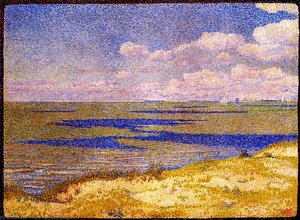
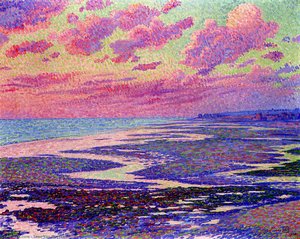
Step into a tranquil moment captured on canvas in Theo van Rysselberghe's "Rainbow." This captivating painting transports the viewer to a picturesque beach scene, bathed in soft light and imbued with a sense of peacefulness. The focal point is undoubtedly the vibrant rainbow arcing across the sky, its colors reflected subtly in the water below. Several horses graze or rest on the sandy shore, adding life and movement to the composition, while two figures provide a gentle human presence within this natural landscape. More than just a depiction of a coastal view, "Rainbow" evokes feelings of serenity, joy, and connection with nature – an invitation to pause and appreciate the simple beauty of the world around us.Pointillist Technique: A Symphony of Dots
Van Rysselberghe masterfully employs the Pointillism style, a revolutionary technique developed in the late 19th century by Georges Seurat and Paul Signac. Rather than blending colors on a palette, he meticulously applies small, distinct dots of pure color directly onto the canvas. When viewed from a distance, these individual dots coalesce to create an impressionistic effect, generating a luminous vibrancy and shimmering texture that is unique to this style. The use of oil paints further enhances the richness and depth of the colors, allowing for subtle gradations and nuanced tonal shifts within the scene. This technique wasn't merely aesthetic; it was rooted in scientific theories about color perception, aiming to create a more intense visual experience through optical mixing – where the viewer’s eye blends the dots rather than the artist physically blending pigments.Historical Context: Neo-Impressionism and "Les XX"
"Rainbow," painted in 1892, firmly places this artwork within the burgeoning movement of Neo-Impressionism. Emerging as a refinement of Impressionism, Neo-Impressionism sought to apply scientific principles of color theory to create more structured and luminous compositions. Van Rysselberghe was a key figure in this movement and an active member of "Les XX," an avant-garde group of Belgian artists who challenged the conventions of academic art. “Les XX” (The Twenty) aimed to exhibit works free from traditional artistic constraints, fostering innovation and paving the way for modern art. The painting’s subject matter – a natural landscape rendered with scientific precision – reflects this commitment to both observation and experimentation.Symbolism and Emotional Resonance
Beyond its technical brilliance, "Rainbow" carries symbolic weight. Rainbows themselves are often associated with hope, promise, and new beginnings. In the context of this painting, it suggests a moment of optimism and tranquility amidst the vastness of nature. The horses symbolize freedom and untamed beauty, while the figures represent humanity’s connection to the natural world. The overall effect is one of peaceful contemplation – an invitation to escape the stresses of daily life and immerse oneself in the serenity of the coastal scene. The painting's enduring appeal lies in its ability to evoke a sense of calm and wonder, resonating with viewers across generations.Питання та відповіді
Якому етапу кар'єри Теофіл ван Рисселбрюгге відповідає дата створення «Rainbow» (1892 рік)?
Дата 1892 дозволяє віднести «Rainbow» до Mature Period творчого розвитку Теофіл ван Рисселбрюгге.
Наскільки виражений контраст у «Rainbow» роботи Теофіл ван Рисселбрюгге?
У творі «Rainbow» роботи Теофіл ван Рисселбрюгге спостерігається Statement контраст між світлими та темними ділянками.
Як сюжет твору "Rainbow" перегукується із звичними темами Теофіл ван Рисселбрюгге?
«Rainbow» змальовує beach, rainbow, horses, landscape, pointillism, serene, coastal, figures, тоді як характерні теми Теофіл ван Рисселбрюгге — це neo-impressionism, french impressionism, scientific color theory, leisure and recreation, connection with nature, belgian coastal life, representative of pointillist style. Порівняння цих двох аспектів демонструє, як цей твір перегукується зі звичними сюжетами митця.



Біографія митця
Théo van Rysselberghe: A Pioneer of Light and Color
Théophile “Théo” van Rysselberghe, a name synonymous with Belgian Neo-Impressionism, was more than just an artist; he was a pivotal figure who bridged the gap between traditional realism and the burgeoning avant-garde movements of the late 19th century. Born in Ghent, Belgium, in 1862, his life’s journey was marked by a relentless pursuit of capturing the ephemeral beauty of light and color – a quest that ultimately shaped not only his artistic style but also the broader landscape of European art.
Van Rysselberghe's early training at the Academy of Ghent instilled in him a solid foundation in academic painting techniques. His initial works, such as *Self-Portrait with Pipe* (1880), reflected this classical influence – characterized by meticulous detail and somber tones. However, even within these early pieces, subtle hints of a burgeoning sensitivity to light and color began to emerge, foreshadowing the radical shift that was to come. The painting *Child in an Open Spot of the Forest* (1880) represents a crucial step away from strict realism, suggesting a nascent interest in capturing the fleeting effects of nature’s brilliance.
Moroccan Impressions: A Catalyst for Change
A transformative period in van Rysselberghe's artistic development unfolded during his extended travels to Morocco between 1882 and 1888. These sojourns, a stark contrast to the muted palette of his earlier work, plunged him into a world saturated with vibrant colors, intense sunlight, and exotic landscapes. Paintings like *Arabian Street Cobbler* (1882), *Arabian Boy* (1882), and *Resting Guard* (1883) vividly demonstrate this shift – capturing the dazzling effects of light on form and revealing a profound fascination with Moroccan culture. These experiences weren’t merely visual observations; they were an immersion into a different way of seeing, broadening his artistic horizons and instilling a lifelong love for travel.
Crucially, these travels coincided with his association with the artist Frantz Charlet and the painter Darío de Regoyos. Together, they explored the Spanish and Moroccan art scene, encountering influences from masters like Pedro Campaña, whose works sparked an interest in capturing the essence of light and atmosphere. This exposure to diverse artistic traditions fueled van Rysselberghe’s evolving style.
The Birth of Les XX: A Hub for Avant-Garde Art
Upon his return to Brussels, van Rysselberghe became a central figure in the burgeoning avant-garde scene. He played a key role in establishing *Les XX* (Les Vingt), an influential exhibition society founded in 1883 alongside Octave Maus and Émile Verhaeren. This group served as a vital platform for showcasing innovative art, music, poetry, and decorative arts – introducing new trends like Impressionism and Symbolism to a Belgian audience largely unfamiliar with such movements. *Les XX* provided van Rysselberghe with invaluable exposure and fostered a collaborative environment where artistic ideas could flourish.
Embracing Neo-Impressionism: A Scientific Approach
The true turning point in van Rysselberghe’s artistic trajectory arrived with his encounter with Georges Seurat's *A Sunday on La Grande Jatte* at the eighth Impressionist exhibition in Paris in 1886. Initially skeptical of Seurat’s meticulous “pointillist” technique – the systematic application of tiny dots of pure color – van Rysselberghe gradually came to appreciate its scientific basis and potential for achieving luminous effects. He began experimenting with divisionism, the Neo-Impressionist method of separating colors into their constituent parts and allowing the viewer’s eye to blend them optically. This wasn't simply a technical shift; it represented a fundamental change in his approach to painting – a move towards a more analytical and objective representation of light and color.
He forged close friendships with other Neo-Impressionist painters like Paul Signac, traveling with him along the French Riviera and exchanging ideas about technique and theory. Van Rysselberghe distinguished himself within the movement by applying pointillism not only to landscapes but also to portraiture, creating strikingly vibrant and psychologically insightful likenesses of his family and friends – works such as *Madame Charles Maus* (1890) are prime examples.
Beyond Pointillism: A Lasting Legacy
While deeply committed to Neo-Impressionism for a significant period, van Rysselberghe eventually moved beyond its strict tenets in the late 1890s. He sought greater freedom in his brushwork and compositions, exploring new ways to express emotion and atmosphere. He continued to be a prolific artist, working in various media including furniture design, book illustration, and decorative arts. His influence extended far beyond Belgium, impacting artists like Piet Mondrian and Jan Toorop who were inspired by his innovative use of color and light.
Van Rysselberghe’s legacy lies not only in his beautiful paintings but also in his role as a catalyst for artistic change – a champion of modernism who helped introduce new ideas and techniques to the Belgian art world. His works are now held in prominent museum collections worldwide, ensuring that his contribution to the history of art continues to be celebrated and appreciated by generations to come. *His dedication to exploring the interplay of light, color, and form cemented his place as a true pioneer of modern painting.*

Теофіл ван Рисселбрюгге
1862 - 1926 , Бельгія
Короткі факти
- Artistic Movement Or Style: Неоімпресіонізм
- Artists Or Movements Influenced By This Artist:
- П’єт Мондріан
- Джан Тоороп
- Artists Who Influenced This Artist:
- Жан-Франсуа Портаельс
- Жорж Сеур
- П’єр-Огюст Ренуар
- Date Of Birth: 23 листопада 1862
- Date Of Death: 13 грудня 1926
- Full Name: Théo van Rysselberghe
- Nationality: Бельгійський
- Notable Artworks:
- Арабська фантазія
- Іспанка
- Севільська жінка
- Place Of Birth: Гент, Бельгія
Пов'язані статті

The Soul of the Brushstroke: Decoding Van Gogh's Emotional Impasto
Explore the profound emotional depth of Van Gogh's impasto technique. Discover how his sculptural brushstrokes and textured oil layers define Post-Impressionism through an expert art-historical lens, perfect for discerning collectors and fine art enthusiasts.
Досліджуйте твори мистецтва, впорядковані за темами, стилями та характеристиками.
