

На зображенні: · Разом із рамою:
 Переглянути в інтер'єрі
 Надіслати як листівку
 Поділитися
 Деталі витвору
 Посібник

 Завантажити
 Схожі екземпляри
 Рентгенівське дослідження
 Слайд-шоу
 Питання та відповіді
 Статистика

₴ 14322
Олійная репродукція ручної роботи
Написана вручну олією на полотні у вашому розмірі та рамі, виготовлена на замовлення нашими художниками. ( Перейти до друку Перейти до цифрових зображень)
Розмір
·Стандартний розмір
індивідуальний розмір
CM
INCH
Обирайте з наших стандартних розмірів, що відповідають оригінальним пропорціям твору мистецтва.
Завантаження розмірів...

ширина
висота
Введіть необхідну ширину та висоту, щоб картина підійшла до вашої рами або стіни. Оскільки це ручний розпис, для зміни пропорцій художник може дописати трохи більше по краях або дещо обрізати композицію — вибір за вами. Перед початком роботи ми надішлемо вам цифровий макет для затвердження. Зображення, показане на цій сторінці, не є реальним результатом — лише макет відображає майбутній вигляд.
 Читати далі
Завершити
·
Білий край ₴1

Розмитий край ₴1

З розширенням ₴1

P118B ₴10

P118H ₴10

P118W ₴10

P438Z ₴10

P508JH ₴12

P508YH ₴12

P805H ₴10

P805Z ₴10

P919BZ ₴10

P919G ₴10

P919XJ ₴10

P959ZH ₴10

P968JZ ₴12

W106C ₴8

W218G ₴10

W218JH ₴8

W218Y ₴10

W307PJ ₴10

W316G ₴10

W316PJ ₴8

W316Y ₴10

W398PJ ₴8

W4111J ₴10

W500HY ₴15

W500JH ₴15

W692G ₴12

W849H ₴8

W940BG ₴15

W953PJ ₴8

H24-GOLD ₴30

H24-SILVER ₴30

H36-GOLD ₴45

H36-SILVER ₴45
Доставляється в захисному тубусі, готовий для оформлення у вашій багетній майстерні.
Додаткові послуги
необов'язковоЩо саме входять до додатків?
Приклади того, що можна змінити: замінити обличчя на фото клієнта; додати домашню тварину (наприклад, замінити кота на собаку); додати приховане повідомлення на фоні; змінити пейзаж або елементи фону.
Після оформлення замовлення команда TopImpressionists.com надішле клієнту електронний лист із запитом інструкцій та надасть попередній макет для перегляду
Після оформлення замовлення команда TopImpressionists.com надішле клієнту електронний лист із запитом інструкцій та надасть попередній макет для перегляду
Доставка по всьому світу () за 3–4 тижні замість стандартних 5 тижнів. (7 Листопад). Без жодних компромісів у якості.
Захисний лак
Етикетка експоната
Деталі гравірування на бронзовій табличці
This elegant plaque features the artist's name and the title of the artwork, finely engraved for a timeless presentation.
It is made from bronze with a refined, elegant finish. The text is precisely laser-engraved for a sharp and permanent result. Measuring 9x2 cm, the plaque is compact yet easy to read. It's built to be durable and scratch-resistant, offering a professional, museum-quality look. Mounting is simple thanks to the included adhesive backing.
Деталі прозорої акрилової таблички
The plaque includes essential engraved details such as the artist's name, the title of the artwork, the date it was created, the type of media used-like oil on canvas or watercolor-a brief description of the piece, and a QR code that links to the complete artwork information.
It is crafted from clear acrylic, offering a sleek, modern appearance. The text is UV-engraved in black to ensure strong visual contrast. With a size of 10x15 cm, it ensures optimal readability. It comes equipped with two metal hooks for secure wall mounting. The plaque is designed to be weather-resistant, making it suitable for various environments, and it includes interactive features that work seamlessly with smartphone scanning.
Деталі чорної акрилової таблички
This elegant plaque includes engraved information such as the artist's name, the title of the artwork, the date it was created, the type of media used (like oil on canvas or watercolor), a short description of the artwork, and a QR code for quick access to more information.
The plaque itself is made from refined black acrylic with a premium finish. The text is laser-engraved in white for high contrast and readability. Its size is 10x15 cm, designed to be easy to read. It comes with two metal hooks for professional mounting. The design is sleek and fits any interior style. It is also weather-resistant and durable, with built-in digital integration for mobile compatibility.
Скляний варіант доступний лише для розмірів до 110 см
 Скляний варіант доступний лише для розмірів до 110 см
- Безкоштовна експрес-доставка по всьому світу
- Високоякісне лляне полотно
- Повне страхове покриття доставки
- Гарантія повернення митних зборів
- Гарантія точного відтворення кольорів
- Політика повернення протягом 100 днів (лише у разі виявлення дефектів)
- Гарантія повернення 100% коштів
- Пропозиція на оптові замовлення


Опис експоната
Explore Walter Ufer’s ‘Sleep,’ a poignant oil painting of Native American women in Taos. Discover realism, rich detail & cultural symbolism – a unique 20th-century artwork.
Біографія митця
Вальтер Уфер (1876-1936) — американський художник німецького походження, відомий емоційними полотнами про життя індіанців у Таос, Нью-Мексико. Ключовий учасник «Десятки Таоса», майстер жанрових сцен та яскравих пейзажів.
Про картину
The Weight of Tradition: An Encounter with Walter Ufer’s “Sleep”
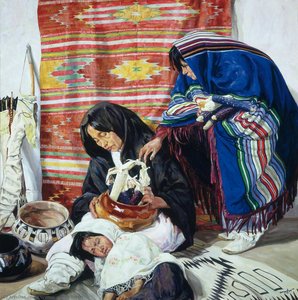
Walter Ufer's "Sleep," painted in 1923, isn’t merely a depiction of three Native American women; it’s an immersion into a world steeped in ritual and profound reverence. The painting immediately draws the viewer in with its rich tapestry of color – predominantly warm reds, oranges, and browns that evoke the earth itself, grounded by cooler blues and greens woven through the textiles and pottery. This palette isn't simply decorative; it speaks to the cultural heritage of the subjects, hinting at a deep connection to the land and ancestral traditions. The composition is carefully orchestrated, centering on the kneeling woman as a focal point, yet subtly inviting us into the periphery of the scene, suggesting an active participation in this sacred space.
Ufer’s masterful technique reveals layers of painstaking detail. He employs a layered oil painting approach, building up texture with deliberate brushstrokes that create a palpable sense of roughness on the clothing – perhaps representing the wear and tear of daily life intertwined with ceremonial garb – while simultaneously rendering the pottery with smooth, almost polished surfaces. This juxtaposition speaks to the duality inherent in Native American culture: the balance between practicality and spirituality, the tangible and the intangible. The lighting, soft and diffused, isn’t dramatic; it's deliberately muted, casting subtle shadows that lend a sense of solemnity and depth to the figures and objects, as if illuminating a secret whispered within a sacred space.
A Window into Taos: Contextualizing Ufer’s Vision
To fully appreciate “Sleep,” it's crucial to understand its historical context. Painted in 1923, during his time in Taos Pueblo, New Mexico, the artwork represents a pivotal moment in Walter Ufer’s career and his deep engagement with Native American culture. He was part of the "Taos Ten," a group of artists who sought to document and celebrate the lives and traditions of the region's indigenous communities. This wasn’t simply an act of observation; it was a deliberate attempt at understanding and portraying these cultures with respect and authenticity, a rare undertaking for American art at the time.
Ufer’s background as a German-born artist profoundly shaped his approach. His training in Europe instilled a meticulous attention to detail and a sophisticated understanding of composition – elements he skillfully translated into his depictions of Native American life. However, it was his immersion within the Taos community that truly informed his work, allowing him to capture not just appearances but also the spirit and essence of these traditions. The painting’s realism is tempered by an underlying sense of mystery, inviting viewers to contemplate the deeper meanings embedded within the scene.
Symbolism Woven into the Fabric
The details within “Sleep” are laden with symbolic significance. The intricately patterned rug serves as a visual anchor, framing the central figures and providing a rich backdrop that speaks to the importance of storytelling and communal life within Native American culture. The pottery, often adorned with geometric designs and natural motifs, represents both artistic skill and spiritual connection – a tangible link to ancestors and the earth. The women themselves, engaged in what appears to be a ritualistic activity, are not simply subjects; they embody generations of tradition, wisdom, and connection to the divine.
The act depicted—kneeling in reverence—suggests healing or a profound spiritual ceremony. The quiet dignity of the figures, coupled with the muted colors and soft lighting, evokes a sense of solemnity and timelessness. It’s an image that transcends mere representation, offering a glimpse into a world governed by ancient beliefs and deeply rooted traditions.
A Legacy of Authenticity: Reproductions and Beyond
Walter Ufer's "Sleep" remains a powerful testament to the beauty and complexity of Native American culture. TopImpressionists offers high-quality, hand-painted reproductions that faithfully capture the painting’s rich detail and evocative atmosphere. These reproductions are more than just images; they are windows into another world—a world of sacred rituals, profound traditions, and enduring wisdom. Investing in a reproduction is an investment in preserving this important piece of American art history and honoring the legacy of Walter Ufer's insightful portrayal.
Питання та відповіді
Як у творі «Sleep» збалансовано світло та тінь?
Зафіксовані значення для «Sleep» роботи Вальтер Уфер: яскравість — bright, світловий потік — Gentle Luminance.
Який настрій передає «Sleep» роботи Вальтер Уфер у межах Contemporary Realism?
Melancholic емоційність твору "Sleep" підкреслюється його стилем Contemporary Realism.
Хто є автором "Sleep" і до якого художнього напряму він належить?
«Sleep» була створена Вальтер Уфер у стилі Contemporary Realism. Автор та художній напрям визначають традицію цього твору.
Короткі факти та вікторина про мистецтво
Про Вальтер Уфер

Вальтер Уфер
1876 - 1936, Німеччина
Біографія митця
Душа Південного Заходу: Життя та спадщина Вальтера Уфера
Вальтер Уфер постає як ключова постать американського імпресіонізму — художник, чиї мазки робили значно більше, ніж просто фіксували світло; вони вловлювали саме серцебиття цілої культури. Народившись у 1876 році в Гюккесвагені, Німеччина, шлях Уфера до високих пустель Нью-Мексико був вистелений суворою європейською підготовкою та глибокою цікавістю до людської природи. Його ранні роки пройшли під впливом німецько-американської діаспори в Луїсвіллі, штат Кентуккі, де він уперше почав вбирати багаті текстури своєї спадщини. Цей фундамент, позначений вивченням літографії та естампного мистецтва, наділив його технічною точністю, яка згодом дозволила йому з неперевершеною майстерністю оперувати складними нюансами світла й тіні.
Пошук художнього досконалості привів його у трансформаційну одіссею Європою. Будучи мандрівним ремісником, Уфер занурювався в різноманітні мистецькі традиції континенту, вдосконалюючи свою техніку в престижних академіях Гамбурга та Дрездена. Цей період інтенсивного інтелектуального та творчого розширення завершився його перебуванням у Мюнхені, де він присвятив себе глибокій студійній практиці. Коли у 1911 році він нарешті повернувся до Сполучених Штатів, він привіз із собою витончену європейську чутливість, яка була готова до глибокої зустрічі з суворими, залитими сонцем ландшафтами американського Заходу.
Візіонер «Десятки Таоса»
1914 рік став вирішальним поворотним моментом у житті Уфера та в траєкторії американського мистецтва. Відвідавши Таос-Пуебло, штат Нью-Мексико, він опинився частиною надзвичайної мистецької революції. Приєднавшись до впливового об'єднання, відомого як «Десятка Таоса», Уфер став центральною фігурою колективу, який прагнув вийти за межі простого пейзажу до більш автентичного, вісцерального зображення життя корінних американців. На відміну від багатьох своїх сучасників, які дивилися на Південний Захід крізь призму романтизації чи колоніального погляду, Уфер підходив до своїх сюжетів із глибокою повагою та здатністю побачити гідність повсякденного існування.
Його творчість стала мостом між європейськими імпресіоністичними техніками та сирою, духовною енергією народу Пуебло. Він був не просто спостерігачем, а хронікером ритуалів, ландшафтів і тихих ритмів спільнотного життя. Центральне місце в цій творчій еволюції посідала його взаємодія з Джимом Мірабалом, індіанцем із Таоса, який був для Уфера одночасно і музою, і партнером. Завдяки цьому зв'язку Уфер здобув інтимне розуміння культурних нюансів регіону, що дозволило йому наповнити свої полотна відчуттям живої правди, яка резонувала далеко за межами Нью-Мексико.
Техніка, символізм та історичне значення
Творчий доробок Уфера характеризується майстерним володінням кольором і сміливим, експресивним нанесенням фарби. Його стиль, хоч і вкорінений у принципах американського імлісіонізму, часто тяжіло до більш потужного та текстурованого підходу, що передавав жар пустельного сонця та вагу землі. Він використовував світло не лише для освітлення форми, а й для пробудження емоцій — створюючи сцени, де сама атмосфера здається насиченою історією та традиціями.
Історичне значення Вальтера Уфера полягає в його здатності піднести жанрову живопис до рівня глибокого соціального та культурного маніфесту. Його досягнення включають:
- Автентична репрезентація: Відмова від «мальовничих» стереотипів життя індіанців на користь більш нюансованого та гуманізованого портрета народу Таоса.
- Мистецький синтез: Успішне поєднання формальної академічної підготовки Німеччини з яскравим, нестримним духом американського Південного Заходу.
- Спадщина «Десятки Таоса»: Вирішальна роль у утвердженні Таоса як провідного центру американського модернізму та життєво важливого осередку мистецтва, зосередженого на корінному населенні.
Сьогодні картини Уфера залишаються незмінними свідченнями періоду інтенсивного культурного перетину. Його здатність переплести технічну суворість європейської освіти з духовною глибиною культури Пуебло гарантує, що його роботи продовжують захоплювати, запрошуючи сучасних глядачів стати свідками позачасового духу долини Таос через його сповнені емоцій та майстерності очі.
Короткі факти про Вальтер Уфер
- Artistic Movement Or Style: Таосський імпресіонізм
- Artists Or Movements Influenced By This Artist: ['']
- Artists Who Influenced This Artist: ['']
- Date Of Birth: 1876
- Date Of Death: 1936
- Full Name: Вальтер Уфер
- Nationality: Німецько-американська
- Notable Artworks:
- Її донька
- Будівельники пустелі
- Після них
- Place Of Birth: Гюккесваген, Німеччина


Вальтер Уфер
Sleep
() ·
Разом із рамою: · Написано олією на льоні вручну
Разом