


 Переглянути в інтер'єрі
 Надіслати як листівку
 Поділитися
 Деталі витвору
 Посібник

 Завантажити
 Схожі екземпляри
 Рентгенівське дослідження
 Слайд-шоу
 Статистика
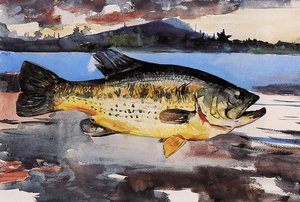
Leaping Trout 1


Winslow Homer’s ‘Leaping Trout,’ painted in 1889, captures Adirondack tranquility with Impressionistic brushstrokes and masterful watercolor layering—a testament to American landscape artistry. Explore this evocative depiction and bring Homer's serene vision home.
 Розгорнути текст
Відкрийте для себе Вінслоу Гомера (1836-1910)! Потужні картини американського реалізму: морські пейзажі, життя та епоха 19 століття. Шедеври 'Західний потік' та 'Вітри на повні пару'.
Гікле / Художній принт
Друк جيкле або на полотні музейної якості з оперативним виготовленням та різноманітними варіантами фінішної обробки. ( Замовити картину ручної роботи Перейти до цифрових зображень)




P118B ₴10

P118H ₴10

P118W ₴10

P438Z ₴10

P508JH ₴12

P508YH ₴12

P805H ₴10

P805Z ₴10

P919BZ ₴10

P919G ₴10

P919XJ ₴10

P959ZH ₴10

P968JZ ₴12

W106C ₴8

W218G ₴10

W218JH ₴8

W218Y ₴10

W307PJ ₴10

W316G ₴10

W316PJ ₴8

W316Y ₴10

W398PJ ₴8

W4111J ₴10

W500HY ₴15

W500JH ₴15

W692G ₴12

W849H ₴8

W940BG ₴15

W953PJ ₴8




Стандартний розмір
індивідуальний розмір
CM
INCH
Обирайте з наших стандартних розмірів, що відповідають оригінальним пропорціям твору мистецтва.
Loading sizes...

ширина
висота
Введіть необхідну ширину та висоту, щоб принт ідеально підійшов до вашої рами або стіни. Принт можна лише обрізати, але не можна зробити більшим за оригінал, тому при зміні пропорцій частина зображення буде втрачена. Перед друком ми надсилаємо вам цифровий макет для затвердження. Зображення на цій сторінці не відображає реальну обрізку — її можна побачити лише на макеті.
Доставка по всьому світу () за 2 тижні замість стандартних 4/5 тижнів. (25 Жовтень)

Безкоштовна експрес-доставка по всьому світу

Високоякісне лляне полотно

Повне страхове покриття доставки

Гарантія повернення митних зборів

Гарантія точного відтворення кольорів

Політика повернення протягом 100 днів (лише у разі виявлення дефектів)

Гарантія повернення 100% коштів

Пропозиція на оптові замовлення
 Скляний варіант доступний лише для розмірів до 110 см

Leaping Trout 1
Гікле / Художній принт
Розмір репродукції
-


Підсумкова вартість
₴ 3097
A Symphony of Motion: The Living Spirit of Winslow Homer
To encounter Winslow Homer’s “Leaping Trout” is to step directly into the pulse of the American wilderness. Completed in 1889, this masterpiece transcends mere biological illustration, offering instead a profound meditation on the raw, unyielding energy of nature. During an era when much of the art world was preoccupied with grand European narratives and historical epics, Homer turned his gaze inward toward the rugged landscapes of the Adirondack Mountains. In this work, he does not simply depict fish in water; he captures the very breath of the wild, translating the subtle, shimmering transitions of light and movement into a canvas that feels vibrantly alive.
The scene centers on a breathtaking moment of kinetic drama: three trout battling for dominance amidst the rhythmic ripples of a serene mountain pool. One fish propels itself upward with singular purpose, breaking the surface in a display of pure, instinctive strength. This choice of perspective—focusing on the subject's struggle rather than the observer's triumph—is what makes the piece so deeply immersive. The viewer is not a distant fisherman watching from the bank, but an intimate witness to the frantic, beautiful struggle for survival. The presence of birds gliding above and perching nearby adds layers of life to the composition, creating a dynamic ecosystem where every element is caught in a fleeting, eternal moment of motion.
Mastery of Light and the Impressionistic Touch
Homer’s technical brilliance in “Leaping Trout” lies in his ability to manipulate the medium of watercolor to achieve an almost ethereal luminosity. While his roots were in the precise world of commercial illustration, his mature style embraced a more fluid, impressionistic sensibility. He eschewed rigid outlines in favor of capturing the ephemeral quality of light reflecting off a disturbed water surface. Through a masterful layering of washes, colors bleed into one another with a soft, organic grace that mirrors the fluidity of the Adirondack streams.
One of the most captivating aspects of his technique is the use of scraping—a method where Homer would use a blunt or sharp tool to remove softened paint and paper fibers from the wet surface. This deliberate manipulation creates brilliant, textured highlights that mimic the dazzling sparkle of sunlight dancing upon the lake. These tactile imperfections lend the water a sense of depth and brilliance, making the ripples appear to move even as the viewer stands still. It is this marriage of meticulous observation and experimental technique that allows the painting to resonate with such profound emotional clarity.
An Enduring Legacy for the Discerning Collector
For the art lover, the collector, or the interior designer, “Leaping Trout” offers much more than visual beauty; it provides a sense of tranquility intertwined with vitality. The cool palette of blues, silvers, and earthy tones makes it an exquisite centerpiece for spaces designed to evoke peace and natural elegance. Whether placed in a sun-drenched study or a sophisticated contemporary living room, the painting acts as a window into an unspoiled world, bringing the restorative power of the American landscape indoors.
Owning a high-quality reproduction of this work allows one to preserve a piece of American art history. It serves as a reminder of a time when artists sought truth in the quietest corners of the earth. As a tribute to Winslow Homer’s ability to find the extraordinary within the ordinary, “Leaping Trout” remains an essential acquisition for those who seek to surround themselves with art that possesses both technical mastery and a soul-stirring connection to the natural world.
Питання та відповіді
«Leaping Trout 1» роботи Вінслоу Гомер — це портретна, пейзажна чи квадратна композиція?
«Leaping Trout 1» роботи Вінслоу Гомер — це композиція у форматі Landscape. Перед вибором розміру друку варто перевірити пропорції.
Чи можу я скористатися доповненою реальністю, щоб побачити «Leaping Trout 1» роботи Вінслоу Гомер у своїй кімнаті?
Сторінка Перегляд в AR для твору «Leaping Trout 1» роботи Вінслоу Гомер використовує технологію доповненої реальності, щоб показати витвір у вашому власному просторі за допомогою сумісного пристрою.
Яка техніка виконання у «Leaping Trout 1» роботи Вінслоу Гомер?
«Leaping Trout 1» виконано в техніці Watercolor.
Схожі твори мистецтва




Біографія митця
Winslow Homer: A Brush With the American Spirit
Winslow Homer, born in Boston in 1836, wasn’t sculpted by the traditional European art academies that shaped so many of his contemporaries. Instead, he emerged from a distinctly American experience, one rooted in practicality and observation. His journey began not with grand historical canvases, but as a commercial illustrator at the tender age of twelve for Harper's Weekly. This early apprenticeship was formative, honing an exceptional ability to capture scenes with clarity and detail – skills that would become hallmarks of his mature work. He wasn’t learning perspective in Paris; he was learning to *see* America, its people, and its unfolding story. The bustling streets of Boston, the quiet dignity of rural New England life, these were his first subjects, rendered with a precision born of necessity for the demands of print media. This foundation allowed him to transition into painting, initially in watercolor, before fully embracing the expressive potential of oil paints.From Pastoral Scenes to the Raw Power of Nature
Homer’s early paintings often depicted idyllic scenes – children playing, farmers tending their fields, quiet moments of domesticity. These works, while charming, hinted at a deeper artistic sensibility waiting to be unleashed. The catalyst for this transformation was undoubtedly the Civil War. As a war correspondent for Harper's Weekly, Homer witnessed firsthand the brutal realities of conflict. He didn’t focus on heroic battles or grand strategies; instead, he documented the everyday lives of soldiers and civilians, the quiet moments of grief and resilience amidst chaos. This experience profoundly altered his artistic vision. The pastoral scenes gave way to more challenging subjects: veterans grappling with trauma, freed slaves navigating a new world, and the stark beauty of landscapes touched by hardship. He began to explore themes of struggle, isolation, and humanity’s precar He wasn't interested in imitating European styles; he wanted to create an art that was uniquely American, reflecting its landscapes, its people, and its challenges. His style also evolved, becoming bolder and more direct, reflecting the raw emotional impact of what he had witnessed. Breezing Up (A Fair Wind), painted in 1876, exemplifies this skill – a quintessential depiction of American maritime life, brimming with energy and movement. The Gulf Stream, created decades later, is perhaps his most iconic work, a powerful and symbolic portrayal of a lone man battling the forces of nature, a metaphor for human struggle against overwhelming odds. He possessed an extraordinary ability to capture light, whether it was the dazzling glare of the sun on the ocean or the soft glow of twilight over a rural landscape. This mastery extended to his watercolors, where he achieved remarkable atmospheric effects through vibrant colors and delicate washes. Innocence, a poignant portrayal of childhood set against the backdrop of nature, and **Man of Science** demonstrating his skill in capturing human psychology, are testaments to this commitment.Mastering Light, Texture, and the American Landscape
Winslow Homer's artistic technique is immediately recognizable for its solidity and texture. He wasn’t interested in fleeting impressions; he wanted to build up a sense of tangible reality on the canvas. His oil paintings are characterized by a direct painting approach – layers of paint applied with confidence, creating depth and luminosity. He wasn’t simply painting what he saw; he was conveying a feeling, an emotional truth about the human condition. His unwavering dedication to capturing the essence of American life—from the serene beauty of coastal vistas to the arduous realities of rural existence—established him as a cornerstone of American Realism.A Legacy Forged in American Realism
His influence can be seen in the work of later American painters who sought to depict their own country with similar directness and emotional depth. He wasn’t interested in imitating European styles; he wanted to create an art that was uniquely American, reflecting its landscapes, its people, and its challenges. His legacy lies in his ability to portray America with honesty and authenticity, without romanticizing or idealizing it. He remained a pivotal figure in the development of American Realism, securing his place as one of America’s most important and enduring artists.- His work continues to inspire contemporary artists.
- Homer remains a cornerstone of American Realism.

Вінслоу Гомер
1836 - 1910 , США
Короткі факти
- Artistic Movement Or Style: Американський Реалізм
- Artists Or Movements Influenced By This Artist: ['Американські художники']
- Artists Who Influenced This Artist:
- Барбізоньський Школа
- Кубер
- Мілет
- Date Of Birth: 3 жовтня 1836 р.
- Date Of Death: 1910 р.
- Full Name: Winslow Homer
- Nationality: Американський
- Notable Artworks:
- Бриз Вітер
- Течія Густини
- Ніна
- Place Of Birth: Бостон, США
Пов'язані статті

Capturing the Soul of Nature: A Journey Through the Sublime Majesty of American Romanticism
Explore the breathtaking beauty of American Romanticism. Discover how Hudson River School masters captured the sublime spirit of the wilderness through luminous oil landscapes and emotional depth. A journey into the soul of nature for the true art enthusiast.

Capturing the Light: A Journey Through the Soul of American Impressionism and the Hudson River School
Explore the luminous beauty of American Impressionism and the Hudson River School. Discover a curated journey through light, landscape, and history, celebrating the enduring legacy of masters through exquisite, hand-painted oil reproductions for the discerning art lover.

Capturing Light: The Ethereal Beauty and Timeless Legacy of Watercolor Landscapes
Embark on a visual journey through the ethereal beauty of watercolor landscapes. Discover how Impressionist masters captured light and emotion, and learn to bring this timeless, luminous elegance into your home with expert art curation and hand-painted reproductions.
Досліджуйте твори мистецтва, впорядковані за темами, стилями та характеристиками.


