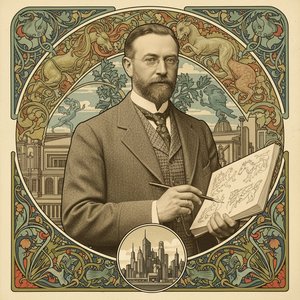
The Life and Career of John McLennan
Born in Edinburgh, Scotland, John Mclenan began his life far from the rugged landscapes that would later define his reputation. His early years were shaped by the disciplined instruction of the Royal Scottish Academy, where he first learned to master the fundamentals of drawing and painting. This formal training provided the foundation for a life spent seeking out the vastness of the natural world. He eventually moved toward the burgeoning American West, becoming a prominent figure in the landscape movement of the Victorian era.
His path was marked by a restless pursuit of scenery and light. During his time in the American West, he traveled extensively, particularly through the regions surrounding Yosemite Valley in California. He sought to document the grandeur of these territories with a precision that spoke to his deep observation of the earth. Throughout his career, he produced approximately 150 paintings and etchings, capturing the spirit of a continent in transition. His work reflected a life spent moving between the quietude of contemplation and the active documentation of wilderness.
Tragedy arrived before his middle years could fully unfold. The illness known as tuberculosis took a heavy toll on his health, cutting his creative output short. He died in New York City in 1865, at the age of 38. Though his time was brief, the breadth of his output left a mark on the landscape traditions of his era, leaving behind a body of work that remains a record of his travels and his vision.
Artistic Style and Technical Mastery
His hand was shaped by the heavy influence of the Romantic tradition, drawing much from the atmospheric landscapes of Turner and Constable. This foundation allowed him to develop a style defined by meticulous detail and a profound sensitivity to tonal variation. He sought to capture the sublime through rugged mountain vistas that appeared bathed in an ethereal light, creating scenes that felt both vast and deeply felt. Rather than focusing solely on the grandeur of the wilderness, he infused these Romantic ideals with a humanist concern, often placing the human element within the expansive landscape to suggest a sense of introspection and connection to the natural world.
In his technical pursuits, he was a champion of the tonal etching technique. He used this method to convey mood and atmosphere with a subtlety that spoke to his patient observation of light and shadow. This mastery of tone was particularly evident in his lithographs, where he sought to translate the emotional resonance of a scene into line and shade. His ability to manipulate these mediums allowed him to document the grandeur of the American scenery with a precision that captured the very spirit of the terrain.
Notable Works and Subject Matter
The landscapes he captured often spoke of a quiet, internal world. He frequently placed solitary figures within his compositions, depicting them engaged in contemplative activities that suggested a deep connection to the surrounding environment. This focus on the human element allowed him to bridge the gap between the vastness of the natural world and the intimate experience of the individual. His eyes were often drawn to the ruggedness of the American West, a passion that led him to travel extensively throughout California during the mid-1860s. During these travels, he documented the grandeur of Yosemite with a precision that revealed the true scale of the valley and its surrounding peaks.
His technical skill was perhaps most evident in his lithographs, where he used tonal etching to convey a specific sense of mood and atmosphere. Two of his most significant prints, Untitled (AQTGP4) and Untitled (AQTGNG), demonstrate this ability to manipulate light and shadow to create a sense of presence. These works, along with Untitled (AQTGNS), highlight his dedication to capturing the subtle nuances of the landscape. Even in his less defined works, such as the undated Untitled (AQTGNY), one can sense the meticulous observation that defined his approach to the natural world.
Legacy and Historical Significance
The passing of this artist at the young age of thirty-eight left a void in the burgeoning landscape movement of the American West. His contributions to American art history remain significant, particularly for how he captured the ruggedness of the Yosemite Valley. He acted as a pioneer of American Landscape Art, documenting the grandeur of the California terrain with a precision that spoke to the changing spirit of the era. His work remains an embodiment of Victorian Aesthetic Values, reflecting the period's fascination with the sublime and the intersection of nature and human contemplation.
Though his career was cut short by illness in New York City, the ripples of his talent reached far beyond his brief years of activity. His influence can be seen in subsequent generations of landscape painters who sought to emulate his distinctive style and convey similar emotional depth. He left behind a body of work that bridged the gap between meticulous observation and the romantic ideals of the nineteenth century. Through his etchings and paintings, he helped shape the visual language used to describe the American wilderness.
Питання та відповіді
Як мені знайти всі роботи John Mclenan у певній техніці виконання?
Сторінка За технікою виконання групує роботи John Mclenan за технікою виконання.
Де можна знайти роботи John Mclenan, згруповані за ключовими словами?
Сторінка За ключовими словами митця John Mclenan групує його роботи за ключовими словами.
Які кольори John Mclenan використовував найчастіше?
Колірний профіль робіт John Mclenan представлений на сторінці Геном палітри митця.
Де я можу знайти статистику щодо творів John Mclenan?
Статистика про роботи John Mclenan доступна на сторінці Статистика відвідувань митця.