





























从与原作比例一致的预设尺寸中进行选择。

您可以输入自定义尺寸,以适配特定的画框或空间。如果所选尺寸与原图比例不符,我们将通过裁剪作品或添加手绘元素来扩展画面。数字样稿将在制作开始前发送给您确认。
请注意,屏幕预览无法准确反映实际的裁剪或扩展效果,只有样稿才能真实呈现最终的构图。
虽然我们提供定制尺寸服务,但为了保留原作比例,建议您从预设列表中选择尺寸。

Buckaroo
复制品尺寸
In the annals of American sculpture, few figures command as much rugged respect as Alexander Phimister Proctor, an artist who famously earned the moniker "the sculptor in buckskin." Born in the quiet township of Bosanquet, Ontario, in 1860, Proctor’s journey was one of constant movement across the North American frontier. His early years, shaped by the arduous migrations of his family through Michigan and Iowa, instilled in him a profound connection to the vast, untamed landscapes of the West. When his family finally settled in Denver, Colorado, the dramatic scenery of the Rocky Mountains and the sweeping plains became more than just a backdrop; they became the very soul of his artistic pursuit. This deep-seated intimacy with the wilderness allowed Proctor to approach his subjects not merely as an observer, and certainly not as a mere decorator, but as a man who understood the rhythmic pulse of animal life and the heavy weight of frontier history.
Proctor’s formal education provided the technical scaffolding for his wilder inspirations. Seeking to refine his raw observations, he traveled to the great artistic hubs of the era, studying at the National Academy of Design and the Art Students League in New York, before venturing to Paris to train at the prestigious Académie Julien and Académie Colarossi. It was in the studios of Europe that he encountered the sophisticated French Beaux-Arts style, a movement characterized by its elegance and anatomical precision. This training allowed him to marry the scientific rigor of a naturalist with the expressive fluidity of a master sculptor. He did not simply model clay; he studied the musculature of bison and the tension in a horse's gait, often undertaking dissections and studying specimens at the American Museum of Natural History to ensure that every bronze tendon and sinew possessed an undeniable truth.
The true brilliance of Proctor’s work lies in his ability to freeze a moment of intense kinetic energy within the permanence of bronze. His sculptures are never static; they breathe with the vitality of the American West. Whether capturing the explosive power of a "Bronco Buster" or the heavy, rhythmic presence of the "Buffalo" statues that grace Washington, D.C., Proctor possessed an uncanny ability to convey movement and psychological depth. His influence from masters like Auguste Rodin is evident in his pursuit of a humanist aesthetic, where the physical form serves as a vessel for emotion. This was particularly evident in his equestrian monuments, where he depicted cowboys and Native Americans with a dignity that transcended mere caricature, presenting them instead as monumental figures of a vanishing era.
His career was punctuated by a series of prestigious triumphs that cemented his status on the world stage:
As the twentieth century progressed, Proctor’s work became an essential part of the American civic landscape. His ability to translate the spirit of the frontier into monumental bronze meant that his art did not just sit in galleries; it lived in public squares and atop bridges, serving as a permanent reminder of the continent's wild heritage. Even as the frontier closed, Proctor’s sculptures remained—vibrant, muscular, and eternally alive. He passed away in 1950, leaving behind a legacy that continues to bridge the gap between the raw, unbridled beauty of nature and the refined sophistication of fine art.

1860 - 1950 , Canada

Explore the captivating world of Charles Marion Russell, 'the cowboy artist.' Discover his life, iconic paintings, advocacy for Native Americans, and investment potential. A guide for discerning art collectors.
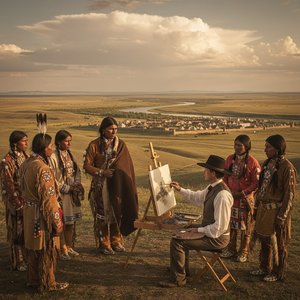
Explore the captivating art of George Catlin, renowned for his vivid portraits & landscapes documenting Native American life on the frontier. Discover a vanishing world through stunning paintings and historical context.

Explore the captivating portraits of James Otto Lewis, a pivotal figure bridging 19th-century realism & American Modernism. Discover his groundbreaking work documenting Native American culture and regional identity.

Explore the captivating world of Paul Manship, a leading figure in American Art Deco sculpture. Discover his iconic works like Prometheus, influence on modernism, and investment potential. Expert insights for collectors.

Explore the captivating art of Karl Bodmer, whose detailed paintings documented Indigenous life along the Missouri River in the 19th century. Discover his legacy and lasting impact on Western art history.


第一时间获取最新的艺术新闻、独家优惠及装饰灵感。
向我们介绍您的项目需求,我们的艺术专家将为您提供 3 个个性化的艺术品推荐。
由我们的专家为您精选 3 款心仪之作 —— 完全免费!


 效果预览
效果预览
 切换至印刷版
 分享
分享 分享
分享
 详情
详情

 下载
下载
 相似作品
相似作品 X射线
X射线 幻灯片播放
幻灯片播放


 展开详情
展开详情









 玻璃选项仅适用于110厘米以下的尺寸。


