

 实景预览
实景预览
 分享
分享 分享
分享
 详情
详情 指南
指南

 下载作品
下载作品
 相似作品
相似作品 X射线
X射线 幻灯片播放
幻灯片播放 问答
问答 统计数据
统计数据


¥ 1802
手工油画复制品
由我们的艺术家按需定制,为您提供您所选尺寸及画框的布面手工油画。 ( 切换至版画销售渠道 切换至数字图像销售渠道)
本作品受版权保护
本页面展示的作品受版权法保护,这意味着我们无法合法地制作或销售与其完全相同的复制品。此项保护依据包括以下国际协议等: 伯尔尼公约 以及各国法律,包括下文所述的法律: 美国版权法第17编。
作为一种既合规又充满敬意的替代方案,我们提供以原作为灵感定制的手绘艺术作品。我们的资深专业艺术家会仔细研读原作的风格、韵味与艺术精髓,以此创作出能够唤起相同情感的新颖且独特的作品——同时确保其本身是一件原创之作。
这种方法完全符合版权法规,因为它并不涉及对受保护艺术品的复制或翻录。相反,它是一种富有创意的重新诠释——是一件受原作启发、但与原作并不相同的全新绘画作品。
 了解更多
了解更多尺寸
·标准尺寸
定制
CM
INCH
您可以从与原作比例一致的预设尺寸中进行选择。
正在加载尺寸...

宽度
高度
请输入您需要的宽度和高度,以适配您的画框或墙面。由于作品为手工绘制,若选择不同比例的尺寸,艺术家可能会在画面边缘多画一些或稍作裁剪 —— 由您决定。在开始绘画之前,我们会为您发送一份数字效果图供您确认。本页面上展示的图片并非最终实物 —— 只有效果图才能反映真实结果。
完成
·
白色边缘 ¥1

边缘晕染效果 ¥1

延展式 ¥1

P118B ¥10

P118H ¥10

P118W ¥10

P438Z ¥10

P508JH ¥12

P508YH ¥12

P805H ¥10

P805Z ¥10

P919BZ ¥10

P919G ¥10

P919XJ ¥10

P959ZH ¥10

P968JZ ¥12

W106C ¥8

W218G ¥10

W218JH ¥8

W218Y ¥10

W307PJ ¥10

W316G ¥10

W316PJ ¥8

W316Y ¥10

W398PJ ¥8

W4111J ¥10

W500HY ¥15

W500JH ¥15

W692G ¥12

W849H ¥8

W940BG ¥15

W953PJ ¥8

H24-GOLD ¥30

H24-SILVER ¥30

H36-GOLD ¥45

H36-SILVER ¥45
采用保护管包装寄送,方便您交由专业的装裱师进行装裱。
增值服务
可选附加内容包含哪些内容?
可定制内容示例:将面部替换为客户照片;添加宠物(例如,将猫替换为狗);在背景中加入隐藏信息;更改背景风景或元素。
下单后,TopImpressionists.com 团队将通过电子邮件联系客户获取具体指令,并提供效果预览图
下单后,TopImpressionists.com 团队将通过电子邮件联系客户获取具体指令,并提供效果预览图
全球配送()仅需 3-4 周即可送达,无需等待标准时效的 5 周。(9 November)。品质绝不妥协。
保护性清漆
展品铭牌
青铜铭牌雕刻详情
This elegant plaque features the artist's name and the title of the artwork, finely engraved for a timeless presentation.
It is made from bronze with a refined, elegant finish. The text is precisely laser-engraved for a sharp and permanent result. Measuring 9x2 cm, the plaque is compact yet easy to read. It's built to be durable and scratch-resistant, offering a professional, museum-quality look. Mounting is simple thanks to the included adhesive backing.
透明亚克力铭牌详情
The plaque includes essential engraved details such as the artist's name, the title of the artwork, the date it was created, the type of media used-like oil on canvas or watercolor-a brief description of the piece, and a QR code that links to the complete artwork information.
It is crafted from clear acrylic, offering a sleek, modern appearance. The text is UV-engraved in black to ensure strong visual contrast. With a size of 10x15 cm, it ensures optimal readability. It comes equipped with two metal hooks for secure wall mounting. The plaque is designed to be weather-resistant, making it suitable for various environments, and it includes interactive features that work seamlessly with smartphone scanning.
黑色亚克力铭牌详情
This elegant plaque includes engraved information such as the artist's name, the title of the artwork, the date it was created, the type of media used (like oil on canvas or watercolor), a short description of the artwork, and a QR code for quick access to more information.
The plaque itself is made from refined black acrylic with a premium finish. The text is laser-engraved in white for high contrast and readability. Its size is 10x15 cm, designed to be easy to read. It comes with two metal hooks for professional mounting. The design is sleek and fits any interior style. It is also weather-resistant and durable, with built-in digital integration for mobile compatibility.
玻璃选项仅适用于110厘米以下的尺寸。
 玻璃选项仅适用于110厘米以下的尺寸。
- 全球免运费特快专递服务
- 优质亚麻画布
- 全程运输保险
- 关税退款保证
- 色彩精准还原保证
- 100天退货保障(仅限制造缺陷)
- 100% 退款保证
- 多件购买优惠


藏品详情
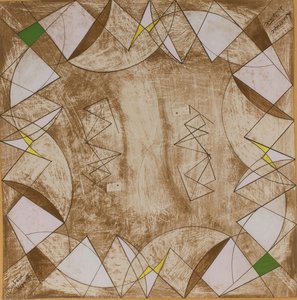
Barbara Hepworth's "Proof for Landscape Sculpture" is a captivating abstract screenprint featuring dynamic triangles and circles—a testament to her modernist vision.
艺术家简介
探索芭芭拉·海沃斯爵士(1903-1975)的现代主义雕塑作品。作为抽象艺术的先驱,海沃斯的作品——包括《椭圆形式》与《两种形式》——融合了超现实主义与抽象主义。前往海沃斯·威克菲尔德美术馆探索她的艺术遗产。
关于作品
The Genesis of a Geometric Dream
Barbara Hepworth's "Proof for 'Landscape Sculpture' Ascher scarf design," created in 1947, isn’t merely a decorative print; it’s a distilled essence of the artist’s profound engagement with form and space. Born in Wakefield, Yorkshire, Hepworth’s journey into abstraction began amidst the burgeoning artistic movements of the early 20th century, influenced by her time in Italy and her close relationships with figures like Ben Nicholson. This particular work represents a pivotal moment – a bridge between her sculptural explorations and a more accessible visual language. The design itself feels almost embryonic, a preliminary sketch for a larger concept, yet it possesses an undeniable maturity and a captivating internal logic. It’s as if Hepworth is inviting us to witness the birth of an idea, a geometric meditation on the relationship between solid form and negative space.
- Key Materials: The print utilizes a limited palette – primarily shades of grey and black – emphasizing the interplay of light and shadow. This restraint amplifies the impact of each shape, creating a sense of quiet intensity.
- Technique: Executed as a screenprint, the work showcases Hepworth’s masterful control over texture and layering. The subtle variations in ink density produce a delicate, almost velvety surface, adding depth to the otherwise flat design.
Deconstructing the Landscape – A Symphony of Triangles
At first glance, the composition appears deceptively simple: a network of interlocking triangles and circles arranged within a central circular void. However, closer inspection reveals a complex system of relationships. The triangles aren’t randomly placed; they seem to be striving for equilibrium, pushing against each other in a dynamic tension. They evoke the fractured planes of a landscape viewed through shifting light, mirroring Hepworth's own sculptural explorations of natural forms – rocks, water, and earth. The circles, acting as anchors, provide stability and suggest the cyclical nature of existence. The deliberate absence of a definitive ‘foreground’ or ‘background’ further enhances this sense of spatial ambiguity, inviting the viewer to actively participate in constructing their own interpretation.
Symbolism Note:Hepworth was deeply influenced by Surrealist ideas and sought to capture the subconscious through her art. The fragmented forms can be interpreted as representing the brokenness of experience, while the circular void suggests a yearning for wholeness or perhaps an acceptance of incompleteness.
A Legacy of Modernism – Hepworth’s Sculptural Roots
Understanding “Proof for ‘Landscape Sculpture’ Ascher scarf design” requires acknowledging Barbara Hepworth's broader artistic context. She was a key figure in the Unit One movement, alongside Ben Nicholson and Paul Nash, which aimed to synthesize Surrealist and abstract principles within British art. Her sculptural work, characterized by its clean lines, biomorphic forms, and exploration of negative space, profoundly influenced her printmaking. The design’s geometric precision reflects this commitment to reductive abstraction – stripping away extraneous detail to reveal the essential form. Her sculptures often sought to capture a sense of movement and dynamism, qualities that are subtly echoed in the arrangement of shapes within the print.
Emotional Resonance - A Quiet Contemplation
Despite its intellectual rigor, “Proof for ‘Landscape Sculpture’ Ascher scarf design” possesses a remarkable emotional resonance. The muted colors and carefully considered composition evoke a sense of quiet contemplation – an invitation to slow down and observe the subtle beauty of form. It's not a work that demands immediate attention; rather, it rewards patient viewing with a growing appreciation for its intricate details and underlying harmony. The design’s inherent ambiguity allows it to resonate differently with each viewer, making it a timeless piece that continues to provoke thought and inspire reflection. Its understated elegance makes it an ideal addition to any space seeking a touch of sophisticated serenity.
艺术速览与艺术小测验
关于 芭芭拉·海沃斯

芭芭拉·海沃斯
1903 - 1975, 英国
艺术家简介
早年生活与教育
芭芭拉·海普沃斯女爵 (Dame Barbara Hepworth) 是一位享誉世界的英国艺术家与雕塑家,于1903年1月10日出生于约克郡的威克菲尔德。她的艺术启蒙始于1920年的利兹艺术学院,随后凭借优异的成绩获得郡奖学金,前往伦敦皇家艺术学院 (RCA) 深造,并于1924年正式获得学位。艺术生涯
- 芭芭拉·海普沃斯女爵 的作品是现代主义,尤其是现代雕塑的典范。在那个时代,她是极少数能够获得国际声望的女性艺术家之一。
- 1933年,她与 本·尼科尔森、保罗·纳什 等人共同创立了“一号单元”(Unit One) 艺术运动,旨在将超现实主义与抽象主义融入英国艺术之中。
- 海普沃斯早期的创作以抽象风格为特征,并积极参与了总部位于巴黎的“抽象创造”(Abstraction-Création) 艺术运动。
代表作品与展览
- 青铜雕塑作品《椭圆形式 (Trezion)》 (Oval Form (Trezion)) 目前收藏于美国沃斯堡的肯贝尔艺术博物馆。(在 TopImpressionists 查看)
- 雕塑作品《两种形式》 (Two Forms) 正在英国威克菲尔德的 海普沃斯威克菲尔德美术馆 进行展出。(在 TopImpressionists 查看)
- 大理石雕塑《图腾》 (Totem) 同样被收录于 海普沃斯威克菲尔德美术馆 的馆藏中。(在 TopImpressionists 查看)
艺术遗产与博物馆收藏
芭芭拉·海普沃斯 的作品得到了广泛的认可,她的雕塑与绘画作品已成为全球各大博物馆的重要馆藏。以艺术家本人命名的 海普沃斯威克菲尔德美术馆 收藏了众多艺术大师的杰作,其中也包括海普沃斯本人的传世之作。(在 TopImpressionists 探索更多关于海普沃斯威克菲尔德美术馆的信息)结语
芭芭拉·海普沃斯女爵 在现代英国雕塑领域的开拓性工作,已在艺术史上留下了不可磨灭的印记。她的艺术遗产持续激励着艺术家与艺术爱好者,她的作品至今仍是其创新精神与艺术天才的永恒见证。在维基百科了解更多关于芭芭拉·海普沃斯的信息关于 芭芭拉·海沃斯 的简介
- Artistic Movement Or Style: 现代主义, 抽象主义
- Artists Or Movements Influenced By This Artist:
- 抽象创作 (Abstraction-Création)
- 一号小组 (Unit One)
- Artists Who Influenced This Artist:
- 亨利·摩尔 (Henry Moore)
- 本·尼科尔森 (Ben Nicholson)
- Date Of Birth: 1903-01-10
- Date Of Death: 1975-05-20
- Full Name: 芭芭拉·海沃斯 (Barbara Hepworth)
- Nationality: 英国
- Notable Artworks:
- 椭圆形式 (Trezion)
- 两种形式
- 图腾
- Place Of Birth: 英国,威克菲尔德


芭芭拉·海沃斯
Proof for
() ·
含框总尺寸: · 亚麻布油画手绘
总计