

 实景预览
实景预览
 分享
分享 分享
分享
 详情
详情 指南
指南

 下载作品
下载作品
 相似作品
相似作品 X射线
X射线 幻灯片播放
幻灯片播放 问答
问答 统计数据
统计数据
- 19.0 x 26.0 cm


¥ 1804
手工油画复制品
由我们的艺术家按需定制,为您提供您所选尺寸及画框的布面手工油画。 ( 切换至版画销售渠道 切换至数字图像销售渠道)
尺寸
·标准尺寸
定制
CM
INCH
您可以从与原作比例一致的预设尺寸中进行选择。
正在加载尺寸...

宽度
高度
请输入您需要的宽度和高度,以适配您的画框或墙面。由于作品为手工绘制,若选择不同比例的尺寸,艺术家可能会在画面边缘多画一些或稍作裁剪 —— 由您决定。在开始绘画之前,我们会为您发送一份数字效果图供您确认。本页面上展示的图片并非最终实物 —— 只有效果图才能反映真实结果。
 了解更多
了解更多完成
·
白色边缘 ¥1

边缘晕染效果 ¥1

延展式 ¥1

P118B ¥10

P118H ¥10

P118W ¥10

P438Z ¥10

P508JH ¥12

P508YH ¥12

P805H ¥10

P805Z ¥10

P919BZ ¥10

P919G ¥10

P919XJ ¥10

P959ZH ¥10

P968JZ ¥12

W106C ¥8

W218G ¥10

W218JH ¥8

W218Y ¥10

W307PJ ¥10

W316G ¥10

W316PJ ¥8

W316Y ¥10

W398PJ ¥8

W4111J ¥10

W500HY ¥15

W500JH ¥15

W692G ¥12

W849H ¥8

W940BG ¥15

W953PJ ¥8

H24-GOLD ¥30

H24-SILVER ¥30

H36-GOLD ¥45

H36-SILVER ¥45
采用保护管包装寄送,方便您交由专业的装裱师进行装裱。
增值服务
可选附加内容包含哪些内容?
可定制内容示例:将面部替换为客户照片;添加宠物(例如,将猫替换为狗);在背景中加入隐藏信息;更改背景风景或元素。
下单后,TopImpressionists.com 团队将通过电子邮件联系客户获取具体指令,并提供效果预览图
下单后,TopImpressionists.com 团队将通过电子邮件联系客户获取具体指令,并提供效果预览图
全球配送()仅需 3-4 周即可送达,无需等待标准时效的 5 周。(7 November)。品质绝不妥协。
保护性清漆
展品铭牌
青铜铭牌雕刻详情
This elegant plaque features the artist's name and the title of the artwork, finely engraved for a timeless presentation.
It is made from bronze with a refined, elegant finish. The text is precisely laser-engraved for a sharp and permanent result. Measuring 9x2 cm, the plaque is compact yet easy to read. It's built to be durable and scratch-resistant, offering a professional, museum-quality look. Mounting is simple thanks to the included adhesive backing.
透明亚克力铭牌详情
The plaque includes essential engraved details such as the artist's name, the title of the artwork, the date it was created, the type of media used-like oil on canvas or watercolor-a brief description of the piece, and a QR code that links to the complete artwork information.
It is crafted from clear acrylic, offering a sleek, modern appearance. The text is UV-engraved in black to ensure strong visual contrast. With a size of 10x15 cm, it ensures optimal readability. It comes equipped with two metal hooks for secure wall mounting. The plaque is designed to be weather-resistant, making it suitable for various environments, and it includes interactive features that work seamlessly with smartphone scanning.
黑色亚克力铭牌详情
This elegant plaque includes engraved information such as the artist's name, the title of the artwork, the date it was created, the type of media used (like oil on canvas or watercolor), a short description of the artwork, and a QR code for quick access to more information.
The plaque itself is made from refined black acrylic with a premium finish. The text is laser-engraved in white for high contrast and readability. Its size is 10x15 cm, designed to be easy to read. It comes with two metal hooks for professional mounting. The design is sleek and fits any interior style. It is also weather-resistant and durable, with built-in digital integration for mobile compatibility.
玻璃选项仅适用于110厘米以下的尺寸。
 玻璃选项仅适用于110厘米以下的尺寸。
- 全球免运费特快专递服务
- 优质亚麻画布
- 全程运输保险
- 关税退款保证
- 色彩精准还原保证
- 100天退货保障(仅限制造缺陷)
- 100% 退款保证
- 多件购买优惠


艺术家简介
Edgar Wood (1860-1935) was a prominent British architect & artist of the Arts and Crafts movement. Known for domestic designs, churches, & masterful use of vernacular Lancashire styles. Discover his legacy & influence on Manchester architecture!
关于作品
艺术速览与艺术小测验
关于 Edgar Wood

Edgar Wood
1860 - 1935
艺术家简介
The Architect of the Arts and Crafts Movement
Born into the industrial heart of Middleton on May 17, 1860, Edgar Wood emerged as a defining figure of the British Arts and Crafts movement. His life was shaped by the tension between tradition and individual ambition; while his father, a strict mill owner, envisioned a future for Edgar within the family cotton business, the young man possessed an irrepressible artistic spirit. This early conflict eventually yielded to a compromise that would define his legacy: he would train as an architect, allowing him to marry structural precision with the soulful, decorative aesthetics of a true artist. Educated at the local Queen Elizabeth Grammar School, Wood’s path was paved through his articles at Mills and Murgatroyd, a prestigious Manchester firm where he honed the technical mastery that would later allow him to breathe life into stone and timber.
Wood's creative philosophy was deeply rooted in the vernacular traditions of Lancashire. Unlike architects who sought to impose grand, foreign styles upon the landscape, Wood found beauty in the local, the domestic, and the tactile. His work is characterized by a profound respect for materials and a desire to integrate architecture with the natural environment. As a proponent of the Arts and Crafts movement, he championed the idea that every element of a building—from its structural bones to its smallest ornamental detail—should be crafted with care and integrity. This devotion to craftsmanship saw him focusing primarily on smaller-scale projects, such as domestic residences and churches, which allowed him to maintain personal control over the design process and ensure that his artistic vision remained uncompromised.
A Legacy Carved in Lancashire
The breadth of Wood's influence extended far beyond the borders of a single city, though Manchester remained his spiritual and professional anchor. His architectural footprint can be found scattered across the towns of Rochdale, Oldham, and Middleton, as well as in more outlying districts like Bramhall and Hale. Through his work, he transformed the local landscape, creating buildings that felt both timeless and deeply connected to their surroundings. His contributions were not merely structural but also communal; as a founder of the Northern Art Workers' Guild in 1896, he helped foster a vibrant ecosystem for provincial artists, ensuring that the spirit of craftsmanship would endure in the North of England.
Wood’s professional achievements were marked by leadership and recognition within his field. His tenure as President of the Manchester Society of Architects from 1911 to 1912 stands as a testament to the respect he commanded among his peers. Even as the architectural landscape shifted toward more modern, industrial styles in the early 20th century, Wood remained steadfast in his commitment to the principles of beauty and utility. Today, his legacy is preserved through the many listed buildings that stand as monuments to his skill. To study the work of Edgar Wood is to witness a masterclass in how architecture can serve as an extension of the human soul, blending the ruggedness of industrial Lancashire with the delicate elegance of fine art.
关于 Edgar Wood 的简介
- Full Name: Edgar Wood
- Nationality: British
- Date Of Birth: 1860
- Date Of Death: 1935
- Artistic Movement Or Style: Arts and Crafts movement
- Artists Or Movements Influenced By This Artist: Arts and Crafts movement
相似作品


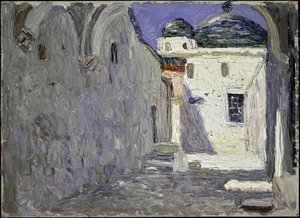


Edgar Wood
Tunisia
() ·
含框总尺寸: · 亚麻布油画手绘
总计