
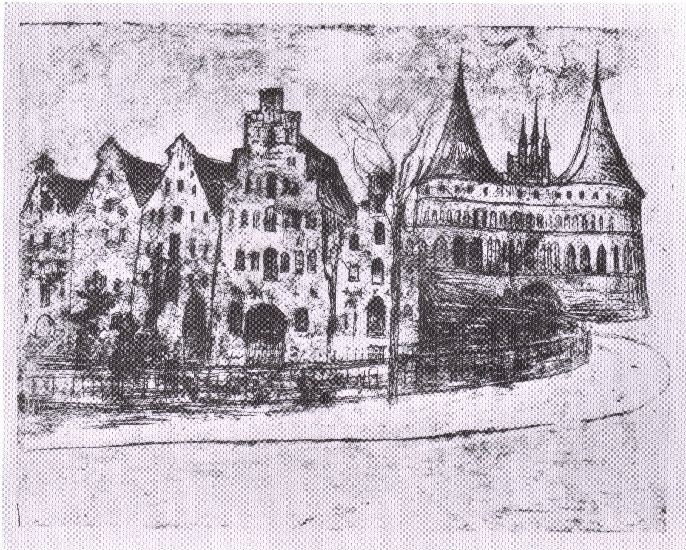





























从与原作比例一致的预设尺寸中进行选择。

您可以输入自定义尺寸,以适配特定的画框或空间。如果您选择的尺寸与原图比例不符,我们将对作品进行裁剪,或通过镜像填充/纯色填充边缘的方式来扩展图像。在开始制作之前,我们会向您发送一份数字效果图供您确认。
请注意,屏幕上的预览并不能反映实际的裁剪或扩展效果。只有效果图才能准确展示最终的构图。
虽然我们提供定制尺寸,但为了保持原图比例,我们建议您从预设列表中选择尺寸。

Lubeck
复制品尺寸
Edvard Munch’s “Lübeck,” painted in 1903, is a poignant example of Expressionism, a movement born from a desire to convey intense subjectivity and emotional truth rather than objective reality. Emerging as a reaction against the perceived detachment of earlier art movements, Expressionism embraced distortion, bold colors, and raw handling of materials to depict inner turmoil and psychological states. Munch, a pivotal figure in this movement and renowned for his iconic "The Scream," masterfully utilizes these techniques in “Lübeck” to create a deeply evocative scene.
The painting depicts a solitary woman standing before an open window, her back turned towards the viewer. This deliberate positioning creates a sense of mystery and introspection, inviting us to share in her gaze as she observes the cityscape beyond. The title "Lübeck" doesn't refer to the German city itself but rather to Franz von Lenbach, a friend and fellow artist of Munch’s. The composition is striking: the woman’s figure appears almost spectral against the vibrant backdrop of Lübeck’s skyline, emphasizing her isolation and perhaps hinting at a deeper emotional disconnect. The open window acts as a symbolic threshold between the interior world of the woman's thoughts and the external world she observes.
“Lübeck” exemplifies Munch’s signature Expressionist style. Bold, non-naturalistic colors dominate the canvas, creating an atmosphere charged with emotion. The brushstrokes are loose and visible, contributing to a sense of immediacy and rawness. Forms are distorted, not for purely aesthetic reasons but to amplify the psychological impact of the scene. Munch’s use of color is particularly noteworthy; the vibrant hues of the cityscape contrast sharply with the muted tones of the woman's figure, further emphasizing her detachment. The painting isn't about a literal depiction of Lübeck; it's about conveying the *feeling* of being there, filtered through the artist's emotional lens.
Munch’s personal experiences profoundly shaped his artistic vision. Haunted by childhood illness and loss, he channeled these emotions into his work. “Lübeck” reflects this preoccupation with mortality, isolation, and the complexities of human relationships. The painting draws inspiration from other German Expressionist painters like Emil Nolde, Max Beckmann, George Grosz, Ernst Ludwig Kirchner, and James Ensor, all of whom shared a commitment to expressing subjective experience through art. The rise of Neo-Expressionism later in the 20th century demonstrates the enduring influence of Munch’s pioneering work.
“Lübeck” resonates with viewers because it taps into universal feelings of loneliness, introspection, and longing. The woman's posture and the vastness of the cityscape evoke a sense of melancholy and quiet contemplation. The painting serves as a powerful reminder of the expressive potential of art to convey complex emotions that transcend language. As an iconic example of Expressionism, “Lübeck” continues to inspire artists and captivate audiences worldwide, solidifying Munch’s place as one of the most important figures in modern art history.

1863 - 1944 , 瑞典
探索表现主义的灵魂!本文精选十幅名作,从莫迪里亚尼到夏加尔,揭秘大师背后的故事与艺术魅力。感受色彩的力量,重塑您的家居空间。TopImpressionists.com 提供博物馆品质的艺术复制品和个性化装饰方案。立即在线探索全系列!
深入探索20世纪具象表现主义:从德国桥社到抽象表现主义的演变。专业艺术分析,收藏指南与高品质油画复制尽在TopImpressionists.com。

Explore the captivating world of contemporary figurative painting. Discover key artists, techniques & collecting insights. Expert analysis for discerning art lovers. TopImpressionists.

Explore 10 defining German Expressionism masterpieces – from Munch's 'The Scream' to Kandinsky’s abstracts. Discover the artists, stories & bold colors behind this powerful art movement. Find museum-quality reproductions at TopImpressionists.com.


第一时间获取最新的艺术新闻、独家优惠及装饰灵感。
向我们介绍您的项目需求,我们的艺术专家将为您提供 3 个个性化的艺术品推荐。
由我们的专家为您精选 3 款心仪之作 —— 完全免费!

 定制手绘复刻品
 分享
分享 分享
分享
 详情
详情

 下载
下载
 相似作品
相似作品 X射线
X射线 幻灯片播放
幻灯片播放

 展开详情
展开详情









 玻璃选项仅适用于110厘米以下的尺寸。


