

从与原作比例一致的预设尺寸中进行选择。

您可以输入自定义尺寸,以适配特定的画框或空间。如果您选择的尺寸与原图比例不符,我们将对作品进行裁剪,或通过镜像填充/纯色填充边缘的方式来扩展图像。在开始制作之前,我们会向您发送一份数字效果图供您确认。
请注意,屏幕上的预览并不能反映实际的裁剪或扩展效果。只有效果图才能准确展示最终的构图。
虽然我们提供定制尺寸,但为了保持原图比例,我们建议您从预设列表中选择尺寸。

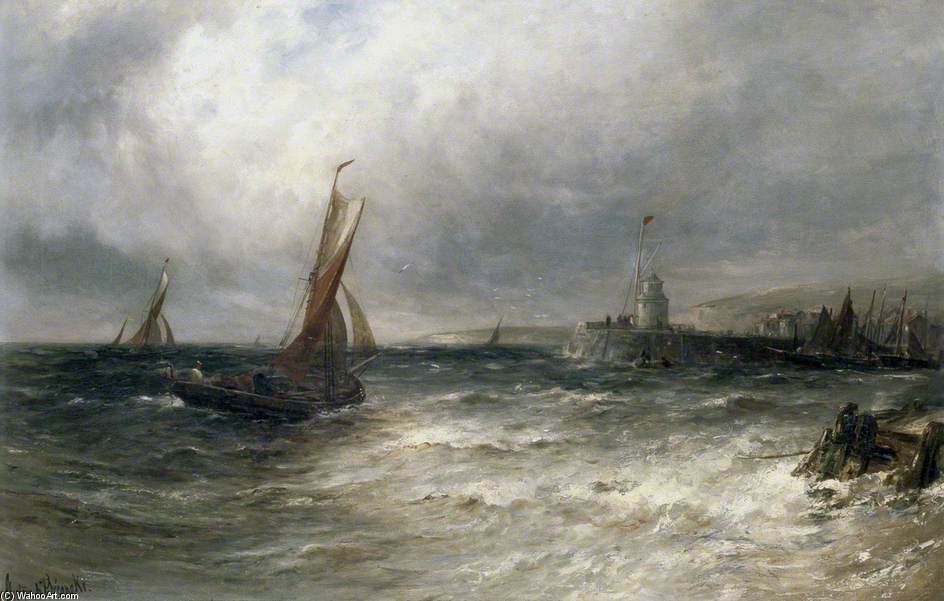
Seascape -
复制品尺寸
Gustave de Breanski (1856–1898) remains a quietly significant figure in 19th-century British art, an artist whose evocative landscapes – particularly his depictions of the Cornish coast and maritime scenes – continue to resonate with a profound sense of atmosphere and light. Born into an artistic family—his brother, Alfred de Breanski, was already establishing himself as a celebrated landscape painter—Gustave’s early life provided him with both a foundation and a subtle competitive pressure that undoubtedly shaped his artistic trajectory. His nephew, Alfred Fontville de Breanski Jr., would later follow in the family tradition, further cementing the legacy of the de Breanski name within the British art world.
De Breanski’s formal training included attendance at the prestigious Royal Academy Schools in London, a crucial step for any aspiring artist seeking recognition. This rigorous education instilled in him a disciplined approach to technique and an understanding of classical composition, yet it was his innate sensitivity to light and color—a quality inherited from his family’s artistic lineage—that truly distinguished his work. Unlike some of his contemporaries who embraced bold, expressive brushstrokes, de Breanski favored a more restrained style, meticulously building up layers of paint to create subtle gradations of tone and texture. This deliberate approach resulted in paintings that possess an almost photographic quality, capturing the fleeting effects of weather and light with remarkable precision.
De Breanski’s most celebrated works are undoubtedly those depicting the rugged beauty of the Cornish coast. These paintings—such as “Cornish Shrimpers”—are not merely topographical representations; they are imbued with a deep sense of mood and atmosphere. He frequently chose to paint during periods of inclement weather, capturing the drama of crashing waves, swirling mists, and brooding skies. The muted palette he employed – dominated by shades of grey, blue, and brown—further enhances this atmospheric effect, creating a feeling of isolation and melancholy. The loose brushstrokes, characteristic of the Impressionist movement but applied with a distinctly British sensibility, contribute to the sense of movement and dynamism in these scenes.
“Cornish Shrimpers,” for example, offers a particularly compelling glimpse into de Breanski’s artistic vision. The painting depicts a small group of shrimpers braving the elements as they haul their nets from the rocky shore. The figures are rendered with remarkable detail, yet they remain somewhat indistinct, almost swallowed by the vastness of the seascape. The focus is entirely on the interplay of light and water—the way the sunlight glints off the waves, the shadows that stretch across the rocks—creating a scene that is both beautiful and unsettling.
Beyond his depictions of the Cornish coast, de Breanski also produced a series of paintings featuring ships at sea. These works are often imbued with symbolic meaning, reflecting themes of adventure, exploration, and the relationship between humanity and nature. “Off The French Coast,” for instance, showcases a stately sailing vessel navigating through choppy waters under a dramatic sky. The ship’s silhouette against the horizon evokes a sense of both power and vulnerability, suggesting the precariousness of human endeavors in the face of the elements.
De Breanski's interest in maritime themes likely stemmed from his upbringing in a family that valued seafaring traditions. His brother, Alfred de Breanski, was known for his paintings of coastal scenes and harbors, further reinforcing this connection to the sea. The symbolism embedded within these works—the ship as a metaphor for human ambition, the ocean as a representation of the unknown—adds another layer of complexity to his artistic vision.
Despite not achieving widespread fame during his lifetime, Gustave de Breanski’s work has been increasingly recognized in recent decades. His paintings are now held by prestigious museums such as the Musée de Pontarlier in France and Brighton and Hove Museums and Art Galleries, demonstrating a growing appreciation for his unique artistic style. His meticulous attention to detail, coupled with his ability to capture the fleeting effects of light and weather, has earned him a place among the leading landscape painters of the late 19th century.
Furthermore, research into de Breanski’s life reveals connections to other prominent artists of the era, including Alfred Fontville de Breanski Jr., highlighting a family legacy within British art. His work stands as a testament to the enduring appeal of atmospheric landscapes and the power of observation in capturing the beauty and drama of the natural world.

1856 - 1898 , United Kingdom


第一时间获取最新的艺术新闻、独家优惠及装饰灵感。
向我们介绍您的项目需求,我们的艺术专家将为您提供 3 个个性化的艺术品推荐。
由我们的专家为您精选 3 款心仪之作 —— 完全免费!
 Preview
 定制手绘复刻品
 分享
分享 分享
分享
 详情
详情

 下载
下载
 相似作品
相似作品 X射线
X射线 幻灯片播放
幻灯片播放 展开详情
展开详情






































 玻璃选项仅适用于110厘米以下的尺寸。


