
从与原作比例一致的预设尺寸中进行选择。

您可以输入自定义尺寸,以适配特定的画框或空间。如果所选尺寸与原图比例不符,我们将通过裁剪作品或添加手绘元素来扩展画面。数字样稿将在制作开始前发送给您确认。
请注意,屏幕预览无法准确反映实际的裁剪或扩展效果,只有样稿才能真实呈现最终的构图。
虽然我们提供定制尺寸服务,但为了保留原作比例,建议您从预设列表中选择尺寸。

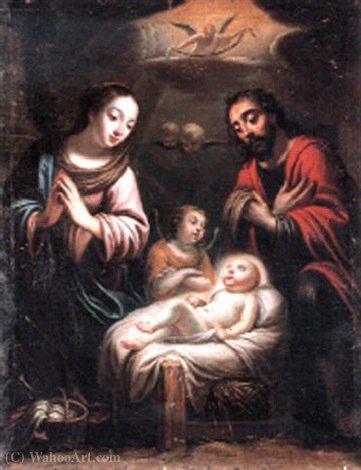
The nativity
复制品尺寸
Guy François, a name perhaps less familiar than some of his contemporaries, stands as a significant figure within the vibrant artistic landscape of 16th-century France. Born in Le Puy in 1578 or 1579, he emerged from a period marked by both religious upheaval and burgeoning Renaissance ideals, shaping his work with a unique blend of Caravaggism, Bolognese classicism, and deeply personal emotion. His life was tragically cut short in 1650, leaving behind a legacy of approximately 300 paintings – a remarkable output considering the challenges he faced throughout his career.
François’s early artistic development is inextricably linked to Carlo Saraceni, a Venetian painter whose workshop in Rome became a crucial training ground. He spent several years there during the late 1610s and early 1620s, absorbing the dramatic chiaroscuro and dynamic compositions characteristic of Saraceni's style. This influence is particularly evident in his later works, where he masterfully employed strong contrasts between light and shadow to create a sense of theatricality and emotional intensity. However, François quickly developed his own distinctive voice, moving beyond mere imitation and forging a style that was both deeply rooted in tradition and remarkably original.
His return to France in 1613 marked the beginning of a prolific career, primarily focused on religious subjects – altarpieces, panel paintings, and numerous devotional images. He received commissions from churches throughout the south of France, including Bordeaux and Montpellier, demonstrating his growing reputation as a skilled and sought-after artist. Crucially, he also found patronage with David, one of the leading figures of the French court, undertaking portraits such as that of Louis-Michel le Pelletier de St Fargeau, a commission that highlights his ability to capture both the outward appearance and inner character of his subjects.
The mid-1630s witnessed a pivotal moment in François’s career: the emergence of Jean-Baptiste Isabey, a miniaturist who became his close friend and invaluable supporter. Isabey recognized François's talent early on and secured commissions for him, notably the portrait of his generous friend – a work that brought significant recognition and financial stability to the artist. This collaboration proved immensely beneficial, allowing François to dedicate himself more fully to his art and expand his circle of patrons.
The success of this portrait led to further opportunities, culminating in 1795 with the creation of *Bélisaire*, a monumental work that secured him membership in the revolutionary tribunal. This period was marked by intense political upheaval, yet François navigated the turbulent times with remarkable resilience and artistic integrity. Despite his aversion to the violence and injustice of the revolution, he continued to produce powerful and emotionally resonant paintings, reflecting the spirit of the age while retaining his own distinctive style.
The late 18th century saw a surge in demand for portraiture, fueled by the rise of the wealthy bourgeoisie and the increasing importance of social status. François capitalized on this trend, executing numerous portraits of prominent figures – from royalty and nobility to leading intellectuals and artists. His ability to capture the personality and charisma of his subjects made him one of the most sought-after court painters of his day. His salon became a hub for artistic and intellectual exchange, further enhancing his reputation and solidifying his position within the Parisian art world.
François’s paintings are characterized by their dramatic use of light and shadow, reminiscent of Caravaggio's style, but infused with a distinctly French sensibility. He employed bold colors, dynamic compositions, and expressive gestures to convey a sense of movement and emotion. His religious works often feature intense emotional scenes, depicting moments of faith, piety, and spiritual struggle. The *Holy Family With St Bruno And St Elisabeth*, for example, showcases his ability to create a deeply moving portrayal of familial devotion, while the *Saint Roch and the Angel* demonstrates his mastery of chiaroscuro and his talent for capturing the vulnerability of human figures.
His portraits are equally compelling, revealing not only the physical likeness of his subjects but also their inner character. The portrait of his friend, now housed in the Louvre, exemplifies his skill in capturing a sense of warmth and generosity. His meticulous attention to detail, combined with his expressive brushwork, created paintings that were both visually stunning and psychologically insightful.
Guy François’s contribution to French art is often overshadowed by more celebrated figures of the era, but his work deserves recognition for its originality, emotional depth, and technical skill. He was a key figure in the transition from Mannerism to Baroque painting in France, bridging the gap between these two styles and forging a unique artistic identity. His paintings continue to be admired for their dramatic intensity, expressive power, and enduring beauty.
His influence can be seen in the work of subsequent generations of French painters, and his legacy endures through the numerous works that survive today. The fact that over 300 paintings remain is a testament to his prolific output and the lasting value of his artistic vision. The works housed in institutions like the Louvre and the Musée des Beaux-Arts de Nancy offer invaluable insights into the life and art of this remarkable artist.

1939 - 1978 , Italy


第一时间获取最新的艺术新闻、独家优惠及装饰灵感。
向我们介绍您的项目需求,我们的艺术专家将为您提供 3 个个性化的艺术品推荐。
由我们的专家为您精选 3 款心仪之作 —— 完全免费!

 效果预览
效果预览
 购买印刷品
购买印刷品 分享
分享 分享
分享
 详情
详情

 下载
下载
 相似作品
相似作品 X射线
X射线 幻灯片播放
幻灯片播放 展开详情
展开详情






































 玻璃选项仅适用于110厘米以下的尺寸。


