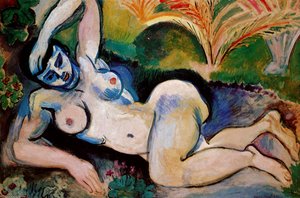
A Symphony of Color: Exploring Henri Matisse’s ‘Pink Nude,’ or Seated Nude
Henri Émile Benoît Matisse, born December 31, 1869, in the tranquil French village of Le Cateau-Cambrésis, embarked on a journey far removed from his initial aspirations for legal pursuits. A sudden illness – appendicitis – dramatically redirected his life’s trajectory during his formative years, gifting him with an unexpected catalyst: painting. Confined to convalescence, Matisse discovered within the simple act of applying pigment and brushstrokes a profound liberation—a revelation that irrevocably altered his path from legal briefs to the boundless realm of artistic expression. Growing up amidst the fertile landscapes of Bohain-en-Vermandois, where he witnessed firsthand the rhythms of rural life and the traditions of grain merchants, Matisse’s upbringing instilled in him an appreciation for observation and a sensitivity to natural beauty—qualities that would prove invaluable as he honed his craft. He pursued formal artistic training at the Académie Julian before progressing to the École Nationale des Beaux-Arts, immersing himself in the intellectual currents of Parisian avant-garde circles.
- Subject Matter: The painting depicts a woman seated gracefully on a chair, her legs crossed in a pose that exudes calm and repose. Her nudity is presented not as provocative but rather as an embodiment of idealized femininity—a deliberate choice reflecting Matisse’s fascination with capturing the essence of human form through expressive color.
- Style: Matisse's work exemplifies Fauvist art, characterized by its audacious use of vibrant hues divorced from naturalistic representation. The artist eschewed meticulous detail in favor of simplified forms and bold strokes—a stylistic decision that prioritized emotional impact over photographic accuracy.
Technique & Composition: Embracing Bold Strokes and Geometric Harmony
Matisse’s technique involved layering paint thickly onto the canvas, creating textured surfaces that pulsate with color. He employed a distinctive brushstroke—often described as “pushing” or “scraping”—to build up pigment and achieve an impressionistic effect. The composition is carefully balanced, utilizing geometric shapes to guide the viewer's eye across the scene. The window framing the woman provides a subtle visual anchor, while the potted plants flanking her contribute to the overall sense of serenity and naturalism. Notably, the surfboard—a seemingly incongruous element—adds an exotic touch and reinforces Matisse’s exploration of unconventional subjects and stylistic approaches.
- Color Palette: Dominating the canvas is a striking pink hue—the namesake of the piece—which radiates warmth and luminosity. Complementary shades of yellow and green are strategically employed to heighten visual interest and create depth within the composition.
- Brushwork: Matisse’s characteristic brushstrokes—loose, energetic, and deliberately uneven—are paramount to conveying emotion and capturing the immediacy of perception. These marks imbue the painting with a palpable sense of movement and vitality.
Historical Context & Artistic Influences: A Dialogue Between Cubism and Expressionism
‘Pink Nude,’ painted in 1909, emerged during a period of significant artistic experimentation—a time when artists were grappling with new ideas about representation and exploring the expressive potential of color. Matisse’s work reflects both the influence of Cubist principles—particularly Picasso’s fragmentation of form—and the burgeoning Expressionist movement's emphasis on conveying inner feelings. However, Matisse skillfully transcends these stylistic precedents, forging his own distinctive visual language that prioritizes beauty and emotional resonance above all else.
Symbolism & Emotional Impact: Capturing Essence Through Color
Beyond its formal elements, ‘Pink Nude’ resonates with profound symbolic significance. The woman embodies idealized femininity—a celebration of grace and serenity—while the surfboard represents a connection to exotic landscapes and an embrace of unconventional perspectives. Ultimately, Matisse's masterpiece succeeds in capturing a fleeting moment of contemplative beauty—inviting viewers to contemplate the interplay between form, color, and emotion. It stands as a testament to Matisse’s unwavering belief that art should illuminate the human spirit and inspire wonder.




































 效果预览
效果预览
 切换至手工绘画版
 分享
分享 分享
分享
 详情
详情

 下载
下载
 相似作品
相似作品 X射线
X射线 幻灯片播放
幻灯片播放
 展开详情
展开详情









 玻璃选项仅适用于110厘米以下的尺寸。