


 PaintingContemporary Art
 1997Contemporary
 130.0 x 140.0 cm
 Contemporary Art Platform
从与原作比例一致的预设尺寸中进行选择。

您可以输入自定义尺寸,以适配特定的画框或空间。如果您选择的尺寸与原图比例不符,我们将对作品进行裁剪,或通过镜像填充/纯色填充边缘的方式来扩展图像。在开始制作之前,我们会向您发送一份数字效果图供您确认。
请注意,屏幕上的预览并不能反映实际的裁剪或扩展效果。只有效果图才能准确展示最终的构图。
虽然我们提供定制尺寸,但为了保持原图比例,我们建议您从预设列表中选择尺寸。

Untitled
复制品尺寸
In this captivating 1997 masterpiece titled Untitled, the late Lebanese visionary Hussein Madi orchestrates a visual symphony that transcends the boundaries of traditional representation. At first glance, the viewer is struck by the vibrant, pulsating energy of a deep red background, which serves as a dramatic stage for the central protagonists: a violin and a cello. Rather than adhering to strict realism, Madi employs an abstract language to deconstruct these iconic musical instruments, reimagining them through fluid lines and rhythmic shapes. The composition breathes with a sense of movement, as if the very pigments are dancing to an unheard melody, inviting the observer to experience the music through sight alone.
The technique employed in this work reflects Madi’s profound mastery over form and texture. By blending elements of his sculptural background with the delicate precision of engraving, he creates a piece that feels both structurally grounded and ethereally light. The instruments are not merely objects but are transformed into symbols of harmony and resonance. Scattered throughout the canvas, smaller, enigmatic figures emerge from the composition, acting as rhythmic accents that guide the eye across the 130 x 140 cm expanse. These figures add a layer of narrative complexity, suggesting a larger, cosmic dance where every element is interconnected within the grand design of the universe.
To understand the emotional depth of this piece, one must look toward the rich cultural tapestry that informed Madi’s life. Having studied in Rome and deeply researched Egyptian and Arabic iconography, Madi possessed a unique ability to weave ancient symbolism into the fabric of modern abstraction. In Untitled, this manifests as a profound respect for balance and rhythm—concepts central to both Middle Eastern art and classical music. The interplay between the bold, saturated reds and the structured silhouettes of the instruments evokes a sense of passion tempered by discipline, mirroring the duality of the artist's own journey between the Mediterranean traditions and contemporary global movements.
For the discerning collector or interior designer, this artwork offers more than just aesthetic beauty; it provides a focal point of intellectual and emotional sophistication. The painting’s ability to command attention through its intense color palette makes it an ideal centerpiece for luxurious, modern interiors that seek to evoke warmth and cultural depth. Whether placed in a curated gallery setting or a grand residential salon, this reproduction of Madi's work serves as a timeless tribute to the enduring power of art to harmonize the human spirit.
In the vast tapestry of Middle Eastern modernism, few threads are as intricately woven or as profoundly resonant as those left by Hussein Madi. Born in the historic coastal city of Sour, Lebanon, in 1938, Madi emerged not merely as an artist, but as a visual poet capable of translating the ancient echoes of Arabic heritage into the language of contemporary form. His journey was one of constant dialogue between the local and the universal, beginning with his foundational studies at the Lebanese Academy of Fine Arts and expanding through a transformative period in Rome. It was in Italy that Madi’s artistic consciousness truly deepened; by immersing himself in the study of Egyptian cultural heritage, he began to synthesize the classical rigor of Western training with the symbolic richness of his Levantine roots.
The years between 1973 and 1986, spent primarily in Rome, served as a crucible for his creative evolution. During this era, Madi moved beyond mere representation, embarking on a scholarly and artistic quest to uncover the hidden iconography of the Arab world. He sought to capture the essence of identity through a vocabulary of shapes that felt both timeless and modern. Upon his return to Lebanon in 1986, he did not merely settle into a studio practice but became a vital pillar of the academic community, teaching sculpture and engraving at the Lebanese University and the Institute of Fine Arts. Through this mentorship, Madi ensured that his dedication to craftsmanship and cultural storytelling would ripple through future generations of Levantine artists.
Madi’s artistic output was characterized by a remarkable duality, masterfully navigating the tactile weight of sculpture and the delicate precision of printmaking. In his sculptural works, often rendered in bronze and stone, he possessed an uncanny ability to freeze motion within stillness. His figures frequently embody ritualistic gestures, capturing a sense of sacred movement that suggests archetypal narratives from Arabic tradition. These works are not static objects; they are breathing entities that invite the viewer into a state of spiritual contemplation, where the heavy permanence of stone meets the ephemeral grace of a human gesture.
Parallel to his sculptural mastery was his profound command of the graphic arts. As an engraver and printmaker, Madi utilized etching techniques to create monochrome worlds of striking contrast. His prints are celebrated for their ability to convey complex emotional landscapes through minimalist lines. A recurring motif in his oeuvre is the stylized bird—a symbol that transcends mere decoration to represent freedom, resilience, and transcendence. These avian forms, soaring across the paper with rhythmic elegance, serve as a visual metaphor for the human spirit’s ability to rise above historical turbulence and find liberty within the constraints of form.
The impact of Hussein Madi’s work extends far beyond the borders of Lebanon, reaching the global stage through prestigious exhibitions and international acclaim. His participation in the Venice Biennale in 2003 stands as a testament to his standing among the world's elite contemporary artists. This recognition was further solidified by receiving the Order of Merit, an honor reflecting his profound contribution to the cultural fabric of the Mediterranean region. His ability to bridge the gap between the historical weight of Islamic and Arabic iconography and the sleekness of modern abstraction allowed him to create a universal aesthetic that resonates across cultures.
Ultimately, the significance of Hussein Madi lies in his role as a guardian of memory and a pioneer of form. Through his meticulous engravings and dynamic sculptures, he provided a visual language for an identity that is both deeply rooted in the soil of Lebanon and soaring with the limitless possibilities of modern art. His legacy remains a vital part of the Middle Eastern canon, reminding us that true art does not just depict history—it breathes life into it.

1938 - 2024 , Lebanon

Journey through Wassily Kandinsky's 25 most iconic abstract paintings. Explore his revolutionary use of color, form & spiritual expressionism. Find museum-quality Kandinsky reproductions and elevate your home decor with TopImpressionists.com. Discover all masterpieces on TopImpressionists.com!

探索抽象表现主义的十幅经典杰作!波洛克、罗斯科等大师作品,揭秘艺术史上的重要瞬间。TopImpressionists.com为您呈现高品质艺术品复制和精选家居装饰方案,感受现代艺术的力量与魅力。立即浏览全系列!

探索马克·罗斯科25幅杰作,感受抽象表现主义的色彩力量与深刻情感。从经典色域绘画到无题系列,了解艺术史上的大师及其作品背后的故事。TopImpressionists.com提供博物馆级高质量复制品,为您的家居装饰带来艺术灵感!立即探索完整收藏。

探索几何抽象艺术的十大杰作!康定斯基、蒙德里安等大师作品,色彩构成与非具象之美。TopImpressionists.com提供博物馆级艺术复制品,为您的家居带来现代艺术灵感。立即在线探索完整系列!
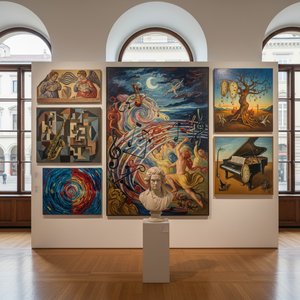
Explore the fascinating history of music's visual representation in art! From ancient symbolism to modern abstraction, discover how artists have captured sound and emotion on canvas. Expert insights & stunning examples.


第一时间获取最新的艺术新闻、独家优惠及装饰灵感。
向我们介绍您的项目需求,我们的艺术专家将为您提供 3 个个性化的艺术品推荐。
由我们的专家为您精选 3 款心仪之作 —— 完全免费!
 定制手绘复刻品
 分享
分享 分享
分享
 详情
详情

 下载
下载
 相似作品
相似作品 X射线
X射线 幻灯片播放
幻灯片播放 展开详情
展开详情






































 玻璃选项仅适用于110厘米以下的尺寸。


