
从与原作比例一致的预设尺寸中进行选择。

您可以输入自定义尺寸,以适配特定的画框或空间。如果您选择的尺寸与原图比例不符,我们将对作品进行裁剪,或通过镜像填充/纯色填充边缘的方式来扩展图像。在开始制作之前,我们会向您发送一份数字效果图供您确认。
请注意,屏幕上的预览并不能反映实际的裁剪或扩展效果。只有效果图才能准确展示最终的构图。
虽然我们提供定制尺寸,但为了保持原图比例,我们建议您从预设列表中选择尺寸。

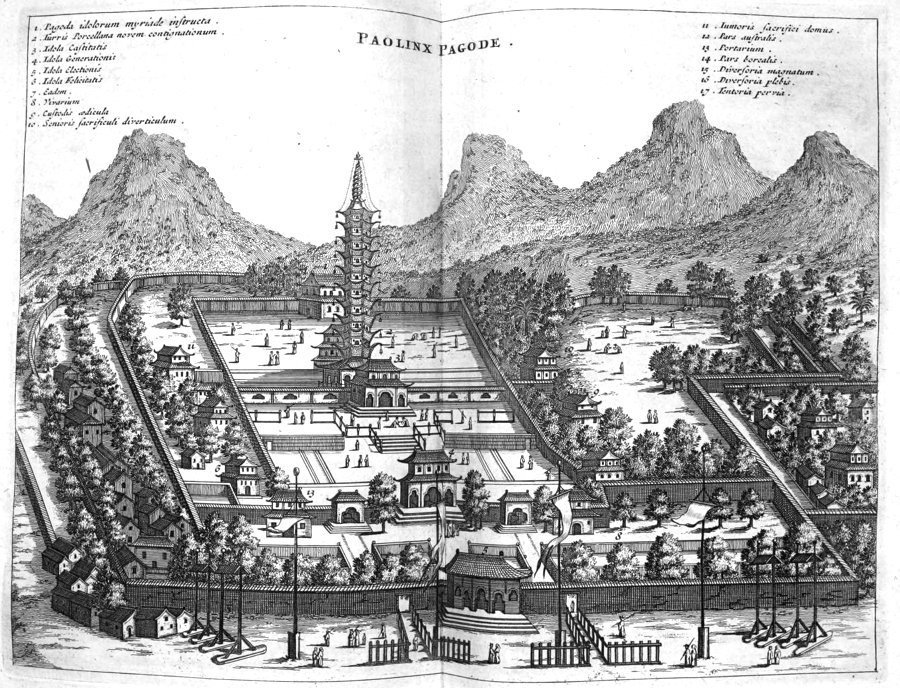
Paolinx pagode
复制品尺寸
In the golden age of Dutch exploration, where the boundaries of the known world were being redrawn by every intrepid voyage, Jacob van Meurs (1619–1680) emerged as a master of visual precision. Born in Arnhem, Netherlands, into a family deeply rooted in the printing traditions of the era, his early life was shaped by the rhythmic press of ink and the meticulous demands of typography. This heritage provided him with more than just technical skill; it instilled a profound understanding of how information could be captured, preserved, and disseminated through the medium of print. As the son of a printer, Van Meurs was uniquely positioned at the intersection of art and intellect, a place where the burgeoning scientific revolution met the exquisite craftsmanship of the Dutch Baroque.
Van Meurs’s career was defined by a rare synthesis of artistic elegance and scientific rigor. While many of his contemporaries sought fame through the dramatic shadows of portraiture or the grand narratives of mythology, Van Meurs turned his gaze toward the earth and the heavens. He became a pivotal figure in Dutch cartography, utilizing the medium of engraving to translate complex geographical and astronomical data into accessible, beautiful imagery. His work was not merely decorative; it served as a vital tool for the era's most profound thinkers. Through his skilled hands, the abstract theories of luminaries such as Nicolaus Copernicus and Johannes Kepler were transformed into compelling visual diagrams, allowing the revolutionary concepts of heliocentrism and planetary motion to permeate the European consciousness.
The true magnitude of Van Meurs’s contribution lies in his ability to document the expanding horizons of the seventeenth century. His most monumental achievement, the ambitious atlas known as “The New World,” stands as a testament to his technical mastery and his role in the age of discovery. Commissioned by powerful figures such as William III of Orange and Philip II of Spain, this work was an extraordinary feat of engraving that brought the distant Americas into the European imagination. By incorporating findings from legendary expeditions led by explorers like Willem Janszoon Tasman, Van Meuts created maps that were both works of art and essential navigational records, capturing the rugged beauty and the mysterious topography of newly encountered lands.
Beyond the vast expanses of his maps, Van Meurs’s portfolio reveals a fascination with the specificities of the world—from the architectural dignity of historic structures like the Kruis Kerk to the vibrant, imagined streets of distant locales such as Nanking. His engravings often captured a sense of wonder and meticulous detail that bridged the gap between reality and the exotic. This versatility allowed him to move seamlessly between scientific illustration and topographical storytelling, ensuring that his prints remained relevant to both the scholar in the study and the merchant in the port. Through his work, the era's thirst for knowledge found its most enduring visual language.
The historical significance of Jacob van Meurs extends far beyond the borders of the Netherlands. He represents a period when art served as the primary vehicle for scientific communication, acting as the lens through which humanity viewed its place in the universe. His life and work remind us that the progress of science is inextricably linked to the power of visual representation. Today, his engravings remain vital artifacts of a time when every new line etched into a copper plate could potentially change the way the world was understood, leaving an indelible mark on the history of both art and exploration.

1619 - 1680 , Netherlands


第一时间获取最新的艺术新闻、独家优惠及装饰灵感。
向我们介绍您的项目需求,我们的艺术专家将为您提供 3 个个性化的艺术品推荐。
由我们的专家为您精选 3 款心仪之作 —— 完全免费!

 效果预览
效果预览
 购买手绘画作
 分享
分享 分享
分享
 详情
详情

 下载
下载
 相似作品
相似作品 X射线
X射线 幻灯片播放
幻灯片播放 展开详情
展开详情






































 玻璃选项仅适用于110厘米以下的尺寸。


