


 实景预览
实景预览
 发送
发送 分享
分享
 详情
详情 指南
指南

 下载图片
下载图片
 相似作品
相似作品 X射线
X射线 幻灯片播放
幻灯片播放 统计数据
统计数据Venice

Discover James Holland’s ‘Venice’ watercolor – a serene canal scene with Venetian architecture & a framed painting. Explore this romantic Impressionistic artwork.
A master of Romantic landscapes and Venice scenes. Discover the exquisite watercolours and oils of James Holland today.
 阅读全文
阅读全文
购买高分辨率增强版数字图像,其品质远超在线预览。
每一份文件都由我们的内部专家使用先进工具与专业的后期润色技术精心打造。我们确保每一张图像都具备卓越的清晰度、精准的色彩还原度以及细腻的细节表现。
最终文件将在 72 小时内通过电子邮件交付,并针对专业、编辑及印刷用途进行了优化。其品质与顶级设计工作室、出版社和画廊所信赖的标准完全一致。
数字图像
下载高分辨率文件,用于个人展示、打印及创意项目。 ( 切换至版画销售渠道 订购此收藏品的纯手工复刻画作)
每份数字图像订单均包含的内容
专业级数字交付,品质无忧
选择 TopImpressionists.com,您获得的不仅仅是一张图像——您收到的是经过专业级增强、精雕细琢的数字艺术作品,并享有满意保证。以下是您的订单中自动包含的所有内容:

即时邮件交付
您的高分辨率数字图像文件将在下单后 72 小时内通过电子邮件发送给您 —— 即可立即使用。

AI 增强型数字图像
您的艺术品经过专业优化,结合先进的 AI 技术与人工修饰,确保呈现极致的细节、清晰度与色彩准确度。

终身免费重发服务
不小心删除了文件或找不到了?没关系——我们将随时为您免费重发。

无需进口税费,始终如一
即刻拥有您的艺术作品,无需支付任何关税、税费或运费——数字下载始终免税。

色彩精准保障
我们通过专业工具与色彩管理技术,确保您的数字图像尽可能真实地还原原作色彩。

100天满意保证
如果您对所购数字图像不满意,我们将在100天内为您进行修改或提供100%的全额退款——无需任何理由。

100% 退款保证
不满意?在收到数字文件后的100天内,您可以申请全额退款——无需任何理由。

批量订购优惠
购买 3 张享 10% 折扣 - 购买 5 张享 15% 折扣 - 购买 10 张以上享 20% 折扣。非常适合创意项目、画廊及机构使用。
相关艺术品
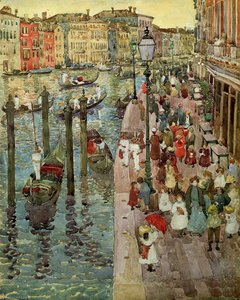


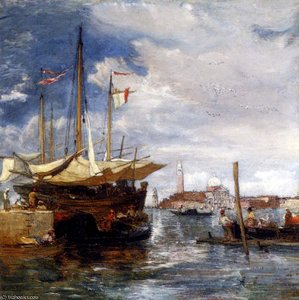


艺术家简介
The Potter's Precision
To understand the technical rigor of James Holland, one must look past the finished landscapes and toward the industrial grit of his beginnings in Burslem, Staffordshire. He did not emerge from a vacuum of pure theory; he was trained by the repetitive, exacting demands of the Davenport Pottery works. From age twelve, his hands were occupied with painting flowers onto porcelain and pottery. This early apprenticeship instilled a specific discipline regarding color and fine detail that remained present even when he transitioned to much larger canvases. He moved to London in 1819, carrying this decorative precision into a new arena of landscape and marine subjects.
His development was marked by a shift from the small-scale botanical accuracy required for ceramics to the broader atmospheric needs of topographical painting. While he continued to work as a pottery painter to sustain himself, his focus expanded toward architecture and natural history. By 1824, his first exhibition at the Royal Academy signaled that his skills were no longer confined to the surface of a teacup. He was a versatile practitioner, equally capable in oils and watercolours, a fact reflected in his prolific exhibition record across various prestigious societies.
Continental Sightings and Technical Shifts
Holland’s reputation was built on his ability to document the European landscape with structural integrity. His travels were not mere sightseeing; they were systematic studies of light and architecture. Between the 1830s and 1850s, he moved through France, Portugal, Switzerland, Austria, and the Netherlands. These excursions provided the raw material for his most recognized works. In France, specifically during visits to Rouen, he focused on architectural studies that demanded a sharp eye for form. His time in Portugal resulted in published works like The Tourist in Portugal, proving his utility as both an artist and a visual chronicler of the era.
His style underwent a visible transformation over the decades. The early watercolours, heavily influenced by the approach of Richard Parkes Bonington, possessed a certain delicate clarity. However, as time progressed, his technique became looser. He began to utilize bodycolour more extensively, moving away from purely transparent washes toward a more substantial, textured application. This shift allowed him to capture the heavier atmosphere of marine scenes and the complex light of Italian vistas with greater weight.
The Venetian Record
Venice remains the most significant anchor in his body of work. It was not a single visit but a recurring obsession that defined much of his later career. He returned to the city multiple times, notably in 1836, 1857, and throughout the mid-century, finding in its canals a subject that demanded both architectural precision and an understanding of light refraction. His depictions of the Grand Canal and Saint Mark's Basin demonstrate a mastery of the Venetian atmosphere, capturing the movement of gondolas and the play of sun on water without descending into mere sentimentality.
His professional standing was solidified through his involvement with major institutions:
- Royal Watercolour Society: He served as an associate in 1835 and achieved full membership by 1857 or 1858.
- Society of British Artists: He joined this group in 1843, remaining a member until 1848.
- Royal Academy: He exhibited thirty-two works here between 1824 and 1865.
- British Institution: His contributions reached ninety-one pieces at this venue.
Ultimately, Holland’s significance lies in his ability to bridge the gap between the meticulous decorative arts of the Potteries and the expansive, atmospheric demands of Victorian landscape painting. He was a colourist of high caliber, producing works that, while sometimes overlooked during his lifetime, gained substantial value as collectors sought the specific clarity he brought to continental views.

James Holland
1799 - 1870
概览
- Artistic Movement Or Style: Romantic Landscape Painting
- Artists Who Influenced This Artist: ['Richard Parkes Bonington']
- Full Name: James Holland
- Nationality: English
- Notable Artworks:
- The Grand Canal, Venice
- Greenwich Hospital as it was in 1837
- Venetian Capriccio
- The Colonnade of Queen Mary Court
- Place Of Birth: Burslem, United Kingdom
- Date Of Birth: 1799
- Date Of Death: 1870