

 实景预览
实景预览
 分享
分享 分享
分享
 详情
详情 指南
指南

 下载作品
下载作品
 相似作品
相似作品 X射线
X射线 幻灯片播放
幻灯片播放 问答
问答 统计数据
统计数据
- 340.0 x 378.0 cm


¥ 1806
手工油画复制品
由我们的艺术家按需定制,为您提供您所选尺寸及画框的布面手工油画。 ( 切换至版画销售渠道 切换至数字图像销售渠道)
尺寸
·标准尺寸
定制
CM
INCH
您可以从与原作比例一致的预设尺寸中进行选择。
正在加载尺寸...

宽度
高度
请输入您需要的宽度和高度,以适配您的画框或墙面。由于作品为手工绘制,若选择不同比例的尺寸,艺术家可能会在画面边缘多画一些或稍作裁剪 —— 由您决定。在开始绘画之前,我们会为您发送一份数字效果图供您确认。本页面上展示的图片并非最终实物 —— 只有效果图才能反映真实结果。
 了解更多
了解更多完成
·
白色边缘 ¥1

边缘晕染效果 ¥1

延展式 ¥1

P118B ¥10

P118H ¥10

P118W ¥10

P438Z ¥10

P508JH ¥12

P508YH ¥12

P805H ¥10

P805Z ¥10

P919BZ ¥10

P919G ¥10

P919XJ ¥10

P959ZH ¥10

P968JZ ¥12

W106C ¥8

W218G ¥10

W218JH ¥8

W218Y ¥10

W307PJ ¥10

W316G ¥10

W316PJ ¥8

W316Y ¥10

W398PJ ¥8

W4111J ¥10

W500HY ¥15

W500JH ¥15

W692G ¥12

W849H ¥8

W940BG ¥15

W953PJ ¥8

H24-GOLD ¥30

H24-SILVER ¥30

H36-GOLD ¥45

H36-SILVER ¥45
采用保护管包装寄送,方便您交由专业的装裱师进行装裱。
增值服务
可选附加内容包含哪些内容?
可定制内容示例:将面部替换为客户照片;添加宠物(例如,将猫替换为狗);在背景中加入隐藏信息;更改背景风景或元素。
下单后,TopImpressionists.com 团队将通过电子邮件联系客户获取具体指令,并提供效果预览图
下单后,TopImpressionists.com 团队将通过电子邮件联系客户获取具体指令,并提供效果预览图
全球配送()仅需 3-4 周即可送达,无需等待标准时效的 5 周。(4 November)。品质绝不妥协。
保护性清漆
展品铭牌
青铜铭牌雕刻详情
This elegant plaque features the artist's name and the title of the artwork, finely engraved for a timeless presentation.
It is made from bronze with a refined, elegant finish. The text is precisely laser-engraved for a sharp and permanent result. Measuring 9x2 cm, the plaque is compact yet easy to read. It's built to be durable and scratch-resistant, offering a professional, museum-quality look. Mounting is simple thanks to the included adhesive backing.
透明亚克力铭牌详情
The plaque includes essential engraved details such as the artist's name, the title of the artwork, the date it was created, the type of media used-like oil on canvas or watercolor-a brief description of the piece, and a QR code that links to the complete artwork information.
It is crafted from clear acrylic, offering a sleek, modern appearance. The text is UV-engraved in black to ensure strong visual contrast. With a size of 10x15 cm, it ensures optimal readability. It comes equipped with two metal hooks for secure wall mounting. The plaque is designed to be weather-resistant, making it suitable for various environments, and it includes interactive features that work seamlessly with smartphone scanning.
黑色亚克力铭牌详情
This elegant plaque includes engraved information such as the artist's name, the title of the artwork, the date it was created, the type of media used (like oil on canvas or watercolor), a short description of the artwork, and a QR code for quick access to more information.
The plaque itself is made from refined black acrylic with a premium finish. The text is laser-engraved in white for high contrast and readability. Its size is 10x15 cm, designed to be easy to read. It comes with two metal hooks for professional mounting. The design is sleek and fits any interior style. It is also weather-resistant and durable, with built-in digital integration for mobile compatibility.
玻璃选项仅适用于110厘米以下的尺寸。
 玻璃选项仅适用于110厘米以下的尺寸。
- 全球免运费特快专递服务
- 优质亚麻画布
- 全程运输保险
- 关税退款保证
- 色彩精准还原保证
- 100天退货保障(仅限制造缺陷)
- 100% 退款保证
- 多件购买优惠


藏品详情
Lorenzo Monaco's 'Antiphonary Folio' (1396) showcases stunning illuminated details of a religious scene, reflecting the monk’s artistic vision and early Renaissance style.
艺术家简介
洛伦佐·莫纳科(约1370-1425)是佛罗伦萨画家,连接了哥特优雅与早期文艺复兴的创新。探索他的精神艺术、手稿插图和独特的风格,代表作包括《圣母怜悯》、《加冕礼》和《东方三博士朝拜》。他是乔托风格最后的代表人物之一。
关于作品
A Monastic Vision: Lorenzo Monaco’s Antiphonary Page
Within the hallowed halls of the Biblioteca Laurenziana in Florence resides a fragment of extraordinary beauty – a page from Lorenzo Monaco's Antiphonary, dating back to 1396. More than just a liturgical manuscript illumination, this piece offers a profound glimpse into the artistic and spiritual world of late medieval Italy, revealing the quiet intensity and contemplative nature of a Camaldolese monk’s vision. It is a testament to a time when art served not merely as decoration but as a conduit for faith, meticulously crafted with tempera and gold on parchment – materials that themselves speak volumes about the piece's value and enduring quality.
The image itself depicts a scene of profound significance: Pentecost. Monaco masterfully captures the moment when the Holy Spirit descends upon the apostles, transforming them into witnesses to Christ’s resurrection. The composition is remarkably balanced, despite the dense grouping of figures within the oval initial. A carefully constructed architectural setting – a simple house with an open doorway – provides a grounding element, while the vibrant colors—a rich palette dominated by reds, blues, and golds—create a luminous atmosphere that seems to radiate divine light. Notice particularly the subtle use of perspective; though not adhering to the emerging principles of linear perspective, Monaco skillfully employs atmospheric shading and spatial relationships to create a sense of depth and realism within the confines of the illuminated initial.
The Monk-Artist: Lorenzo Monaco’s Unique Style
Lorenzo Monaco's identity as a monk profoundly shaped his artistic practice. Born Piero di Giovanni around 1370 in Siena, he entered the Camaldolese order at Santa Maria degli Angeli and dedicated his life to prayer and illumination. This monastic commitment instilled within him a distinctive style characterized by a restrained palette, elongated figures, and a profound sense of introspection. Unlike the more flamboyant styles prevalent during the period, Monaco’s work possesses a quiet dignity and emotional restraint—a reflection of the contemplative life he led.
His artistic journey began under the tutelage of masters like Giotto, Spinello Aretino, and Agnolo Gaddi in Florence. However, it was his embrace of monasticism that truly defined him as “Lorenzo Monaco,” or “Lawrence the Monk.” This dedication to a life of contemplation profoundly influenced the character of his work, imbuing it with an introspective quality rarely found in secular art of the time. He wasn’t simply replicating religious scenes; he was translating spiritual experience into visual form, creating images that resonated with a deep sense of faith and humility.
Symbolism and Spiritual Resonance
The Antiphonary page is replete with symbolic details that enrich its meaning. The figures themselves—the Virgin Mary, the apostles, and the two onlookers—represent key elements of Christian theology and narrative. The presence of Matthias, chosen to replace Judas, subtly underscores themes of redemption and forgiveness. The architectural setting, a humble dwelling, symbolizes the arrival of grace in an ordinary space. The birds scattered throughout the scene are often interpreted as symbols of the Holy Spirit, further emphasizing the central event depicted.
Beyond these specific symbols, the entire page exudes a sense of spiritual resonance. The muted colors and elongated figures create a dreamlike atmosphere, inviting viewers to contemplate the mysteries of faith. The careful attention to detail—from the folds of the drapery to the expressions on the faces—demonstrates Monaco’s mastery of his craft and his deep understanding of the subject matter. It's not merely a depiction of an event; it is an invitation into a sacred space, a moment of quiet contemplation within the heart of faith.
A Legacy of Monastic Art
Lorenzo Monaco’s Antiphonary page stands as a remarkable example of monastic art—a testament to the enduring power of faith and beauty. Its creation reflects the artistic priorities of the Camaldolese order, where illumination was not simply an embellishment but a vital component of liturgical worship. The piece's survival through centuries speaks to its quality and significance, offering us a rare glimpse into the creative spirit of a dedicated monk-artist who sought to capture the essence of faith in his art.
常见问题与解答
哪里可以买到洛伦佐·莫纳科 (Luòléngcòu·Mònàkè) 的《Antiphonary (Cod. Cor. 1, folio 111v)》的手绘复制品?
您可以在洛伦佐·莫纳科 (Luòléngcòu·Mònàkè) 的《Antiphonary (Cod. Cor. 1, folio 111v)》的手工油画复刻页面直接订购其手绘复制品:亚麻画布手工油画复制品,按需定制。
洛伦佐·莫纳科 (Luòléngcòu·Mònàkè) 的《Antiphonary (Cod. Cor. 1, folio 111v)》 是否属于备受追捧的 International Gothic 流派作品之一?
在馆藏的 International Gothic 作品中,"Antiphonary (Cod. Cor. 1, folio 111v)" 的流行程度被记录为 Recognized。
如何以幻灯片形式查看洛伦佐·莫纳科 (Luòléngcòu·Mònàkè) 的《Antiphonary (Cod. Cor. 1, folio 111v)》?
您可以在作品的 幻灯片展示 页面上以幻灯片形式浏览 洛伦佐·莫纳科 (Luòléngcòu·Mònàkè) 的《Antiphonary (Cod. Cor. 1, folio 111v)》。
艺术速览与艺术小测验
关于 洛伦佐·莫纳科 (Luòléngcòu·Mònàkè)

洛伦佐·莫纳科 (Luòléngcòu·Mònàkè)
1370 - 1425, 意大利
艺术家简介
佛罗伦萨修士的愿景:洛伦佐·莫纳科的世界
洛伦佐·莫纳科,原名皮耶罗·迪·乔万尼,大约于1370年出生在锡耶纳,占据了文艺复兴早期一个引人入胜且至关重要的位置。他从中世纪晚期哥特式风格的优雅过渡到文艺复兴早期的理想。尽管关于他的生平细节仍然稀少,但他的艺术之旅揭示了一个适应、创新和深刻精神信仰的故事。莫纳科在佛罗伦萨学徒,吸收了乔托、斯皮内洛·阿雷蒂诺和安尼奥洛·加迪等大师的教诲——这些艺术家奠定了叙事清晰度和情感共鸣的基础。然而,真正塑造他的艺术身份并使他获得“洛伦佐·莫纳科”或“劳伦斯修士”这个名字的是他在1390年拥抱修道生活,加入了圣玛丽亚 degli Angeli 的卡马尔多利会。他对沉思生活的承诺深刻地影响了他作品的性格,赋予它内省的品质和对宗教主题的关注。融合哥特式优雅与文艺复兴萌芽
莫纳科的早期作品出现在1390年代,展示了当时欧洲盛行的国际哥特式风格的出色掌握能力。这些绘画以其精致的优雅、细腻的线条和最初在色彩范围上受到限制的调色板为特征。然而,即使在这种既定的框架内,他个人艺术的声音也开始显现。他吸收了同时代艺术家洛伦佐·吉贝尔蒂和杰拉多·斯塔尼纳的影响,融入了他们复杂的构图和对细节的关注。随着时间的推移,莫纳科的风格不断发展,越来越以细长的身影为特征,这些身影披着流畅飘逸的长袍,偏爱锐利的边缘和鲜艳的色彩——特别是金色和青金石的华丽色调——以及微妙而空灵的光质。他的姿势通常是含蓄的,暗示内心的情感而不是公然地展示它,并且他的空间安排往往是扁平化的,优先考虑象征意义共鸣而非严格的现实主义。他始终致力于描绘充满强烈精神价值的场景,经常远离纯粹的自然主义表现的追求。信仰与艺术创新的杰作
莫纳科的艺术作品广阔而令人印象深刻,包括面板绘画、壁画和手稿插图。现藏于佛罗伦萨 Galleria dell'Accademia 的《圣母怜悯像》是他早期精湛技艺的证明,展示了线条中的紧张感和切实的感情张力。《加冕圣母像》,现在装饰着乌菲兹美术馆,体现了他成熟的风格——一幅由圣徒组成的充满活力的挂毯,以流畅的形式和令人眼花缭乱的色彩呈现。同样在 Galleria dell'Accademia 的《蒙特奥利韦托祭坛画》揭示了深刻的精神信仰,预示着弗拉·安杰利科的作品。也许是他最著名的成就之一是《东方三博士朝拜》(1420-1422年),他在其中对透视的创新运用,虽然缺乏严格的几何透视,创造了一个引人入胜且视觉上令人惊叹的构图。巴托里尼·萨利姆贝尼教堂的壁画代表了他为数不多的幸存的壁画作品之一,让我们得以一窥他作为大型装饰者的技艺。这些作品不仅展示了精湛的技术,还表现出他对神学象征意义的深刻理解以及致力于以清晰和优雅的方式传达宗教叙事的承诺。连接不同时代的桥梁
尽管在他的一生中佛罗伦萨涌现出革命性的艺术潮流——特别是马萨乔和菲利波·布鲁内莱斯基在透视和自然主义方面的开创性创新——洛伦佐·莫纳科却在很大程度上不受这些发展的影响。他坚定地保持了他独特的风格,开辟了一条独特道路,弥合了晚期哥特式传统与新兴文艺复兴美学之间的差距。乔尔乔·瓦萨里在他的《艺术家传记》中承认了莫纳科的才华,同时指出他在大约1425年因不明原因感染而英年早逝。尽管关于他的生平细节有限,但他对艺术史的贡献是不可否认的。他代表着乔托风格最后的重大代表人物,保留了它的遗产,同时也融入了预示未来艺术转型的元素。他对灵性、程式化形式和精致优雅的强调代表了佛罗伦萨绘画中的一种独特美学,给后代艺术家留下了持久的印记。遗产与持久的影响
洛伦佐·莫纳科的作品继续以其细腻的美丽、深刻的虔诚和微妙的创新吸引着观众。他不是像马萨乔那样具有革命性的人物,但他的贡献在于他将现有传统综合成一种和谐而高度个性化的风格的能力。他证明了艺术卓越可以在既定惯例的范围内蓬勃发展,通过个人表达和精神深度丰富它们。他的影响可以从后来欣赏他精致技巧和虔诚感艺术家的作品中看到。今天,他的绘画作为进入艺术史关键时刻——一个过渡、实验和信仰通过艺术愿景体现出的持久力量的宝贵窗口而存在。关于 洛伦佐·莫纳科 (Luòléngcòu·Mònàkè) 的简介
- Artistic Movement Or Style: 哥特式,早期文艺复兴
- Artists Or Movements Influenced By This Artist: ['弗拉·安杰利科']
- Artists Who Influenced This Artist:
- 乔托
- 斯皮内罗·阿雷蒂诺
- 安尼奥洛·加迪
- Date Of Birth: 约1370年
- Date Of Death: 约1425年
- Full Name: 洛伦佐·莫纳科
- Nationality: 意大利国籍
- Notable Artworks (List Of Titles):
- 《圣母怜子像》
- 《加冕礼》
- 《蒙特奥利维托祭坛画》
- 《东方三博士朝拜》
- Place Of Birth (City And Country): 意大利锡耶纳

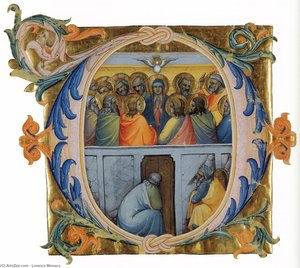
洛伦佐·莫纳科 (Luòléngcòu·Mònàkè)
Antiphonary (Cod. Cor. 1, folio 111v)
() ·
含框总尺寸: · 亚麻布油画手绘
总计