





























从与原作比例一致的预设尺寸中进行选择。

您可以输入自定义尺寸,以适配特定的画框或空间。如果您选择的尺寸与原图比例不符,我们将对作品进行裁剪,或通过镜像填充/纯色填充边缘的方式来扩展图像。在开始制作之前,我们会向您发送一份数字效果图供您确认。
请注意,屏幕上的预览并不能反映实际的裁剪或扩展效果。只有效果图才能准确展示最终的构图。
虽然我们提供定制尺寸,但为了保持原图比例,我们建议您从预设列表中选择尺寸。

Alameda Gran Torino
复制品尺寸
In the quiet, sun-drenched streets of mid-century America, there exists a profound beauty in the unremarkable. Robert Bechtle, a master of American Photorealism, possessed the rare ability to freeze these fleeting, mundane moments and transform them into enduring monuments of light and memory. His 1974 masterpiece, Alameda Gran Torino, serves as a breathtaking window into a bygone era, inviting the viewer to pause and appreciate the stillness of a suburban afternoon. The painting captures a scene that feels both deeply personal and universally nostalgic: a classic brown and green Ford Gran Torino parked before a modest home, its polished surfaces reflecting the soft glow of a California day. Through Bechtle’s lens, a simple driveway becomes a stage where the drama of everyday life unfolds with quiet, dignified grace.
The brilliance of this work lies in the delicate tension between its photographic origins and its painterly soul. While Bechtle utilized photographs as his foundational guides, he never sought to merely mimic a camera's mechanical eye. Instead, he employed a sophisticated technique characterized by a textured web of meticulous strokes and subtle dabs. Upon closer inspection, the smooth sheen of the car’s metallic body reveals an intricate, layered complexity. This approach allows the light to dance across the canvas, creating a sense of depth that a mere photograph could never achieve. For the discerning collector or interior designer, this piece offers a rich tactile quality; it is a work that rewards the eye with every new angle, blending the sharp edges of reality with the soft, impressionistic touch of a master's brush.
Beyond its technical prowess, Alameda Gran Torino resonates with a deep sense of historical and emotional resonance. The presence of the vintage automobile, flanked by other vehicles from the era and a solitary figure moving through the background, evokes a powerful sense of nostalgia for the mid-1970s. It is a period piece that captures the essence of American suburbia—a time of stability, familiarity, and a slower pace of life. The composition, with its balance of architectural lines from the white garage door and the organic curves of the car, creates a harmonious atmosphere that is both calming and contemplative. This painting does not demand attention through grand gestures or chaotic movement; rather, it seduces the viewer through its stillness, making it an ideal centerpiece for a space designed for reflection, sophistication, and timeless elegance.

In the quiet, sun-drenched streets of mid-century America, there exists a profound beauty in the unremarkable. Robert Bechtle (1932–2020) possessed the rare, almost supernatural ability to freeze these fleeting, mundane moments and transform them into enduring monuments of light and memory. Born in San Francisco during the Great Depression, Bechtle’s lifelong fascination with his surroundings—particularly the unassuming landscapes of the Bay Area—became the bedrock of a distinctive visual language that would eventually redefine American painting. Unlike many of his contemporaries who sought grand narratives or dramatic, sweeping expressions, Bechtle found his muse in the quietude of the everyday: the glint of chrome on a parked car, the stillness of a suburban driveway, and the familiar geometry of neighborhood streets.
His artistic journey was shaped by both formal discipline and unexpected global encounters. His formative years at the California College of Arts and Crafts (CCAC) provided him with the foundational skills that would underpin his groundbreaking style, fueled by a scholarship secured through national competition. However, it was perhaps the most unplanned chapter of his life that broadened his aesthetic horizons; his service in the German Army in 1960 allowed him to immerse himself in the great European art museums. This period of exploration deepened his understanding of artistic tradition, providing a classical counterpoint to the burgeoning modern movements he would later help lead back in California.
Bechtle’s approach to the canvas was nothing short of revolutionary, marking him as a cornerstone figure in the Photorealism movement that emerged in the late 1960s and early 1970s. Rejecting the expressive, often turbulent brushstrokes favored by Impressionists and Expressionists, Bechtle sought an unparalleled level of detail. His method was meticulous, often involving the painstaking transfer of photographs onto canvas to achieve a clarity that many described as photographic. Yet, to view his work as mere mechanical mimicry would be to miss its soul. As noted by critics like Peter Schjeldahl, there was a subtle, textured complexity beneath the surface.
Upon closer inspection, Bechtle’s paintings reveal a sophisticated web of meticulous strokes and delicate dabs. He utilized the photograph as a foundational guide rather than a final destination, employing light and color to create a sense of depth that a camera alone could not capture. In masterpieces such as Alameda Gran Torino (1974), the polished surfaces of a vintage automobile reflect the soft glow of a California afternoon with a painterly richness. This tension between the sharp edges of reality and the soft, impressionistic touch of his brush allows light to dance across the canvas, creating a tactile quality that rewards the discerning eye.
Throughout his career, Bechtle remained deeply rooted in the geography of his home. Whether teaching at San Francisco State University or establishing his studio in Potrero Hill, his work remained an intimate dialogue with the Bay Area. He focused on what he knew best: family, cars, houses, and neighborhoods. In doing so, he elevated middle-class American life to a level of high art, turning the ephemeral into the eternal. His significance lies in this very act of elevation—the ability to find the extraordinary within the ordinary.
The enduring impact of his work can be summarized through several key contributions to the art world:
Robert Bechtle left behind a legacy that continues to inspire collectors and historians alike. He taught us that beauty does not always require grand gestures; sometimes, it is found in the quiet, sun-drenched stillness of a street corner, waiting patiently to be noticed.

1932 - , United States of America

Explore the profound beauty of American Realism. From the Ashcan School's urban grit to intimate portraits, discover how artists captured the authentic soul of a nation through unvarnished truth and masterful observation.
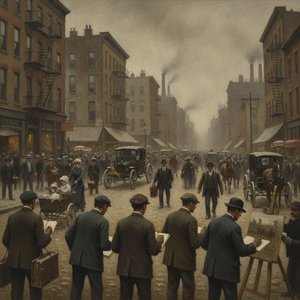
Discover the raw beauty of the Ashcan School. Explore how masters like Bellows and Henri captured the gritty, vibrant soul of early 20th-century New York through profound American Realism and evocative urban landscapes.


第一时间获取最新的艺术新闻、独家优惠及装饰灵感。
向我们介绍您的项目需求,我们的艺术专家将为您提供 3 个个性化的艺术品推荐。
由我们的专家为您精选 3 款心仪之作 —— 完全免费!


 效果预览
效果预览
 切换至手工绘画版
 分享
分享 分享
分享
 详情
详情

 下载
下载
 相似作品
相似作品 X射线
X射线 幻灯片播放
幻灯片播放


 展开详情
展开详情









 玻璃选项仅适用于110厘米以下的尺寸。


