
 1800
1800 8.0 x 14.0 cm
 Manx National Heritage
从与原作比例一致的预设尺寸中进行选择。

您可以输入自定义尺寸,以适配特定的画框或空间。如果您选择的尺寸与原图比例不符,我们将对作品进行裁剪,或通过镜像填充/纯色填充边缘的方式来扩展图像。在开始制作之前,我们会向您发送一份数字效果图供您确认。
请注意,屏幕上的预览并不能反映实际的裁剪或扩展效果。只有效果图才能准确展示最终的构图。
虽然我们提供定制尺寸,但为了保持原图比例,我们建议您从预设列表中选择尺寸。

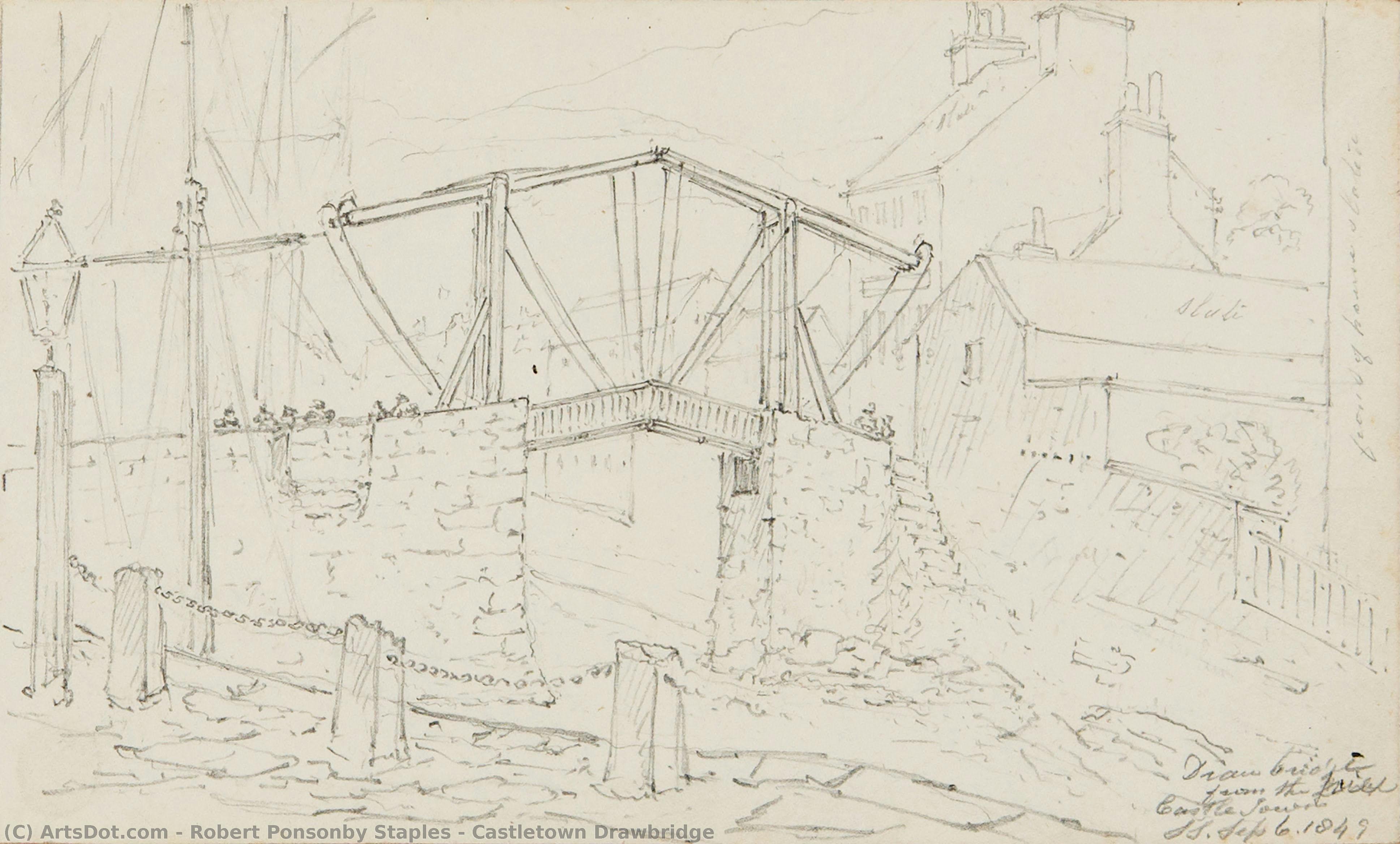
Castletown Drawbridge
复制品尺寸
In the grand tapestry of British and Irish art, few figures possess a thread as colorful or as unconventional as Robert Ponsonby Staples. Known to many as the "barefoot baronet," Staples was a man whose very existence seemed to defy the rigid social structures of the Edwardian era. Born in Dundee, Scotland, in 1853, he carried with him a spirit of profound eccentricity that would later define his artistic persona. His most famous quirk—the refusal to wear shoes due to a conviction that leather soles blocked the vital electrical currents of the earth—was not merely a personal oddity but a reflection of a life lived in constant, tactile connection with the world around him. This sensory intimacy with nature likely informed the meticulous textures and atmospheric depths found within his most celebrated works.
Staples’ journey toward artistic mastery began far from the rolling hills of Ireland. His early education was marked by a rigorous pursuit of architectural precision, studying at the Catholic University of Leonardo in Belgium. This foundational training in structure and spatial relationships provided him with a unique advantage; while his heart sought the ephemeral beauty of light and landscape, his hand possessed the disciplined ability to render the permanence of stone and the complexity of historical architecture. Following his studies, his travels through Dresden, Paris, and London allowed him to absorb the diverse artistic currents of Europe, eventually leading him to settle in Ireland in 1879 at Lissan House, near Cookstown, County Tyrone.
It was within the verdant landscapes of Ireland and the rugged coasts of the Isle of Man that Staples truly found his voice. His paintings were far more than mere topographical records; they were emotional evocations of a vanishing era. He possessed an uncanny ability to capture the spirit of place, whether through the shimmering, heavy textures of a peat bog or the formidable, weathered granite of Ramsey Head. In works such as "From Our Sitting Room," one can sense his dedication to a realism that does not sacrifice intuition, allowing the viewer to feel the dampness of the Irish air and the shifting light of a maritime afternoon.
Beyond the quietude of nature, Staples was also a chronicler of human industry and historical grandeur. His repertoire extended into the monumental and the social, capturing the rhythmic labor of rural life and the patriotic fervor of his time. Notable achievements include:
The historical significance of Robert Ponsonby Staples lies in his ability to bridge the gap between the disciplined precision of the architectural tradition and the emotive freedom of late 19th-century landscape painting. He moved seamlessly between the high society of Edwardian London—frequenting the famous Café Royal alongside luminaries like Sir William Orpen—and the humble, mud-streaked fields of Ulster. This duality allowed him to document both the grandeur of the British Empire and the intimate, hardworking soul of the Irish countryside.
Though his life ended in 1943, leaving behind a legacy as much defined by his character as by his canvas, Staples remains a vital figure for those studying the intersection of eccentricity and artistry. He reminds us that true observation requires more than just sight; it requires a willingness to strip away the layers of societal convention—sometimes quite literally—to touch the very essence of the subject being painted. His work stands as a testament to a man who saw the world not through the barrier of leather, but through a direct, unmediated connection to the earth and its many stories.

1853 - 1943


第一时间获取最新的艺术新闻、独家优惠及装饰灵感。
向我们介绍您的项目需求,我们的艺术专家将为您提供 3 个个性化的艺术品推荐。
由我们的专家为您精选 3 款心仪之作 —— 完全免费!

 效果预览
效果预览
 购买手绘画作
 分享
分享 分享
分享
 详情
详情

 下载
下载
 相似作品
相似作品 X射线
X射线 幻灯片播放
幻灯片播放 展开详情
展开详情






































 玻璃选项仅适用于110厘米以下的尺寸。


