藏品详情
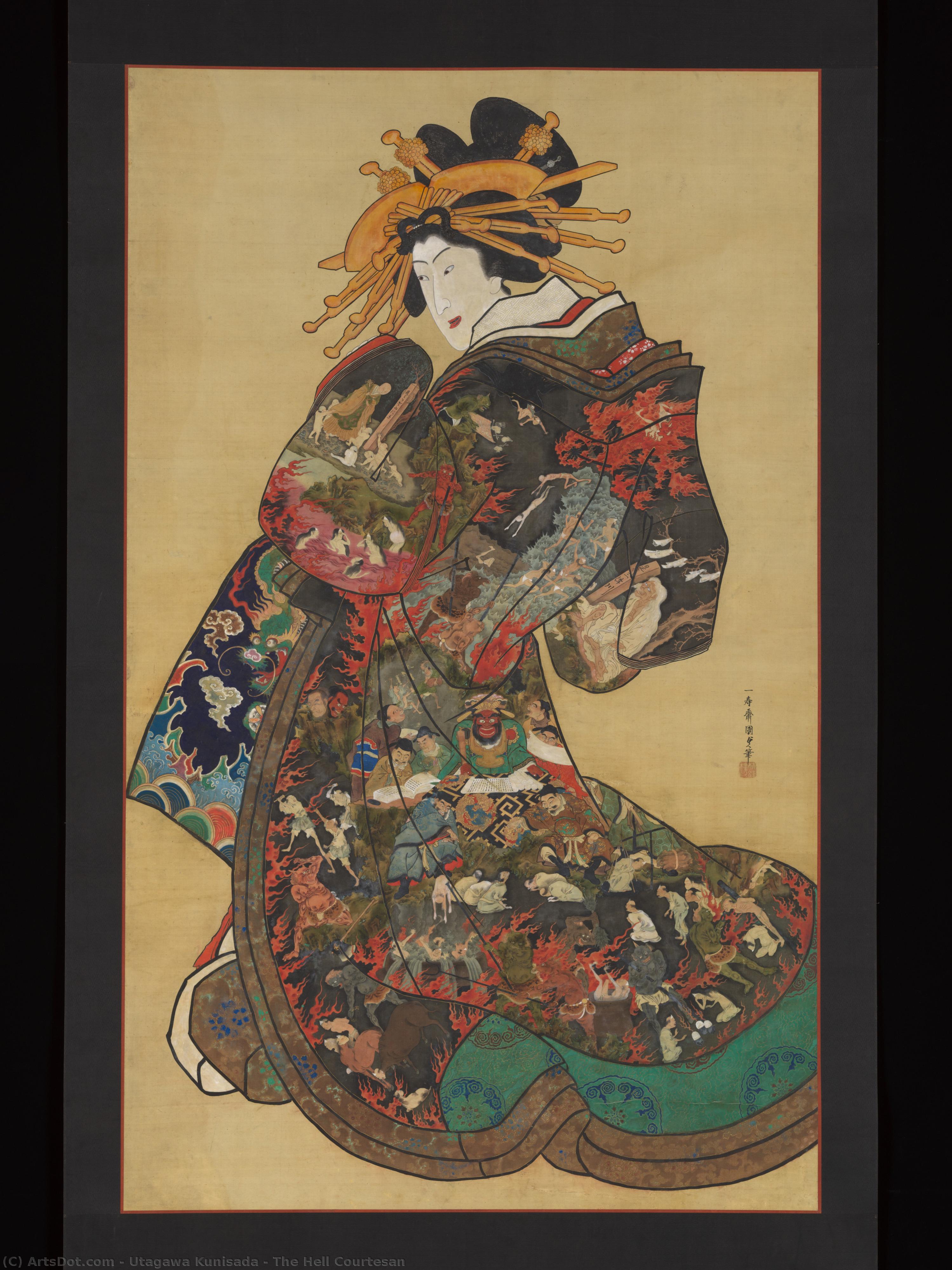
This dazzling, nearly life-size, portrayal of a courtesan commands our attention because of the sumptuously patterned robes showing gory scenes of the Buddhist hell, presided over by Enma-ō, a wrathful god in Buddhism who judges the dead and presides as the King of Hell. Seated on throne, he is surrounded by seven of his judges while he reviews and records the misdeeds of the recently deceased, some of whom are prostrated in terror before him. Surrounding the central image of King Enma’s court are gory scenes of punishments of hell with demons presiding over sinners being variously tortured, burnt, and boiled.The subject is a woman of medieval times in Japan who worked in the Takasu district of Osaka and who was known as the Hell Courtesan, (Jigoku Dayū). Jigoku, literally “hell,” was also a term referring to unlicensed courtesans, while tayū (read dayū in combination with jigoku) was the term for the highest-ranking courtesan. In this portrayal, the woman’s high status is recognizable through her ornate hair adornments and luxurious, layered garments. Jigoku is said to have achieved redemption through an encounter with the fifteenth-century Zen monk Ikkyū (1394–1481), son of an emperor and forty-seventh abbot of the great Rinzai Zen temple Daitokuji in Kyoto. Although one of most venerable monks in the history of medieval Buddhism, Ikkyū was notorious for pursuing the path of enlightenment while enjoying the sensual pleasures of drink and cavorting with prostitutes. He mocked the hypocrisy of other monks who adopted a holier-than-thou attitude. According to legend, on his first encounter with Jigoku, he composed the opening stanza of a linked verse (renga):Kikishi yorimite osoroshikiJigoku kanaThough I had heardall about “Hell,”seeing the real thing—more daunting still!The Hell Courtesan"s beauty was osoroshiki, which can mean “frightening.” as in the case of the Buddhist hell, or “daunting,” to describe the attractions of this femme fatale. Jigoku, a woman of many talents, immediately improvised the final stanza:Iki-kuru hito moochizarameyawaEven the living who draw nearcannot but fall into the abyss!(Trans. John T. Carpenter)By cleverly alluding to men who are ensnared by the beauty of courtesans, Jigoku revealed herself already enlightened in a worldly sense, and Monk Ikkyū was to direct her on the path to spiritual redemption. The apocryphal story was updated by the popular writer and ukiyo-e artist Santo Kyōden (Kitao Masanobu, 1761–1816) in Stories of drunken enlightenment in Japan (Honchō suibodai zenden), illustrated by Utagawa Toyokuni and published in 1809. This book inspired numerous nineteenth-century paintings of the Hell Courtesan including by prominent artists Kuniyoshi, Kunichika, and at the fin-de-siecle, by Kawanabe Kyōsai. The story was even more widely popularized when the play Ikkyū’s Tale of Hell (Ikkyū jigoku banashi) by the leading Kabuki dramatist, Kawatake Mokuami (1816–1893), was performed at the Ichimura theater in Tokyo in 1865. Actor prints commemorating the play, including one by Kunisada II, circulated widely. In the Kabuki version of events, Ikkyū enters a brothel and meets the courtesan Jigoku. As he dances with women in the brothel Jikoku peeps from behind a screen and to her astonishment sees that Ikkyū’s voluptuous companions have shriveled to their bare bones. The vision of dancing skeletons vanishes when she rejoins the group, but still viewers were reminded of the underlying Buddhist truth that beneath even the most glamorous facade lurks inevitable old age and death. In the play, Jigoku finds enlightenment with this graphic demonstration of human impermanence.

 1850
1850 165.0 x 101.0 cm





 效果预览
效果预览
 切换至手工绘画版
 分享
分享 分享
分享
 详情
详情

 下载
下载
 相似作品
相似作品 X射线
X射线 幻灯片播放
幻灯片播放 展开详情
展开详情






































 玻璃选项仅适用于110厘米以下的尺寸。


