
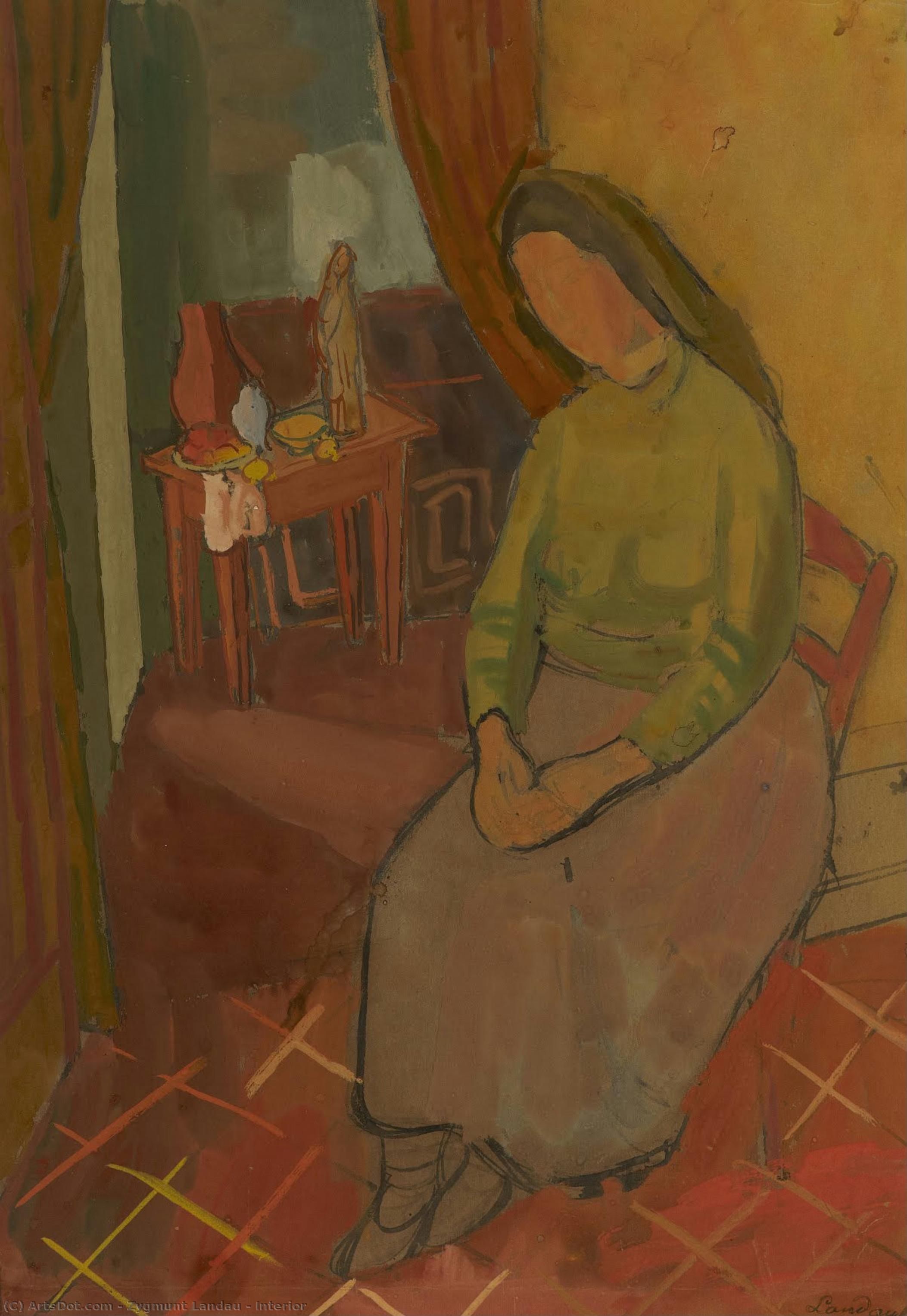
 65.0 x 49.0 cm
 Ben Uri Gallery and Museum
从与原作比例一致的预设尺寸中进行选择。

您可以输入自定义尺寸,以适配特定的画框或空间。如果您选择的尺寸与原图比例不符,我们将对作品进行裁剪,或通过镜像填充/纯色填充边缘的方式来扩展图像。在开始制作之前,我们会向您发送一份数字效果图供您确认。
请注意,屏幕上的预览并不能反映实际的裁剪或扩展效果。只有效果图才能准确展示最终的构图。
虽然我们提供定制尺寸,但为了保持原图比例,我们建议您从预设列表中选择尺寸。

Interior
复制品尺寸
Maurits Cornelis Escher (1898-1972) remains one of the most singularly inventive and enduring figures in the history of graphic art. More than simply a printmaker, he was a mathematician, a visual explorer, and a master of illusion who challenged our perceptions of space, time, and infinity. His work, initially largely ignored by the mainstream art world, has since achieved global recognition, captivating audiences with its intricate beauty and profound conceptual depth. Escher’s legacy lies not just in his stunningly detailed images but in his ability to translate complex mathematical principles into accessible and mesmerizing visual experiences.
Born in Leeuwarden, Netherlands, into a family of teachers, Escher's artistic inclinations manifested early. He initially pursued architecture at the Haarlem Academy of Fine Arts, but quickly realized that his passion lay in the realm of graphic art. His early work reflected a fascination with nature – meticulous studies of insects, landscapes, and lichens – all meticulously rendered with an almost obsessive attention to detail. These observations would later inform the intricate tessellations and geometric patterns that became hallmarks of his mature style. A pivotal moment came during travels in Italy and Spain, particularly his visits to the Alhambra palace in Granada and the Mezquita-Cathedral of Córdoba. The complex geometries and repeating tilework of these historic structures ignited a lifelong interest in tessellation – the art of covering a surface with identical shapes without gaps or overlaps – which would become central to his artistic explorations.
Escher’s work is deeply rooted in mathematics, yet he never considered himself a mathematician. Instead, he engaged in a collaborative dialogue with leading mathematicians like George Pólya, Roger Penrose, and Donald Coxeter, seeking to understand the underlying principles that governed his visual creations. He was particularly drawn to concepts such as infinity, perspective, symmetry, and impossible objects – forms that appear to defy the laws of physics but are logically consistent within their own constructed realities. His mastery of printmaking techniques—woodcuts, lithographs, and mezzotints—allowed him to execute these complex designs with remarkable precision and subtlety. He wasn’t simply reproducing images; he was actively manipulating them, creating visual paradoxes that forced the viewer to reconsider their assumptions about how things work.
While Escher resisted being labeled a Surrealist, his work shared many affinities with the movement’s emphasis on dreamlike imagery and subconscious exploration. His meticulous attention to detail and his ability to create unsettling yet captivating visual experiences resonated with the Surrealists' interest in challenging conventional perceptions of reality. Following World War II, Escher’s art began to gain wider recognition, partly through the influence of Martin Gardner, a popular science writer who featured Escher’s work in his *Mathematical Games* column in *Scientific American*. This exposure helped to introduce Escher’s unique vision to a broader audience and cemented his place as a significant figure in 20th-century art.
Today, Maurits Cornelis Escher is celebrated worldwide for his extraordinary artistic ingenuity and his ability to seamlessly blend mathematics, art, and illusion. His work continues to inspire artists, mathematicians, and designers alike, demonstrating the power of visual communication to explore complex ideas and challenge our perceptions of the world. Escher’s legacy extends far beyond the realm of fine art; his images have been used in everything from architecture and design to computer graphics and animation, proving that his exploration of impossible worlds remains remarkably relevant in the 21st century.
Further resources can be found on The Official M.C. Escher Website and through extensive documentation available at Wikipedia’s entry on M.C. Escher.

1898 - 1962 , Poland


第一时间获取最新的艺术新闻、独家优惠及装饰灵感。
向我们介绍您的项目需求,我们的艺术专家将为您提供 3 个个性化的艺术品推荐。
由我们的专家为您精选 3 款心仪之作 —— 完全免费!

 效果预览
效果预览
 购买手绘画作
 分享
分享 分享
分享
 详情
详情

 下载
下载
 相似作品
相似作品 X射线
X射线 幻灯片播放
幻灯片播放 展开详情
展开详情






































 玻璃选项仅适用于110厘米以下的尺寸。


