Early Life, Family and Training
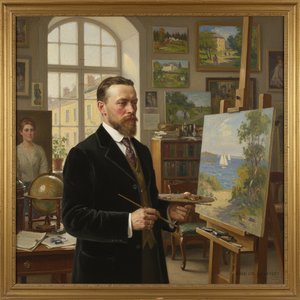
Born on October 4, 1855, in Skibby Parish, Alexander Wilde entered a world shaped by both maritime tradition and intellectual rigor. He was the son of Ida Thiele and the naval officer Otto Alexander Klemme Wilde. This lineage provided a foundation of discipline and social standing that would follow him into his adult life. While his later years would be defined by the brush and the pastel, his early path was directed toward the complexities of the law. He pursued his studies with diligence, eventually graduating with a cand.jur. from the University of Copenhagen in 1880.
His domestic life was intertwined with the cultural fabric of Denmark through his marriage to Johanne Wilde, who was born Købke. This union connected him to a lineage of significant artistic presence, as Alexander Wilde would eventually become the uncle of the painter Harald Giersing. Such familial ties suggest a life where the boundaries between the legal profession and the creative impulse were constantly in conversation. He moved through the world of officials and scholars, yet the seeds of his visual sensitivity were already present in his upbringing.
Professional Career and Artistic Emergence
While his brush captured the nuances of light, Alexander Wilde’s daily life was governed by the steady duties of a civil servant. He began his professional path within the Ministry of Finance, a role that demanded a structured mind quite different from the creative impulses of his studio. This administrative life took him across the Danish landscape as he moved into higher positions of responsibility. From 1892 to 1897, he served as the county administrator on Møn, and he continued this path of public service in Randers Amt until 1924.
His sudden arrival upon the art scene was as unexpected as it was impactful. He did not emerge through a slow, predictable climb, but rather through a striking presence that caught the attention of the era's most discerning eyes. In 1888, he was chosen to represent the youngest generation of Danish art at Den Nordiske Industri-, Landbrugs- og Kunstudstilling. This recognition signaled that his talent could not be contained by his official duties. His ability to translate the world onto canvas earned him further prestige when he was selected to participate in the Raadhusudstillingen in 1901.
Technique and Artistic Style
Wilde possessed a keen eye for the subtle interplay of light and the way coloristic shadows could transform a scene. He sought to capture the shifting nuances of illumination, a pursuit that found its most profound expression through the medium of pastel. In these works, he developed a lyrical sensitivity that allowed him to navigate the delicate balance between the medium's inherent softness and its capacity for precision. He moved through the medium with a certain security, demonstrating a deep understanding of both the expansive possibilities and the strict limitations that pastel imposes upon the hand.
This mastery of pastel stood in contrast to his approach to other mediums. While his pastels possessed a certain freshness, his oil paintings did not quite reach that same level of vitality. There was a distinct difference in the spirit of his brushwork when he moved away from the dry, powdery grace of his preferred technique. He seemed most at home when working with the light-catching qualities of the pastel, where his ability to manipulate color and shadow could truly flourish.
问答详情
在哪里可以按氛围浏览 Alexander Wilde 的作品?
您可以在艺术家 Alexander Wilde 的 情境空间 页面上按心情浏览其作品,该页面已根据作品所传达的情绪进行了分类整理。
如何按特定媒介查找 Alexander Wilde 的所有作品?
所有媒介 页面按媒介分类展示了 Alexander Wilde 的作品。
如何按特定主题查找 Alexander Wilde 的作品?
您可以通过艺术家关键词分类页面,按关键词探索Alexander Wilde的作品。每个关键词都汇集了相关的艺术品。
Alexander Wilde 的创作时期属于哪个历史阶段?
Alexander Wilde 的创作活跃于 19th Century 时期,这一时期确立了艺术家在艺术史上的地位。