The Life and Training of Alfred Olsen
Born on September 23, 1854, in the small Danish island of Fejø, Alfred Olsen began his life far from the bustling streets of the capital. His early years in this maritime setting likely instilled in him a deep familiarity with the rhythms of the sea and the shifting light of the Danish coast. This connection to the water would eventually define his professional life, as he grew into a dedicated marine painter who sought to capture the essence of the ocean and its surrounding landscapes.
His formal development as an artist took place under the guidance of Jens J. Jensen-Egeberg. Through this mentorship, Olsen learned to translate the movement of waves and the atmosphere of the coast onto canvas. He moved beyond simple sketches to master the nuances of oil on canvas, developing a way of seeing that focused on the specificities of light and weather. His training provided him with the technical foundation necessary to document the maritime life of Denmark with precision and sensitivity.
As his career progressed, Olsen became a fixture in the artistic circles of his country. He spent much of his time observing the natural world, often traveling to coastal regions to find his subjects. He remained active in his craft until his death in Copenhagen on October 30, 1932. His life was a steady devotion to the study of the sea, a pursuit that began in the quietude of Fejø and continued through his many years as a painter of the Danish coast.
Artistic Specialization and Coastal Landscapes
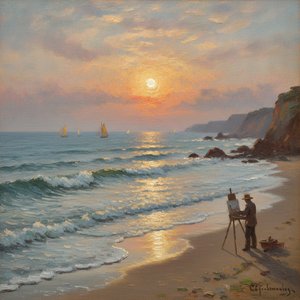
Olsen found his true calling in the restless movement of the sea and the shifting moods of the Danish coast. He turned his gaze toward maritime motifs, seeking to capture the essence of the water and the land that meets it. His brush was drawn repeatedly to the specific textures of the shoreline, finding deep inspiration in the salt-sprayed landscapes of Skagen and his birthplace, Fejø. These locations provided him with a constant study of how the elements interact, allowing him to focus his efforts on the subtle nuances of the Danish coast.
The true soul of his work lay in the way he handled the changing light and the unpredictable weather. He possessed a keen eye for the atmosphere, recording how a sudden cloud or a shift in the wind could transform a quiet bay into a scene of tension. His paintings do not merely depict a place, but rather the very air and light that inhabit it. He sought to translate the fleeting sensations of a calm day at sea or the heavy atmosphere of a coastal evening onto the canvas, making the invisible qualities of the weather visible to the viewer.
Notable Works and Subjects
Olsen possessed a keen eye for the shifting moods of the Danish shoreline, often returning to the same stretches of coast to capture the interplay of light and salt. In 1886, he turned his attention to a coastal area from Hornbæk, recording the scene with a steady hand. His brush frequently sought out the quiet details left behind by the tide, such as scattered driftwood resting upon the sand. He found a particular rhythm in the way the sea met the land, often placing a faintly visible windmill on the distant horizon to provide a sense of scale and human presence against the vastness of the sky.
The artist’s fascination with the dunes led him to compose landscapes like the one at Nymindegab, Blåbjerg, where the undulating earth meets the elements. He was drawn to the atmospheric qualities of the coast, whether he was painting a calm coastal landscape around 1900 or observing the more rugged textures of the dunes. His work often centered on the sea itself, capturing the way water and wind transformed the landscape. Through these studies, he documented the specific character of the Danish coast, from the sandy expanses of Blåbjerg to the salt-sprayed reaches of Hornbæk.
问答详情
Alfred Olsen 的创作时期属于哪个历史阶段?
Alfred Olsen 的创作活跃于 19th Century 时期,这一时期确立了艺术家在艺术史上的地位。
目前目录中共有多少件 Alfred Olsen 的作品可供浏览?
您可以在 全部作品 页面浏览由 Alfred Olsen 创作的 6 件作品 件作品。
Alfred Olsen 出生于何时何地?
Alfred Olsen 于 1854 出生于 Fejø。
我可以通过色谱来探索 Alfred Olsen 的作品吗?
您可以在Alfred Olsen的色彩索引页面上按色彩探索其作品。