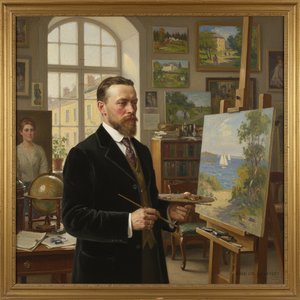
The Life and Academic Career of Ferdinand Pauwels
Ferdinand Pauwels was a Belgian history painter who lived and worked in Germany. His formal training began between 1842 and 1850 at the Royal Academy of Fine Arts in Antwerp, where he studied under Gustave Wappers and Nicaise De Keyser, developing his skills as an outstanding colorist. In 1852, he was awarded the Prix de Rome for Belgium for his painting Coriolanus at Rome, which allowed him to spend four years studying in Italy.
His career included significant academic roles, serving as the Professor of History Painting at the Weimar Saxon-Grand Ducal Art School from 1862 to 1872. During this productive period, he completed seven large wall panels at the Wartburg depicting the life of Martin Luther. Later, he became a professor at the Dresden Academy of Fine Arts, where he taught students such as Ludwig von Hofmann, Osmar Schindler, Paul Thumann, and Oskar Zwintscher.
Major Works and Historical Commissions
Pauwels is noted for several large-scale historical commissions. In addition to his work at the Wartburg, he executed six large historical wall panels at the Fürstenschule in Meissen. Between 1870 and 1881, he produced what was considered his greatest work: twelve frescoes in the upper part of the Ypres Cloth Hall. These frescoes, which depicted scenes from the history of Ypres from 1187 to 1383, were left incomplete by Charles de Groux. While most of the Cloth Hall and these frescoes were destroyed during World War I, the city of Ypres eventually acquired six of his paintings for its Municipal Art Museum.
问答详情
在哪里可以参观Ferdinand Pauwels作品的3D虚拟展厅?
Ferdinand Pauwels 的 3D 艺术展厅 可以在虚拟三维展厅中欣赏到艺术家的作品。
是否有关于Ferdinand Pauwels所创作的所有主题的概览?
Ferdinand Pauwels 的 主题索引 旨在通过主题对艺术家的作品进行分类索引。
Ferdinand Pauwels 的艺术生涯是如何划分为不同时期的?
Ferdinand Pauwels 的艺术生涯在 艺术历程 页面上按时期逐一展开:以横向时间轴的形式呈现作品,并按创作时期划分为不同的篇章。