The Maritime Vision of Jules Vernier
In the quiet, salt-sprayed corners of late nineteenth-century France, the works of Jules Vernier emerged as a profound meditation on the relationship between humanity and the sea. Born in 1862, Vernier belonged to a generation of artists who sought to capture the fleeting atmospheric shifts of the coast, finding poetic resonance in the rhythmic movement of tides and the sturdy silhouettes of maritime life. His era was one of transition, where the traditional weight of academic painting began to yield to a more sensory, impressionistic appreciation for light and motion. Through his eyes, the bustling ports of France were not merely sites of commerce, but stages for a dramatic interplay between the elements and the vessels that braved them.
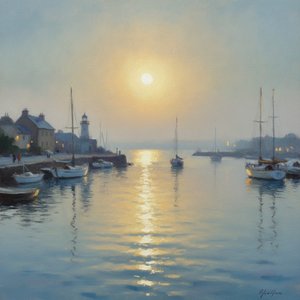
Vernier’s artistic journey is most vibrantly felt in his depictions of French maritime landscapes, particularly around regions like Finistère. His canvases often transport the viewer to the Port de Conquet, where he meticulously rendered the intricate details of boats under repair or sailing through the harbor. There is a palpable sense of atmosphere in his work; one can almost feel the dampness of the coastal air and hear the creaking of wooden masts. By focusing on subjects such as fishing boats, sailing vessels, and the inner harbors of Le Havre, he elevated the mundane activities of maritime labor into something timeless and monumental.
Technique and Atmospheric Mastery
The brilliance of Vernier’s technique lies in his ability to balance structural precision with an evocative, painterly touch. While his compositions often possess a clear, observational clarity—notably in his depictions of Venice or the trading vessels within its lagoons—he never allowed the technicality of form to overshadow the emotional weight of the scene. His use of light serves as the primary protagonist in many of his paintings, casting long shadows across docks and illuminating the translucent surfaces of water. This mastery of light allows him to capture the specific "mood" of a location, whether it be the bright, midday clarity of a summer harbor or the brooding, overcast tension of a storm-tossed coast.
His development as an artist saw him navigating various nuances of the landscape genre:
- The Port Life: A deep fascination with the structural beauty of ships and the organized chaos of busy harbors.
- Atmospheric Perspective: The use of soft edges and tonal shifts to create a sense of depth and distance across the sea.
- Maritime Realism: An unwavering commitment to capturing the authentic textures of wood, rope, and weathered hulls.
Legacy and Historical Resonance
Though the specific details of his personal life remain as veiled as a morning mist over the Atlantic, Jules Vernier’s legacy is firmly etched in the annals of French maritime art. His work serves as a vital historical record of a bygone era of seafaring, preserving the visual essence of ports that have since been transformed by modernity. To look upon a Vernier painting is to engage in a dialogue with history, witnessing the enduring strength of the maritime spirit through his brushstrokes. His contributions continue to resonate within the art market and among collectors, standing as a testament to the enduring power of the sea as an infinite source of artistic inspiration.
问答详情
在哪里可以找到关于Jules Vernier作品的相关统计数据?
有关 Jules Vernier 作品的统计数据,请参阅艺术家的 统计数据 页面。
是否有Jules Vernier作品的3D虚拟展厅巡览?
您可以在Jules Vernier的3D 艺术展厅页面中,通过3D展厅欣赏其艺术作品。
Jules Vernier 的创作时期属于哪个历史阶段?
Jules Vernier 的创作活跃于 19th Century 时期,这一时期确立了艺术家在艺术史上的地位。
可以按媒介类型浏览 Jules Vernier 的作品吗?
若要查找Jules Vernier在特定媒介下的所有作品,请访问艺术家的所有媒介页面。