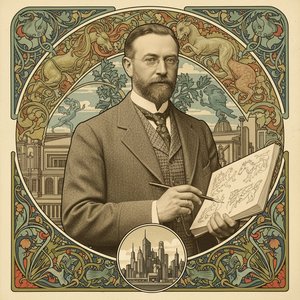
The Life and Background of Macneil Macleay
To understand the weight of Macneil Macleay’s contribution to Scottish landscape painting, one must look at the specific social and geographic origins that shaped his perspective. Born in 1806 in Perthshire, Scotland, Macneil Macleay was the son of Robert Macleay, a diplomat and prominent landowner, and Elizabeth Sutherland. This lineage provided a foundation of stability and access to the very landscapes he would later spend his life documenting. He did not emerge from a vacuum; his upbringing in the Scottish countryside provided the direct visual data that fueled his later output.
His development as an artist was shaped by a specific set of influences rather than formal academic instruction. Macneil Macleay drew heavily from the Romantic movement, specifically the approaches taken by painters like Turner and Constable. This influence is evident in his focus on atmospheric conditions and the emotional weight of the natural world. He moved away from mere topographical recording to capture the specific mood of the Highlands. By the time of his death in 1883, he had established a visual language that prioritized the character of the terrain over rigid, clinical detail.
Artistic Technique and Visual Style
Macleay’s approach to the landscape was defined by a commitment to Luminism. Rather than relying on sharp, hyperrealistic lines, he prioritized atmospheric perspective and tonal gradation to establish mood. This method allowed him to move beyond mere topographical recording, focusing instead on how light interacts with the Scottish environment. His brushstrokes remained deliberate yet understated, avoiding the heavy-handedness found in more aggressive Romantic works. By softening outlines and blurring edges, he achieved an ethereal quality that emphasizes the weight of the air and the shifting nature of light over the physical solidity of the terrain.
Watercolor was his primary medium, a choice that dictated his technical execution. He achieved depth and luminosity through the painstaking layering of washes. This process required a disciplined control of moisture and pigment to build up the subtle transitions necessary for his depictions of lochs and mountains. His ability to manipulate these layers allowed for a sense of dimensionality that remains technically impressive. The resulting works do not demand attention through frantic movement but through a controlled, quiet intensity of color and light.
Notable Landscapes and Key Works
Macleay’s output was prolific, totaling over 300 paintings that document the shifting light of the Scottish landscape. His early focus on the Perthshire region established a technical foundation that would define his career. In works like The South Inch, Perth and A View on the River Tay at Perth Looking South, both dated about 1842, he demonstrated an early ability to handle the specific atmospheric conditions of the Tay valley. These compositions move beyond mere topographical recording to capture the specific character of the river and its surrounding terrain.
As his career progressed, his subjects became more structurally complex. Perth from Barnhill, dated about 1852, shows a refined command of perspective and distance. By 1876, his work had reached a peak of compositional strength with two significant subjects: Stirling Castle and Loch Awe. The latter depicts a castle situated on a mountain overlooking a serene lake, with boats providing a sense of scale and movement on the water's surface. These later works rely on a precise understanding of how light interacts with geological formations and water to create depth.
- Castle Campbell (undated)
- Highland Landscape (undated)
- River by a Town (undated)
Legacy and Where to See His Works
Macneil Macleay’s influence is cemented by his role in establishing Luminism as a dominant aesthetic within British art. He moved landscape painting away from mere topographical recording toward a focus on light and atmospheric effect. This shift changed how British artists approached the depiction of mood and environment. His technical approach to color and light remains a significant point of study for those examining the development of 19th-century landscape traditions.
His surviving body of work is distributed across several key Scottish institutions. The National Galleries Scotland holds a significant portion of his output, ensuring his contribution to the national canon remains accessible. For those studying his specific regional focus, the Perth Museum & Art Gallery and The Stirling Smith Art Gallery - Museum house important examples of his paintings. These collections provide the necessary context to understand his command over the Scottish landscape. Additionally, the National Trust For Scotland, Maybole, maintains his work Castle Campbell, preserving a specific piece of his visual record.
问答详情
在哪里可以按主题查看Macneil Macleay的作品分布?
Macneil Macleay 的 主题索引 旨在通过主题对艺术家的作品进行分类索引。
哪里可以浏览Macneil Macleay的所有作品?
您可以在 Macneil Macleay 的 全部作品 页面上浏览其在 本站 上的所有作品。
是否有关于 Macneil Macleay 的生平年表?
您可以在艺术家的 艺术历程 页面上查阅 Macneil Macleay 作品的编年史,其作品按创作顺序分章节依次呈现。
Macneil Macleay 是否还有其他别名或曾用名?
Macneil Macleay 也以 James Macneil Macleay 等其他名称为人所知。