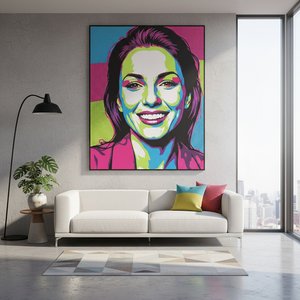
A Striking Exploration of Identity & The Human Form
This captivating work by
Andy Warhol presents a powerfully unsettling portrait that moves beyond simple representation. Rooted in both Pop Art and Surrealist traditions, it possesses a uniquely clinical yet emotionally detached quality. The composition immediately draws the viewer into a complex consideration of identity, observation, and perhaps even societal dissection through its bold division between a partially rendered female face and a regimented series of geometric faces arranged linearly in the background.
Style & Technique: Beyond Silkscreen
Warhol’s signature Pop Art aesthetic is readily apparent – flattened perspective, expressive color application, and simplified forms are all present. However, this piece notably diverges from his celebrated silkscreen prints. The visible brushstrokes suggest a hand-painted acrylic on canvas technique, lending the work an intimate textural quality that contrasts with its cool subject matter. The prominent lines aren’t merely descriptive; they function as analytical tools, outlining facial features and anatomical diagrams with equal precision. This fusion of portraiture and scientific illustration is central to understanding the artwork's unsettling power.
Symbolism & Interpretation: Deconstructing Perception
The inclusion of anatomical details – hinting at dissection or clinical study – is profoundly impactful. It prompts questions about how we perceive and categorize the female form, suggesting objectification and a reduction of personality to biological components. The obscured nature of the central figure’s face further emphasizes this sense of alienation and detachment. Are we viewing a woman, or an *idea* of a woman? The background faces, arranged like specimens, reinforce this feeling of observation and categorization. They aren't traditional portraits; they are fragments – building blocks of identity stripped bare.
Historical Context: Warhol & The Manufactured Image
Emerging in the 1960s, Andy Warhol challenged conventional art norms by embracing popular culture and mass production techniques. Fascinated by celebrity, consumerism, and image construction, he explored how identity is manufactured, consumed, and deconstructed in modern society. While this work doesn’t depict a recognizable face like Marilyn Monroe or Elizabeth Taylor, it shares their underlying concern. The clinical approach here can be interpreted as commentary on the increasingly mediated nature of experience – we often encounter representations *of* people rather than genuine connection.
Emotional Impact & Interior Design
This artwork isn’t intended to offer comfort; it evokes unease, prompting viewers to confront challenging questions about perception and identity. Its starkness and geometric precision make it a powerful statement piece. In an interior design context, this work is best suited for modern or contemporary spaces where its bold aesthetic can take center stage. The limited color palette allows integration into various schemes, but the impact is strongest against neutral backgrounds that emphasize its graphic quality. It’s a conversation starter – perfect for those seeking art with intellectual depth and emotional resonance.
Key Features
- Artist: Andy Warhol (1928-1987)
- Medium: Acrylic on Canvas (presumed based on visible brushstrokes)
- Style: Pop Art, Surrealism
- Themes: Identity, Objectification, Perception, Modern Society
- Emotional Tone: Unsettling, Clinical, Detached, Thought-Provoking



 اطلب نسخة مرسومة يدوياً
 مشاركة
 مشاركة
 التفاصيل

 تحميل الملف
 قطع مشابهة
 الأشعة السينية
 عرض شرائح

 عرض المزيد






































 خيار الزجاج متاح فقط للمقاسات التي تقل عن 110 سم