A Vision of Turbulent Emotion
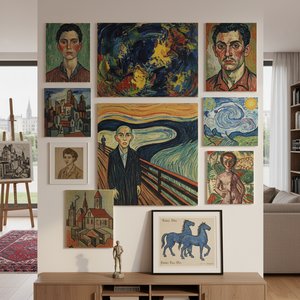
“Untitled (8851)” by Edvard Munch stands as a cornerstone of Expressionism, encapsulating the profound psychological anxieties that gripped Europe at the turn of the century. Painted in 1894, this oil on canvas depicts a serene coastal landscape—a deceptively tranquil façade concealing an inner turmoil that defines Munch’s artistic legacy.
The scene unfolds with muted hues of grey and ochre dominating the palette, mirroring the pervasive melancholy characteristic of Munch's oeuvre. Two boats glide across the calm waters, their presence juxtaposed against a backdrop of gently sloping hills dotted with houses—a deliberate contrast intended to heighten the sense of unease. Above them, a solitary bird ascends into the sky, symbolizing fleeting hope amidst overwhelming dread.
Technique and Composition: Capturing Inner States
Munch’s masterful brushstrokes convey an immediacy that transcends mere representation; they embody emotion itself. Thick impasto creates textural surfaces that ripple with movement, mirroring the turbulent currents of feeling beneath the surface. The artist employs a technique reminiscent of Symbolism, prioritizing emotional resonance over literal accuracy—a conscious decision to communicate psychological states rather than visual impressions.
The composition is carefully balanced yet unsettling. The boats serve as anchors for the eye, grounding the viewer in the physical world while simultaneously directing attention upwards towards the bird and the expansive sky. This upward gaze symbolizes aspiration but also vulnerability—a yearning for transcendence tempered by awareness of mortality.
Symbolism and Emotional Resonance
“Untitled (8851)” is laden with symbolic significance, reflecting Munch’s preoccupation with themes of isolation, fear, and existential dread. The muted colors contribute to the overall atmosphere of gloom, reinforcing the painting's emotional core. The bird’s flight represents a fragile attempt at escape from darkness—a poignant reminder of humanity’s struggle against despair.
Furthermore, Munch’s depiction of a human figure positioned in the foreground adds another layer of complexity. This solitary presence embodies vulnerability and contemplation, gazing out towards the horizon with an expression that conveys both serenity and apprehension. The painting's impact is undeniable—it compels viewers to confront their own anxieties and grapple with questions about life’s inherent uncertainties.
A Legacy of Psychological Depth
“Untitled (8851)” remains a powerful testament to Munch’s artistic genius and his ability to translate inner experience into visual form. Its enduring appeal lies in its capacity to evoke profound emotions—fear, melancholy, hope—and to provoke contemplation on the human condition. As a reproduction, it allows admirers of Munch's work to immerse themselves in this seminal masterpiece, experiencing firsthand the artist’s masterful exploration of psychological depth.



 Preview
 اطلب نسخة مرسومة يدوياً
 مشاركة
 مشاركة
 التفاصيل

 تحميل الملف
 قطع مشابهة
 الأشعة السينية
 عرض شرائح
 عرض المزيد






































 خيار الزجاج متاح فقط للمقاسات التي تقل عن 110 سم