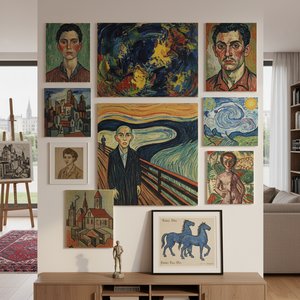
The Brother – An Exploration of Vulnerability and Mortality
Egon Schiele’s “The Brother,” painted in 1911, stands as a poignant testament to the artist's preoccupation with themes of intimacy, loss, and the inescapable confrontation with death—a characteristic hallmark of Expressionist art. This arresting watercolor depicts two figures seated closely together, their faces turned towards each other in an unspoken exchange of gaze. The man’s posture exudes quiet contemplation, while his eyes are fixed on the woman beside him who is enveloped in repose.
- Subject Matter: The painting centers around a pair of individuals—likely Schiele’s wife Edith Harms and herself—creating an immediate connection between viewer and artwork.
- Style: Schiele's signature Expressionist style is evident in the deliberate distortion of form and color, prioritizing emotional intensity over realistic representation. This stylistic choice underscores the painting’s core message about confronting uncomfortable truths.
- Technique: Watercolor was Schiele’s favored medium, allowing for subtle gradations of tone and capturing a sense of fragility—a visual metaphor for the vulnerability inherent in human relationships and life itself. The delicate washes contribute to an ethereal quality that amplifies the painting's melancholic mood.
Historical Context – Vienna’s Artistic Landscape at the Turn of the Century
Vienna during Schiele’s time was a crucible of artistic innovation, fueled by intellectual currents questioning traditional values and embracing psychological exploration. The Expressionist movement sought to convey inner emotional states rather than external appearances—a reaction against Impressionism's focus on capturing fleeting moments of beauty. Schiele’s work aligns perfectly with this broader artistic ethos, reflecting the anxieties and uncertainties of a generation grappling with societal upheaval.
Symbolism – Death as Companion
The inclusion of a figure representing death—often interpreted as a stylized monk—is arguably the painting's most striking symbolic element. This depiction isn’t merely gruesome; it serves as a visual representation of mortality and its inescapable influence on human experience. The woman’s closed eyes symbolize acceptance, perhaps even surrender to the inevitable, while the man’s gaze suggests an attempt to comprehend this profound reality.
Emotional Impact – A Portrait of Quiet Despair
"The Brother" transcends mere visual depiction; it evokes a palpable sense of melancholy and introspection. Schiele skillfully captures the unspoken tension between intimacy and fear—the awareness that even in moments of closeness, death looms as an ever-present shadow. The painting’s subdued palette and expressive brushstrokes invite contemplation on themes of loss, vulnerability, and the human condition—a timeless exploration of existential concerns that continues to resonate with audiences today.



 Preview
 اطلب نسخة مرسومة يدوياً
 مشاركة
 مشاركة
 التفاصيل

 تحميل الملف
 قطع مشابهة
 الأشعة السينية
 عرض شرائح

 عرض المزيد






































 خيار الزجاج متاح فقط للمقاسات التي تقل عن 110 سم