وصف القطعة الفنية
A Symphony of Form and Light: Delving into Léger’s “The Star”
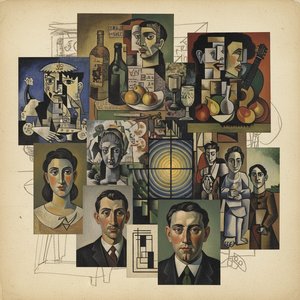
Fernand Léger's 1936 painting, “The Star,” is not a depiction of celestial bodies but rather an exploration of the radiant energy inherent in modernity itself. The canvas pulses with a dynamic interplay of geometric shapes and vibrant color blocks, a testament to Léger’s distinctive style – often referred to as ‘Tubism,’ a fascinating offshoot of Cubism. Unlike the fractured perspectives championed by Picasso and Braque, Léger embraced simplification, constructing his compositions from bold, flattened planes and cylindrical forms that evoke the machinery and industrial landscapes rapidly transforming the world around him. The painting isn’t about *representing* something; it's about *being* a force – an energetic presence distilled into pure visual form. A stylized, face-like element emerges as a focal point, encircled by radiating lines and shapes, suggesting expansion, communication, or perhaps even an internal luminescence that justifies the evocative title. It’s a work that doesn’t simply ask to be looked at; it demands to be *felt*.
The Echo of an Era: Historical Context and Artistic Evolution
To understand “The Star” is to appreciate Léger's remarkable artistic journey. Beginning with Impressionism, he swiftly absorbed the lessons of the avant-garde movements that defined the early 20th century. By the mid-1930s, he had firmly established himself as a leading figure in modern art, boldly embracing industrial imagery and striving to create an aesthetic that was both accessible and revolutionary. The year 1936 itself was fraught with political tension across Europe, casting a shadow of uncertainty over the continent. While “The Star” doesn’t directly engage with these anxieties, its assertive energy can be interpreted as a reflection of the era's complex emotions – a defiant expression of hope and dynamism in the face of looming challenges. Léger wasn’t merely painting *about* the modern world; he was attempting to capture its very essence, its relentless forward momentum, and its inherent contradictions. The influence of Constructivism is also palpable, visible in the machine-like precision and focus on geometric abstraction that characterize his work during this period.
Decoding the Radiance: Symbolism and Emotional Resonance
The central, face-like form within “The Star” invites contemplation. Is it a portrait? An archetype representing humanity itself? Or perhaps a symbol of inner strength and resilience, radiating outwards into the surrounding space? Léger intentionally left these questions open to interpretation, believing that art should be both visually stimulating and intellectually engaging. The radiating lines are particularly compelling – they suggest energy, growth, connection, and an outward projection of force. The painting exudes a sense of optimistic dynamism; its bold colors and geometric forms are invigorating and uplifting. It’s a work that speaks to the power of human ingenuity and the potential for progress. “The Star” isn't simply a beautiful object; it’s a visual embodiment of hope, resilience, and the enduring spirit of innovation.
A Modern Accent: Integrating “The Star” into Your Space
Imagine this striking artwork as a focal point in a contemporary interior. Its vertical orientation makes it particularly well-suited for hallways, entryways, or above seating areas, drawing the eye upwards and creating a sense of spaciousness. The vibrant palette complements neutral color schemes beautifully, adding a pop of sophisticated energy to any room. Conversely, its bold hues provide a powerful contrast against darker tones, making it stand out as a captivating statement piece. “The Star” isn’t just an artwork; it's an investment in visual harmony and emotional resonance – a conversation starter that will enrich your living space for years to come. Its smooth texture and masterful control of color contribute to its overall sense of polished modernity, making it a timeless addition to any art collection or interior design scheme.



 اطلب نسخة مرسومة يدوياً
 مشاركة
 مشاركة
 التفاصيل

 تحميل الملف
 قطع مشابهة
 الأشعة السينية
 عرض شرائح


 عرض المزيد






































 خيار الزجاج متاح فقط للمقاسات التي تقل عن 110 سم