A Masked Identity: Exploring Giorgio de Chirico’s ‘Teste di gladiatori’
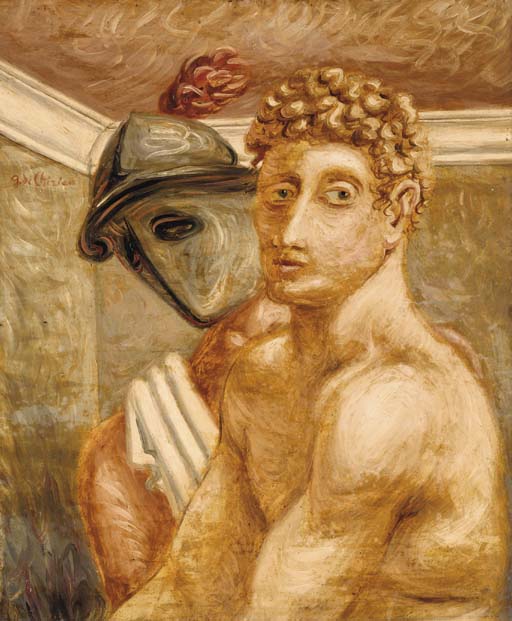
Giorgio de Chirico's *Teste di gladiatori* (Heads of Gladiators) is a captivating and unsettling work emblematic of his pioneering Metaphysical art. Painted during a pivotal period in the artist’s career, this piece transcends mere portraiture to become a profound meditation on identity, illusion, and the fragmented nature of modern experience.
Subject & Composition
The painting presents a strikingly close-up view of a nude male figure, his head adorned with an ornate classical mask. This juxtaposition – the vulnerability of exposed flesh against the concealing artifice of the mask – immediately draws the viewer into a complex psychological space. The composition is tightly focused on the face and upper torso, intensifying the sense of intimacy and immediacy. De Chirico deliberately minimizes background detail, employing broad, textured brushstrokes to suggest an ambiguous interior setting that doesn’t distract from the central figure.
Style & Technique: A Metaphysical Approach
*Teste di gladiatori* is a prime example of de Chirico's *pittura metafisica*. This style, which profoundly influenced Surrealism, rejects traditional perspective and naturalistic representation in favor of dreamlike atmospheres and illogical spatial arrangements.
The artist’s masterful use of impasto – thick layers of paint applied with visible brushstrokes – creates a tactile surface that adds to the painting's emotional weight. The diffused, warm lighting casts soft shadows, emphasizing the figure’s form while contributing to an overall sense of mystery and unease.
Historical Context & Symbolism
De Chirico developed his Metaphysical style in the years leading up to World War I, a period marked by growing anxieties about modernity and societal upheaval. The classical mask alludes to antiquity – specifically, the brutal spectacle of gladiatorial combat – but its presence on a nude figure suggests a detachment from historical context.
It becomes a symbol of constructed identity, a façade concealing an underlying vulnerability. The figure’s gaze is particularly compelling; it's difficult to discern whether he is looking *through* the mask or *at* the viewer, adding another layer of ambiguity. The work invites contemplation on themes of performance, alienation, and the search for meaning in a fragmented world.
Emotional Impact & Interpretation
The painting evokes a powerful sense of introspection and disquiet. It’s not simply a depiction of a masked figure; it's an exploration of the human condition – our tendency to hide behind masks, both literal and metaphorical. The unsettling combination of beauty and unease makes *Teste di gladiatori* a truly memorable work.
Collecting & Interior Design
A reproduction of *Teste di gladiatori* would serve as a striking focal point in any interior space. Its rich color palette and textured surface lend themselves well to both modern and traditional settings.
- Its enigmatic quality makes it ideal for living rooms, studies, or libraries – spaces conducive to contemplation.
- The painting’s muted tones complement a variety of color schemes, from neutral palettes to bolder, more vibrant arrangements.
- Consider pairing it with contemporary furniture and minimalist décor to create a striking contrast between the classical subject matter and modern aesthetics.
De Chirico's *Teste di gladiatori* is not merely an artwork; it’s a visual poem that continues to resonate with viewers today, prompting us to question our own perceptions of identity and reality.


 معاينة الحجم الحقيقي
 اشترِ لوحة مرسومة يدويًا
 مشاركة
 مشاركة
 التفاصيل

 تحميل الملف
 قطع مشابهة
 الأشعة السينية
 عرض شرائح

 عرض المزيد






































 خيار الزجاج متاح فقط للمقاسات التي تقل عن 110 سم



