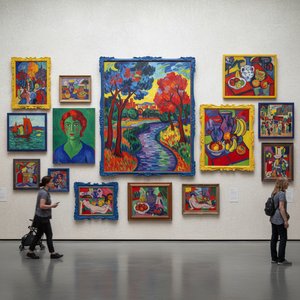
A Bold Statement of Color and Form
Henri Matisse’s “The Arm,” painted in 1938, isn't merely a depiction of a woman’s limb; it’s an explosion of vibrant emotion rendered with the audacious spirit that defined the Fauvist movement. This intimate yet powerfully expressive work immediately commands attention, drawing the viewer into a world where color reigns supreme and traditional representational concerns are delightfully abandoned. The painting captures a fleeting moment – perhaps a gesture, a contemplation – imbued with a sense of intense feeling through Matisse’s masterful manipulation of hue and brushstroke. It's a testament to his belief that color itself could be a subject, capable of conveying mood, emotion, and even narrative.

Color and Composition: A Symphony of Contrasts
At first glance, the composition appears deceptively simple: a green dress against a backdrop of blue. However, this is precisely where Matisse’s genius lies. He doesn't merely paint colors; he orchestrates them. The intense emerald green of the dress vibrates against the cool, almost ethereal blue of the background, creating a dynamic tension that immediately grabs the eye. These aren’t naturalistic shades; they are deliberately heightened and saturated, characteristic of Fauvist technique. Notice how Matisse employs thick, visible brushstrokes – a deliberate rejection of illusionism – to build up layers of color and texture. The interplay between these bold hues generates a palpable sense of energy and movement, suggesting not just the form of the arm but also the underlying passion within.
- Green: Represents vitality, growth, and perhaps even sensuality, anchoring the composition with its richness.
- Blue: Evokes a feeling of serenity and distance, providing a counterpoint to the vibrant green and creating visual interest.
- Red & Orange (implied): Hints of these warm tones within the background contribute to the overall sense of dynamism and emotional intensity.
Fauvism: A Revolutionary Approach
“The Arm” is a quintessential example of Fauvist art, a movement that emerged around 1904 and profoundly challenged the established conventions of painting. The term “Fauve,” meaning “wild beast,” aptly describes this style’s unrestrained use of color and its rejection of academic realism. Matisse, along with André Derain, spearheaded this revolution, prioritizing expressive power over accurate representation. This wasn't about depicting reality; it was about conveying feeling through the language of color. The painting reflects a shift towards subjective experience, where the artist’s emotional response becomes paramount. It’s important to note that Matisse’s work in Fauvism built upon earlier influences, particularly the Impressionists and Post-Impressionists, but he pushed these ideas to their most radical conclusion.
Orientalist Echoes and a Universal Appeal
Beyond its purely Fauvist qualities, “The Arm” also reveals subtle echoes of Orientalist themes – a stylistic influence that was prevalent in Matisse’s work. The use of bold patterns and vibrant colors reminiscent of Middle Eastern textiles suggests an awareness of the exotic and the sensual. However, unlike traditional Orientalist paintings, which often depicted idealized or romanticized scenes, Matisse's approach is far more direct and emotionally charged. The painting transcends its specific influences, offering a universal exploration of human form and emotion—a testament to Matisse’s ability to distill complex ideas into a single, captivating image. It invites contemplation on themes of beauty, desire, and the power of color to evoke profound feelings.



 معاينة الحجم الحقيقي
 التحويل إلى لوحة مرسومة يدوياً
 مشاركة
 مشاركة
 التفاصيل

 تحميل الملف
 قطع مشابهة
 الأشعة السينية
 عرض شرائح


 عرض المزيد






































 خيار الزجاج متاح فقط للمقاسات التي تقل عن 110 سم