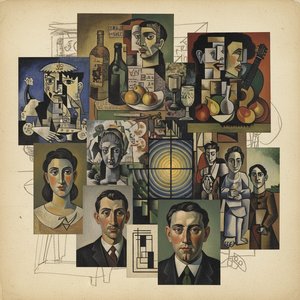
A Fragmented Portrait of Domesticity: Picasso’s *Dans le Boudoir*
Pablo Picasso's *Dans le Boudoir*, painted in 1912, isn’t merely a portrait; it’s a carefully constructed puzzle of perception. This oil on canvas offers a glimpse into the intimate world of a woman preparing for an evening meal, yet simultaneously dismantles that reality through the lens of Cubism. The painting immediately arrests the eye with its bold, fractured forms and vibrant palette – a deliberate departure from the naturalistic traditions of earlier portraiture. Picasso’s genius lies in his ability to present multiple viewpoints of a single subject at once, forcing the viewer to actively engage in reconstructing the image within their own mind.
The Language of Cubism: Deconstructing Reality
Created during a pivotal period in Picasso's artistic development, *Dans le Boudoir* is a cornerstone example of Analytical Cubism. The artist doesn’t aim to represent the woman as she appears in a single moment; instead, he breaks her form – and indeed, the entire room – into a series of geometric planes and angles. Notice how the chair, the table, even the woman herself are rendered as overlapping shards of color and shape. This fragmentation isn't arbitrary; it’s a conscious effort to depict the subject from multiple perspectives simultaneously, capturing not just its appearance but also its essence. The use of monochromatic browns, reds, and blues creates a sense of depth and volume despite the flattened perspective, mirroring the techniques pioneered by Paul Cézanne, another key influence on Picasso's evolving style.
Symbolism Within the Fragment
Beyond its formal innovations, *Dans le Boudoir* is rich in subtle symbolism. The woman’s red dress immediately draws attention, a splash of vibrant color against the muted background – perhaps representing passion or vitality amidst an otherwise subdued scene. The presence of plates and cutlery suggests a meal to be shared, hinting at domesticity and social interaction. However, these elements are presented in a disjointed manner, reflecting the fractured reality of Cubism. Even the clocks, positioned prominently on the wall, subtly underscore the passage of time and the fleeting nature of moments. The handbag, a small detail often overlooked, could symbolize both practicality and feminine allure.
A Revolutionary Vision: Picasso’s Legacy
*Dans le Boudoir* stands as a testament to Pablo Picasso's revolutionary spirit and his profound impact on the course of modern art. His exploration of form, perspective, and representation challenged established conventions and paved the way for subsequent avant-garde movements like Synthetic Cubism and Futurism. The painting’s influence extends far beyond the realm of fine art, impacting fields such as architecture and design, where the principles of geometric abstraction continue to be employed today. Owning a high-quality reproduction of *Dans le Boudoir* offers not just a beautiful work of art but also a connection to one of the most transformative figures in artistic history – an artist who dared to dismantle reality and rebuild it according to his own extraordinary vision.
- Artist: Pablo Picasso
- Year: 1912
- Style: Cubism (Analytical)
- Medium: Oil on Canvas
- Dimensions: Unknown



 شراء نسخة مطبوعة
 مشاركة
 مشاركة
 التفاصيل

 تحميل الملف
 قطع مشابهة
 الأشعة السينية
 عرض شرائح
 عرض المزيد






































 خيار الزجاج متاح فقط للمقاسات التي تقل عن 110 سم