وصف القطعة الفنية
Les Ménines: A Fragmented Reflection on Royal Power
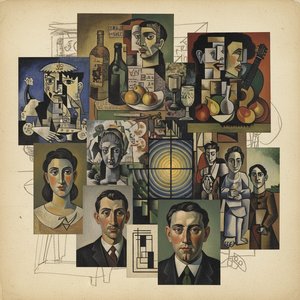
Pablo Picasso’s *Les Ménines* (1957) isn't merely a painting; it’s an audacious reimagining of Diego Velázquez’s monumental masterpiece, a deliberate provocation that embodies the spirit of Cubism and its profound questioning of artistic conventions. Rather than attempting to faithfully reproduce Velázquez’s opulent depiction of the Spanish court—a scene brimming with dignitaries, courtiers, and attendants preparing for a formal portrait session—Picasso dismantles it, fracturing perspective and flattening form into geometric planes, mirroring Picasso's own exploration of visual language.
Deconstructing Tradition: The Cubist Approach
The stylistic core of *Les Ménines* resides in Picasso’s unwavering commitment to Cubism, pioneered alongside Georges Braque. Departing from the Renaissance obsession with illusionistic depth, Picasso presents a deliberately ambiguous space where objects overlap and intersect without adhering to realistic spatial relationships. This fragmentation isn't accidental; it serves as a visual metaphor for dismantling established hierarchies of representation—a direct challenge to Velázquez’s portrayal of royal authority. The artist actively disrupts our perception, forcing us to reconstruct the scene mentally, mirroring Picasso’s own artistic process.
Color and Composition: Blocks of Emotion
A striking contrast defines the color palette – cool blues and grays dominate the upper portion of the canvas, reflecting a sense of formality and restraint, while warmer hues—reds, yellows, and greens—burst forth in the lower section, injecting an element of dynamism and perhaps even unease. These colors aren’t blended seamlessly; they appear as blocks or planes, mirroring Picasso's exploration of expressive color alongside geometric abstraction. The composition itself is deliberately asymmetrical, guiding the viewer’s gaze across multiple viewpoints simultaneously, furthering the Cubist impulse to destabilize traditional visual conventions.
Material and Technique: Impasto Echoes
Executed in oil paint on canvas—a medium consistent with Picasso’s stylistic preferences—*Les Ménines* showcases a technique characterized by layering of colors and shapes, punctuated by visible brushstrokes that lend texture to the surface. These impasto marks aren't merely decorative; they convey an emotional intensity, mirroring Picasso’s desire to capture not just what is seen but also how it feels. The artist’s meticulous attention to detail—particularly in capturing the subtle nuances of light and shadow—demonstrates a masterful command of artistic craft.
Symbolism Beyond Representation: Disruption as Revelation
Beyond its formal innovations, *Les Ménines* operates on a symbolic level that transcends mere visual depiction. Picasso's fragmentation speaks to anxieties surrounding identity and perception, mirroring Picasso’s own preoccupation with psychological complexity. The painting compels us to reconsider the very act of representation itself—to question whether capturing an image faithfully conveys its essence or if disruption—like Picasso’s artistic démarche—can unlock deeper truths about human experience. Ultimately, *Les Ménines* remains a testament to Picasso's genius: a bold reimagining that secures its place as one of the most influential artworks of the 20th century.



 Preview
 اطلب نسخة مرسومة يدوياً
 مشاركة
 مشاركة
 التفاصيل

 تحميل الملف
 قطع مشابهة
 الأشعة السينية
 عرض شرائح
 عرض المزيد






































 خيار الزجاج متاح فقط للمقاسات التي تقل عن 110 سم