A Sacred Stillness: The Soul of Les premiers communiants
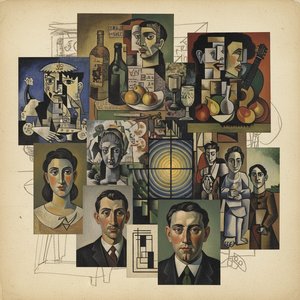
In the vast, revolutionary landscape of Pablo Picasso’s career, certain works emerge not as loud declarations of rebellion, but as quiet, profound whispers of the spirit. Les premiers communiants, painted around 1953, is precisely such a masterpiece. It serves as a poignant meditation on childhood innocence and religious devotion, capturing a moment of solemnity that feels suspended in time. The canvas presents two figures standing before a simple wooden chair, bathed in a diffused, ethereal light that lends the scene an almost otherworldly stillness. As one gazes upon the woman in her white robes—symbolizing purity and grace—and the man in his formal attire, there is an immediate sense of being invited into a private, sacred ritual. This is not merely a depiction of a ceremony; it is an exploration of the weight of faith and the quiet dignity of human devotion.
The emotional resonance of the piece lies in its ability to balance the monumental with the intimate. While the scale of the work suggests importance, the subject matter remains deeply personal. The way the figures clutch their books—likely prayer texts—reinforces a central focus on spiritual communion and the shared experience of reverence. For the collector or the interior designer, this painting offers a unique atmospheric quality; it possesses a gravity that can anchor a room, providing a focal point that encourages contemplation rather than mere observation. It is a work that breathes with a sense of peace, making it an exquisite addition to spaces designed for reflection and quiet elegance.
The Intersection of Cubism and Expression
Technically, Les premiers communiants showcases Picasso’s mature mastery, where the radical experiments of his youth have matured into a sophisticated, expressive language. While the ghosts of Analytic Cubism haunt the composition—visible in the subtle fragmentation of the chair and the slightly distorted perspectives of the figures—the artist has moved far beyond rigid geometric abstraction. Instead, he employs a masterful blend of Surrealist influence and expressive distortion to prioritize emotional impact over anatomical perfection. The forms are not broken for the sake of complexity, but rather to suggest the multidimensionality of memory and feeling.
The technique employed is a testament to Picasso’s enduring command over his medium. Using oil on canvas, he applied paint with a deliberate, textured touch that gives the work a palpable physicality. The brushstrokes are not merely marks on a surface; they are rhythmic elements that capture the subtle nuances of light and shadow, creating a sense of depth that draws the viewer inward. This textural richness is essential to the painting's success, as it allows the diffused light to seem as though it is truly emanating from within the canvas itself. For those seeking a high-quality reproduction, capturing this specific interplay of texture and light is paramount to preserving the soul of Picasso’s vision.
A Legacy of Introspection
To understand Les premiers communiants, one must consider the historical context of Picasso's later years. Moving away from the turbulent, politically charged energy of works like Guernica, this period of his life was marked by a shift toward introspection and spiritual contemplation. The painting reflects a departure from the external chaos of the world toward an internal landscape of meaning. It is a window into a mind that, having already dismantled and reconstructed reality through Cubism, was now seeking to find the sacred within the simple.
This piece stands as a bridge between the revolutionary and the devotional. It invites the viewer to look past the surface of the paint and engage with the universal themes of innocence, tradition, and the search for transcendence. Whether displayed in a private gallery or a curated residential setting, Les premiers communiants remains an enduring icon of twentieth-century art—a testament to the idea that even within the most fragmented forms, a profound sense of wholeness and peace can be found.



 معاينة الحجم الحقيقي
 اشترِ لوحة مرسومة يدويًا
 مشاركة
 مشاركة
 التفاصيل

 تحميل الملف
 قطع مشابهة
 الأشعة السينية
 عرض شرائح

 عرض المزيد






































 خيار الزجاج متاح فقط للمقاسات التي تقل عن 110 سم