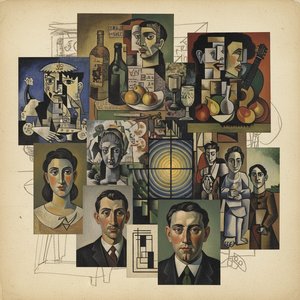
A Fragmented Vision of Humanity
In the transformative landscape of early twentieth-century modernism, few works capture the radical restructuring of reality quite like Pablo Picasso’s “Man with a Guitar.” Painted in 1913, this masterpiece serves as a profound cornerstone of Synthetic Cubism, marking a decisive departure from the more analytical, monochromatic explorations that had previously defined the movement. The painting presents us with a man seated in profile, his form intertwined with the instrument he holds across his shoulder. Yet, this is no mere portrait; it is an intricate tableau where the boundaries between the human figure and the surrounding space begin to dissolve. Alongside the central subject, two indistinct figures linger in the background, creating an atmosphere that feels simultaneously intimate and unsettling, as if we are peering into a fractured dream of social interaction.
The technique employed by Picasso in this period was nothing short of revolutionary. Moving away from the shattered, glass-like shards of his earlier work, he embraced the concept of layering and superimposition. In “Man with a Guitar,” we see fractured planes of color stacked upon one another to present multiple perspectives at once. The palette is masterfully restrained, dominated by earthy, grounded tones that are suddenly interrupted by deliberate splashes of vibrant blues and reds. This contrast is not merely decorative; it is a structural tool used to heighten the visual impact and guide the eye through the geometric labyrinth of the composition. The guitar itself is stripped of its realistic curves, instead being reimagined through a series of essential geometric shapes that mirror the fragmentation of the man’s own form.
Symbolism and the Modern Soul
To gaze upon this work is to confront the anxieties of a world in flux. Created during an era of rapid industrialization and urban expansion, the painting reflects Picasso's engagement with the disintegration of traditional values. The guitar serves as a potent symbol of musical expression—a sanctuary of rhythm and melody amidst the chaos of modernity. However, because the instrument is rendered in a broken, deconstructed state, it suggests that even our most cherished forms of refuge are being reshaped by the pressures of a changing society. There is a palpable sense of isolation within the piece; the man’s enigmatic gaze invites deep introspection, suggesting a soul caught between the internal world of thought and the external world of observation.
For the discerning collector or interior designer, this artwork offers more than just aesthetic brilliance; it provides a profound emotional anchor. The blurred figures in the background represent an external reality that feels distant and incomprehensible, emphasizing the solitary nature of the human experience. Whether displayed in a contemporary gallery setting or as a focal point in a sophisticated residential space, a high-quality reproduction of this piece brings with it a sense of intellectual depth and historical gravity. It is a conversation starter that bridges the gap between the turbulent history of the 1910s and the refined elegance of modern decor, making it an essential acquisition for those who appreciate art that challenges the eye and stirs the spirit.



 معاينة الحجم الحقيقي
 اشترِ لوحة مرسومة يدويًا
 مشاركة
 مشاركة
 التفاصيل

 تحميل الملف
 قطع مشابهة
 الأشعة السينية
 عرض شرائح

 عرض المزيد






































 خيار الزجاج متاح فقط للمقاسات التي تقل عن 110 سم