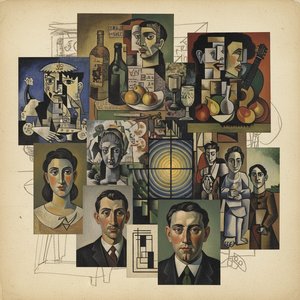
A Portrait of Maternal Love: Decoding Picasso’s ‘Mother and Child’
Pablo Picasso's “Mother and Child,” painted in 1938, transcends mere representation; it embodies the very essence of maternal tenderness within the framework of Cubism. This pastel masterpiece captures a moment of profound intimacy between Marie-Therese Viallon, Picasso’s muse and mother to his son Claude, and Maya Viallon, Marie-Therese's daughter. The scene unfolds in a dimly lit interior, subtly hinting at the quiet sanctuary of domestic life—a deliberate choice reflecting Picasso’s fascination with capturing everyday realities infused with emotional depth.
- Style & Technique: Picasso masterfully employs Cubist principles – fragmentation and multiple perspectives – to depict Marie-Therese cradling Maya. Unlike traditional portraiture, which strives for idealized beauty, Picasso dismantles form into geometric planes, presenting a fractured image that simultaneously reveals and obscures the subject’s contours. This technique isn't merely stylistic; it serves as a powerful tool for conveying psychological complexity.
- Color Palette: The muted pastel hues—primarily peach, mauve, and cream—create an atmosphere of serenity and vulnerability. Picasso eschews bold colors, favoring tones that evoke softness and warmth, mirroring the nurturing embrace of motherhood. These delicate shades contribute significantly to the painting’s emotional resonance.
- Historical Context: Created during the tumultuous years leading up to World War II, “Mother and Child” speaks to themes of familial bonds amidst societal upheaval. Picasso's personal life was marked by tragedy – his sister Paloma tragically died in infancy – influencing his artistic explorations of grief and remembrance. The painting stands as a testament to resilience and enduring love.
Symbolism: The positioning of Marie-Therese and Maya—one dominating the frame, the other nestled securely within her arms—represents the protective role of motherhood. The fragmented planes symbolize not only visual complexity but also the multifaceted nature of human experience. Picasso’s deliberate use of geometric shapes underscores the idea that reality is never entirely singular; it exists in multiple dimensions simultaneously.
- Emotional Impact: “Mother and Child” evokes a palpable sense of compassion and tenderness. The painting's quiet stillness invites contemplation on themes of maternal devotion, familial connection, and the beauty found within domestic tranquility. It’s a work that resonates deeply with viewers seeking solace and inspiration—a timeless depiction of love and vulnerability.
- Material Reproduction: TopImpressionists offers exceptionally detailed reproductions of Picasso's “Mother and Child,” utilizing archival pigment printing on museum-grade canvas to faithfully capture the original artwork’s subtle nuances. Each print is meticulously crafted by skilled artisans, ensuring exceptional color accuracy and textural fidelity.
Explore More: Discover related artworks by Pablo Picasso at
Musée Picasso Paris, delve into the legacy of Picasso’s wife Dora Maar at
Pablo Iglesias Foundation and immerse yourself in Barcelona's artistic heritage with
Museu Picasso. Bring the beauty of Picasso’s vision into your home with a stunning reproduction today!



 معاينة الحجم الحقيقي
 اشترِ لوحة مرسومة يدويًا
 مشاركة
 مشاركة
 التفاصيل

 تحميل الملف
 قطع مشابهة
 الأشعة السينية
 عرض شرائح
 عرض المزيد






































 خيار الزجاج متاح فقط للمقاسات التي تقل عن 110 سم