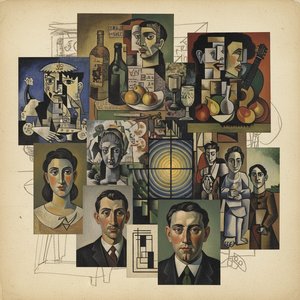
A Fragmented Melody: Exploring Pablo Picasso’s “Woman with Mandolin”
Pablo Picasso's "Woman with Mandolin," painted in 1909, isn’t merely a portrait; it’s a pivotal moment in the birth of modern art. This oil on canvas piece, residing within the vibrant and challenging world of early Cubism, invites us to reconsider our very perception of form, space, and representation. More than just depicting a woman playing an instrument, Picasso constructs a visual puzzle—a deliberate disruption of traditional artistic conventions that speaks volumes about his revolutionary approach to art and its relationship to the world around it.
The painting immediately captivates with its fractured composition. The subject, a woman enveloped in a muted palette of browns, ochres, and greys, is rendered not as a unified whole but as a collection of interlocking geometric planes. Picasso masterfully dismantles her figure, presenting her simultaneously from multiple viewpoints—a technique central to Analytical Cubism. Lines slice across the canvas, dissecting the form and suggesting that there’s no single, fixed perspective. The mandolin itself, an instrument deeply rooted in Spanish culture and often associated with passion and storytelling, is similarly fragmented, its curves and contours broken down into sharp angles and overlapping shapes. This deliberate ambiguity forces the viewer to actively participate in reconstructing the image, creating a dynamic and engaging experience.
Influences and Artistic Context
Picasso’s exploration of this fractured aesthetic was profoundly shaped by his intellectual and artistic environment. The painting emerged during a period of intense experimentation within the Parisian art scene, fueled by collaborations with figures like Daniel-Henry Kahnweiler, a prominent art dealer who championed Cubism, and influenced by the works of Paul Cézanne, whose emphasis on geometric forms and multiple viewpoints laid the groundwork for Picasso’s innovations. Furthermore, Picasso's fascination with African masks and tribal sculpture—a passion ignited during his time in Barcelona—is evident in the simplified, almost mask-like quality of the woman’s face. These diverse influences coalesced to propel Picasso toward a radical departure from traditional representation.
Synthetic Cubism and the Reconfiguration of Reality
“Woman with Mandolin” is considered a key example of Synthetic Cubism, a phase characterized by the incorporation of disparate elements—fragments of objects, newspaper clippings, and other found materials—into a single composition. This technique aimed to challenge the viewer’s assumptions about reality, suggesting that perception itself is subjective and constructed. Picasso doesn't simply depict what he sees; he actively rearranges and reinterprets it, creating a new visual language. The muted color palette further contributes to this sense of disorientation, dissolving any illusion of depth or spatial coherence. The painting’s power lies not in its realistic portrayal but in its ability to evoke a feeling—a sense of dynamism, fragmentation, and the inherent instability of perception.
Symbolism and Emotional Resonance
Beyond its formal innovations, “Woman with Mandolin” carries layers of symbolic meaning. The mandolin itself represents not just music but also Spanish culture, tradition, and perhaps even a longing for connection. The woman’s enigmatic expression invites speculation—is she lost in thought, expressing joy, or conveying a sense of melancholy? Picasso deliberately avoids providing definitive answers, allowing the viewer to project their own emotions and interpretations onto the image. The overall effect is one of quiet intensity, suggesting that beauty can be found not in perfect representation but in the exploration of complex ideas and emotional states.
TopImpressionists offers meticulously crafted, hand-painted oil painting reproductions of “Woman with Mandolin,” capturing every nuance and detail of Picasso’s groundbreaking work. These reproductions are created by skilled artists who share a deep appreciation for Picasso's legacy, ensuring that you own a stunning piece of art history—a testament to the enduring power of Cubism and one of the most significant works in modern art.
Explore our selection of Picasso’s masterpieces, including “Woman with Mandolin” (130 x 97 cm, Synthetic Cubism, Oil On Canvas) and other iconic pieces on TopImpressionists.com. Discover the beauty of a fragmented melody.



 شراء نسخة مطبوعة
 مشاركة
 مشاركة
 التفاصيل

 تحميل الملف
 قطع مشابهة
 الأشعة السينية
 عرض شرائح

 عرض المزيد






































 خيار الزجاج متاح فقط للمقاسات التي تقل عن 110 سم