وصف القطعة الفنية
Picnic 6: A Fragmented Vision of Leisure
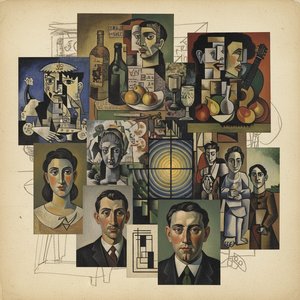
Pablo Picasso’s “Picnic 6,” painted circa 1953, stands as a quintessential example of Cubist exploration—a deliberate dismantling and reconstruction of perception that captures the essence of a seemingly simple moment. More than just depicting an outdoor gathering, this artwork delves into the complexities of human experience through fractured forms and vibrant color palettes, inviting viewers to contemplate the elusive nature of reality itself.
Style and Technique: The Language of Cubism
Picasso’s mastery of Cubist principles is immediately apparent. Unlike traditional representational art which strives for accurate depiction, Cubism rejects single viewpoints, presenting subjects from multiple perspectives simultaneously. In “Picnic 6,” figures are fragmented into geometric planes—cubes, cylinders, and cones—that overlap and intersect, creating a dynamic visual illusion. This technique isn’t merely stylistic; it's conceptual – Picasso sought to capture not just what he *saw*, but how he *understood* the scene. The artist employs bold brushstrokes and contrasting colors—primarily yellows, reds, and blues—to heighten the sense of movement and emphasize the fractured nature of form. These pigments are applied with a deliberate roughness, mirroring the disruption inherent in Cubist aesthetics.
Historical Context: Picasso’s Late Period – Embracing Abstraction
“Picnic 6” belongs to Picasso's prolific late period, following his groundbreaking experiments with Surrealism and marking a decisive shift towards pure abstraction. This era witnessed Picasso pushing boundaries of artistic expression, rejecting representational constraints in favor of exploring inner emotions and psychological states. The painting emerged during a time when Picasso was grappling with personal anxieties and reflecting on themes of memory and loss—influences subtly woven into the artwork’s visual language. It's important to note that Picasso’s Cubist explorations weren’t isolated endeavors; they were part of a broader artistic dialogue challenging established conventions and redefining notions of beauty and truth.
Symbolism: Layers of Meaning Beyond Appearance
While visually arresting, “Picnic 6” is laden with symbolic significance. The fragmented figures represent not just individuals but also the fractured nature of consciousness—the way we perceive and interpret the world around us. The inclusion of objects like a chair, bowl, and cup serves as anchors within this chaotic composition, grounding the scene in tangible reality while simultaneously highlighting its instability. Color choices contribute to the artwork’s emotional impact; yellows evoke warmth and optimism, yet also hint at unease—a reflection perhaps of Picasso's own psychological landscape. The overall impression is one of melancholy contemplation – inviting viewers to consider what lies beneath the surface of appearances.
Emotional Impact: Capturing Transient Moments
Ultimately, “Picnic 6” succeeds in conveying a profound emotional resonance. Despite its geometric abstraction, the painting captures the fleeting beauty and vulnerability of human connection—the quiet intimacy of a picnic amongst friends. Picasso’s masterful use of color and form compels us to confront our own perceptions of reality, prompting introspection and stimulating imaginative engagement. It's a testament to his ability to transform seemingly mundane subjects into vehicles for exploring universal themes of emotion and experience – ensuring that “Picnic 6” continues to captivate audiences decades after its creation.



 معاينة الحجم الحقيقي
 التحويل إلى لوحة مرسومة يدوياً
 مشاركة
 مشاركة
 التفاصيل

 تحميل الملف
 قطع مشابهة
 الأشعة السينية
 عرض شرائح
 عرض المزيد






































 خيار الزجاج متاح فقط للمقاسات التي تقل عن 110 سم