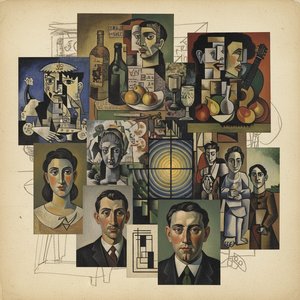
Seated Man 1: A Study in Fragmented Form and Emotional Resonance
Pablo Picasso’s “Seated Man 1,” painted in Paris between 1915 and 16 during the height of Cubist experimentation, stands as a testament to artistic innovation and a profound exploration of human psychology. This watercolor and opaque watercolor on paper depicts a solitary figure seated in a chair—a deceptively simple composition that belies the complex intellectual currents shaping Picasso’s oeuvre at the time.
The painting exemplifies Cubism's core principles: fragmentation, simultaneity, and multiple perspectives. Picasso abandons traditional representational conventions, dissecting the human form into geometric planes and facets—a technique pioneered alongside Georges Braque—to convey not just what is seen but also how it is perceived. The chair itself isn’t rendered realistically; instead, it's broken down into angular shapes that contribute to the overall sense of disorientation and abstraction.
- Style: Cubism – Characterized by geometric simplification and multiple viewpoints simultaneously presented.
- Technique: Watercolor and opaque watercolor—allowing for subtle tonal variations and layering effects, crucial in capturing the mood and atmosphere of the scene.
- Color Palette: Primarily muted blues and reds—creating a melancholic yet arresting visual experience that reflects Picasso’s preoccupation with themes of isolation and contemplation.
Beyond its formal innovations, “Seated Man 1” resonates deeply with biographical context. Created shortly after Picasso's sister’s tragic death – an event profoundly impacting his artistic sensibility – the painting embodies a palpable sense of sorrow and introspection. The figure’s gaze is averted, conveying a quiet sadness that speaks to the artist’s own emotional turmoil.
The deliberate ambiguity surrounding the man’s identity—his face rendered in bold reds and lips—further enhances the artwork's symbolic power. It invites viewers to contemplate notions of vulnerability, resilience, and the human condition itself. Picasso skillfully utilizes color and form not merely to depict a subject but to communicate an emotional state—a hallmark of his distinctive artistic vision.
As showcased in The Metropolitan Museum of Art’s collection (https://www.metmuseum.org/art/collection/search/500453), “Seated Man 1” continues to captivate audiences with its masterful execution and enduring intellectual depth. Its influence extends far beyond the confines of Cubism, establishing Picasso as one of the most transformative figures in modern art.



 Preview
 Switch to hand made Painting
 مشاركة
 مشاركة
 التفاصيل

 تحميل الملف
 قطع مشابهة
 الأشعة السينية
 عرض شرائح
 عرض المزيد






































 خيار الزجاج متاح فقط للمقاسات التي تقل عن 110 سم