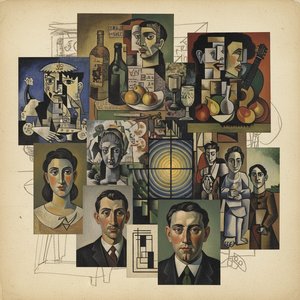
A Symphony of Color and Gesture: Decoding Picasso’s “The Aubade”
Pablo Picasso's "The Aubade," painted in 1965, stands as a testament to his unwavering fascination with Surrealism and his masterful ability to distill complex emotions into deceptively simple visual forms. Measuring 130 x 195 cm, this oil on canvas piece transcends mere representation; it’s an invitation to contemplate the interplay between music, joy, and contemplation—themes that permeate Picasso's oeuvre throughout his prolific career.
Style and Technique: Embracing Naive Art’s Raw Expression
Classified under the Naive Art / Primitivism style, “The Aubade” exemplifies Picasso’s deliberate exploration of artistic primitivism. Unlike academic painting traditions focused on meticulous realism, Picasso deliberately eschewed technical precision, favoring bold colors and expressive brushstrokes that prioritize feeling over observation. This stylistic choice aligns perfectly with the broader movement's ethos—to recapture the spontaneity and unfiltered emotion characteristic of folk art—resulting in a visual experience that is both visceral and profoundly engaging.
A Scene Steeped in Symbolism: Music, Time, and Domestic Tranquility
The composition itself speaks volumes. Two figures dominate the foreground, one engaged in playing an instrument – likely a trombone or trumpet – while the other appears to be singing with palpable enthusiasm. This dynamic duo is positioned against a vibrant crimson backdrop, immediately establishing a sense of energy and movement. The inclusion of a clock subtly underscores the passage of time, juxtaposed against the idyllic scene of performance. Furthermore, the bowl at the bottom right corner hints at nourishment and comfort—elements that contribute to the painting’s overarching atmosphere of contentment.
Picasso's Legacy: Bridging Movements and Defining Modern Art
"The Aubade" isn't merely a standalone artwork; it represents a pivotal moment in Picasso’s artistic journey. As a pioneer of Cubism alongside Georges Braque, he consistently pushed boundaries, experimenting with diverse styles and techniques to challenge conventional notions of representation. This painting underscores his ability to synthesize influences from various artistic traditions—a characteristic that cemented his position as one of the most influential artists of the 20th century.
Comparative Works: Echoes of Picasso’s Vision
Considered alongside other celebrated pieces like “The Man with a Pipe,” “Standing female nude and man with pipe,” and “Woman with book,” "The Aubade" reveals Picasso's unwavering commitment to exploring themes of human emotion and artistic innovation. These works demonstrate his profound understanding of the psychological landscape—a hallmark of Surrealism—and solidify his enduring legacy as an artist who fundamentally reshaped the course of modern art.



 اطلب نسخة مرسومة يدوياً
 مشاركة
 مشاركة
 التفاصيل

 تحميل الملف
 قطع مشابهة
 الأشعة السينية
 عرض شرائح


 عرض المزيد






































 خيار الزجاج متاح فقط للمقاسات التي تقل عن 110 سم