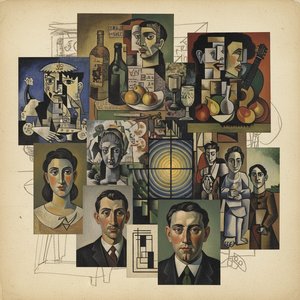
وصف القطعة الفنية
Pablo Picasso’s “The Card Player”: A Fragment of Existential Reflection
“The Card Player,” painted in 1947, stands as a quintessential embodiment of Pablo Picasso's mature Cubist style—a deceptively simple composition brimming with layers of intellectual and emotional complexity. More than just a depiction of a man absorbed in the game of cards, it’s an exploration of human psychology, rendered with meticulous attention to form and color that continues to resonate powerfully with viewers today. The painting resides within Musée Picasso Paris, offering visitors a chance to immerse themselves in the artist's profound vision.
Deconstructing Reality: Cubism and Artistic Innovation
Picasso’s embrace of Cubism revolutionized artistic representation. Departing from traditional perspective, he shattered objects into geometric planes—cubes, cylinders, and cones—juxtaposed against each other on a single canvas. This technique wasn't merely stylistic; it was fundamentally driven by Picasso’s desire to capture the multifaceted nature of reality as perceived by the human eye. As he famously stated, “I do not paint what I see but what I feel.” In "The Card Player," this philosophy is palpable—the figure isn’t rendered realistically, but rather fragmented and reconstructed according to a system that prioritizes visual sensation over accurate depiction. The artist deliberately avoids creating an illusion of depth, forcing the viewer to actively engage with the artwork's spatial arrangement.
Symbolism Within Fragmentation: Time, Uncertainty, and Human Condition
Beyond its formal innovation, “The Card Player” is laden with symbolic significance. The clock prominently displayed on the wall serves as a poignant reminder of time’s relentless passage—a theme recurrent throughout Picasso’s oeuvre. However, unlike a conventional portrait conveying status or achievement, this image presents an individual seemingly detached from external concerns, focused solely on his internal preoccupation. This isolation speaks to the anxieties inherent in human existence, mirroring the existential dilemmas explored by philosophers and writers of the period. The card player's posture—hunched over the table, gaze fixed downwards—suggests vulnerability and contemplation, inviting viewers to ponder questions of identity and purpose.
Technique and Color Palette: Precision and Emotional Resonance
Picasso’s masterful execution is evident in every brushstroke. He employed a palette dominated by earthy tones – browns, ochres, and reds – creating a sense of muted solidity that contrasts sharply with the fractured planes of his composition. Careful attention to detail—the texture of the fabric draped over the chair, the subtle shading on the face—further enhances the painting’s realism despite its abstract form. Picasso meticulously blended pigments to achieve nuanced gradations of color, conveying not only visual information but also emotional atmosphere. The subdued hues contribute to the overall feeling of melancholy and introspection, mirroring the artist's own personal struggles during World War II.
A Legacy of Artistic Influence
“The Card Player” cemented Picasso’s position as one of the most influential artists of the 20th century. Its impact extends far beyond the realm of painting, influencing subsequent generations of artists and shaping the trajectory of modern art. It remains a testament to Picasso's unwavering commitment to artistic experimentation and his ability to distill profound philosophical ideas into visually arresting imagery—a masterpiece that continues to captivate audiences worldwide.



 معاينة الحجم الحقيقي
 التحويل إلى لوحة مرسومة يدوياً
 مشاركة
 مشاركة
 التفاصيل

 تحميل الملف
 قطع مشابهة
 الأشعة السينية
 عرض شرائح
 عرض المزيد






































 خيار الزجاج متاح فقط للمقاسات التي تقل عن 110 سم