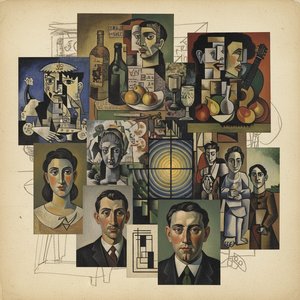
A Moment of Contemplation: Unpacking Picasso’s ‘The Large Bather’
Pablo Picasso's “The Large Bather,” painted in 1921, isn’t a straightforward depiction of a nude figure; it’s an intensely psychological portrait rendered with the bold geometric language that defined his Cubist period. Initially appearing as a simple scene – a woman seated on a chair, legs crossed, seemingly lost in thought – the painting quickly reveals layers of complexity and emotional depth. It's a work that invites prolonged observation, rewarding viewers who are willing to engage with its fragmented forms and evocative atmosphere. The scale itself—a monumental size for the subject matter—contributes significantly to the feeling of being drawn into the woman’s private world, creating an intimate yet powerful experience.

Cubism and the Fragmentation of Form
Picasso’s approach to “The Large Bather” is deeply rooted in Cubist principles, though it moves beyond the purely analytical style he explored earlier. He employs a deliberate fragmentation of space and form, breaking down the woman's body into geometric planes and presenting multiple viewpoints simultaneously. The chair, rendered with sharp angles and overlapping forms, anchors her within this fractured reality. Notice how the folds of her drapery aren’t smoothly curved but are instead constructed from angular shapes, creating a dynamic tension between solidity and fluidity. This technique isn’t merely stylistic; it reflects Picasso's interest in exploring the subjective experience of perception – how we see an object at different times and from different angles.
- Color Palette: The painting is dominated by a verdant green, edged with silver, creating a sense of both vitality and melancholy. This unusual combination adds to the work’s enigmatic quality.
- Compositional Dynamics: Picasso masterfully uses overlapping planes and receding spaces to create a feeling of depth, even within the relatively shallow pictorial space.
Symbolism and Emotional Resonance
While Picasso himself resisted definitive interpretations of his work, “The Large Bather” is widely believed to be imbued with themes of introspection, solitude, and perhaps even a touch of sadness. The woman’s gaze—directed inward rather than outward—suggests a state of deep contemplation or melancholy. The presence of the other chairs and couch hints at isolation and a retreat from external reality. Some scholars connect this work to Picasso's personal experiences during this period, including the loss of his sister, which often informed his artistic themes. The bull, a recurring motif in Picasso’s oeuvre, is notably absent here, suggesting a shift away from overtly aggressive symbolism towards a more nuanced exploration of inner states.
A Legacy of Monumentality and Emotional Intensity
“The Large Bather” stands as one of the few instances where Picasso deliberately employed monumental scale in his work. This choice amplifies the painting’s emotional impact, drawing the viewer into a world of quiet intensity. It's a testament to Picasso’s ability to transform a seemingly simple subject—a woman sitting alone—into a profound meditation on human experience. Reproductions of this iconic piece offer an accessible way to appreciate the genius of Picasso and his enduring influence on modern art, allowing viewers to engage with its complex layers of form, color, and symbolism from their own spaces.



 Preview
 Switch to hand made Painting
 مشاركة
 مشاركة
 التفاصيل

 تحميل الملف
 قطع مشابهة
 الأشعة السينية
 عرض شرائح

 عرض المزيد






































 خيار الزجاج متاح فقط للمقاسات التي تقل عن 110 سم