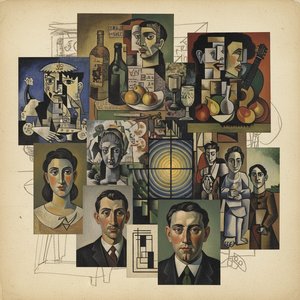
The Painter and His Model 22
Pablo Picasso’s “The Painter and His Model” stands as a testament to the artist's enduring fascination with capturing human relationships within the framework of artistic creation. Painted in 1963, this deceptively simple composition embodies the core principles of Cubism—a movement that revolutionized visual art at the dawn of the 20th century—and reveals Picasso’s masterful command of geometric abstraction and Proto-Cubist techniques.
Introduction to Cubism
Cubism, spearheaded by Picasso alongside Georges Braque, fundamentally challenged traditional artistic conventions by rejecting illusionistic representation in favor of fragmented perspectives. Instead of depicting objects as seen from a single viewpoint, Cubists dissected them into interlocking planes and angles, presenting multiple viewpoints simultaneously on a canvas surface. This stylistic approach aimed to convey the totality of an object’s form—its essence—rather than merely its appearance. “The Painter and His Model” exemplifies this concept brilliantly, demonstrating how Picasso skillfully utilizes geometric shapes to capture the dynamism inherent in the scene.
Composition and Style
The painting depicts a man seated at a table with a woman standing behind him. The artist’s deliberate use of Proto-Cubism—a precursor to full Cubist exploration—is evident in the flattened planes that define both figures and the surrounding environment. Notice how Picasso employs bold lines and vibrant colors, notably reds and yellows, to create a sense of depth and movement despite the absence of conventional shading or perspective. The woman’s posture subtly suggests support and contemplation, while the man's gaze directs attention towards his paintbrush—a symbol of artistic endeavor and creative process.
Historical Context
“The Painter and His Model” emerged during Picasso’s mature period, marking a significant departure from his earlier stylistic experiments. It reflects the broader artistic landscape of the time—characterized by a rejection of academic realism and an embrace of abstraction as a means of expressing emotion and intellectual ideas. The painting's influence extends beyond its formal qualities; it embodies Picasso’s ongoing exploration of themes related to art, gender roles, and human psychology.
Museum Quartier Des Héronnières
The Museum Quartier Des Héronnières in Fontainebleau, France, houses an impressive collection of artworks—including masterpieces by Picasso—providing visitors with a unique opportunity to immerse themselves in the artistic heritage of Europe. Explore this cultural landmark and appreciate the enduring legacy of Pablo Picasso’s groundbreaking contributions to modern art. For more information, visit
The Museum Quartier Des Héronnières on TopImpressionists.



 معاينة الحجم الحقيقي
 اشترِ لوحة مرسومة يدويًا
 مشاركة
 مشاركة
 التفاصيل

 تحميل الملف
 قطع مشابهة
 الأشعة السينية
 عرض شرائح

 عرض المزيد






































 خيار الزجاج متاح فقط للمقاسات التي تقل عن 110 سم