Jackson Pollock’s ‘Number 27, 1950’: A Symphony of Controlled Chaos
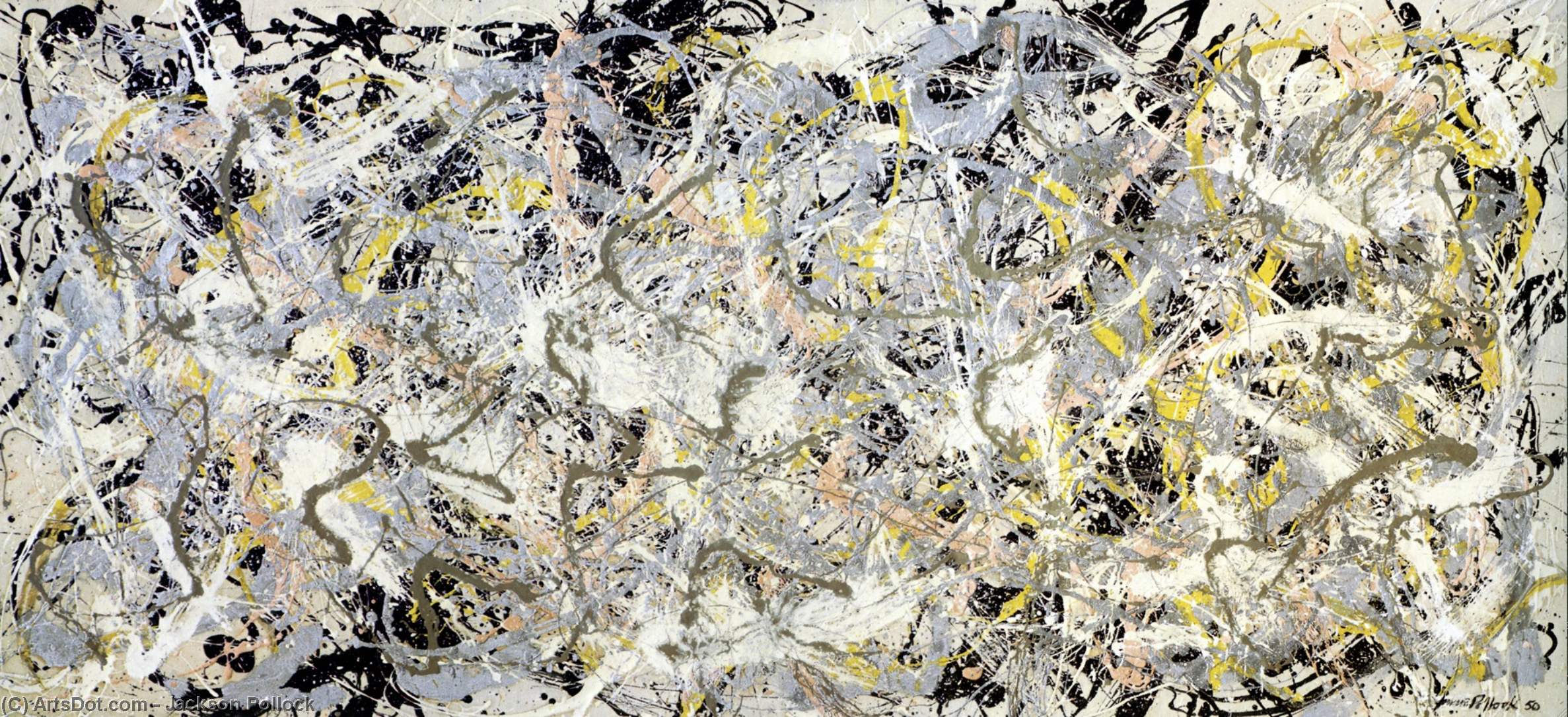
Number 27, 1950 is a landmark achievement in the history of Abstract Expressionism, embodying the movement's radical departure from traditional artistic conventions. This large-scale oil on canvas (137 x 109 cm) currently resides at the Museum of Modern Art (MoMA) in New York City, serving as a powerful testament to Pollock’s innovative spirit and enduring legacy.
Deconstructing the Abstract: Style & Technique
This painting is quintessential Pollock – a mesmerizing web of poured, dripped, and flung paint. Rejecting the easel and brushwork of his predecessors, Pollock laid his canvas directly on the floor, engaging in what he termed “action painting.” This technique allowed him to approach the canvas from all sides, creating an "all-over" composition devoid of a central focal point. The resulting surface is richly textured, built up through layers of interwoven lines and shapes in shades of red, yellow, blue, black, and white against a largely neutral ground.
The technique isn’t random; it's a carefully orchestrated dance between control and chance. Pollock wasn’t simply splashing paint – he was *moving* with the paint, channeling his inner energy onto the canvas.
Historical Context: The Rise of Abstract Expressionism
Emerging in post-World War II America, Abstract Expressionism represented a shift in artistic focus from representational imagery to subjective emotional expression. New York City became the new center of the art world, eclipsing Paris. Pollock was at the forefront of this movement, challenging established norms and pushing the boundaries of what painting could be.
His work reflected a broader cultural climate grappling with existential anxieties and seeking new forms of meaning. The period saw artists looking inward, exploring the subconscious mind and expressing raw emotion through abstract forms.
Symbolism & Interpretation: Beyond Representation
While devoid of recognizable figures or objects,
Number 27, 1950 is far from meaningless. The complex network of lines can be interpreted as a visual representation of the human psyche – a tangled web of thoughts, feelings, and experiences. Some see echoes of Native American sand paintings in Pollock’s work, reflecting his early exposure to Indigenous art forms.
Ultimately, the painting's symbolism is open-ended, inviting viewers to project their own interpretations onto its dynamic surface. It evokes a sense of energy, movement, and even chaos, but within that apparent disorder lies a compelling underlying structure.
Emotional Impact & Aesthetic Appeal
Experiencing
Number 27, 1950, whether in person or through a high-quality reproduction, is an immersive experience. The painting’s scale and complexity draw the viewer in, creating a sense of being enveloped by its energy. It's a work that demands attention and rewards contemplation.
The interplay of color and texture creates a visual rhythm that can be both exhilarating and calming.
Integrating ‘Number 27, 1950’ into Your Space
- For the Modern Collector: This piece is a cornerstone of modern art history. A reproduction adds instant sophistication to any collection.
- Interior Design Statement: The dynamic composition and bold color palette make it a striking focal point in contemporary living spaces, particularly those with minimalist or industrial aesthetics.
- Color Palette Inspiration: The painting’s hues – deep reds, vibrant yellows, cool blues, and stark blacks – can inspire entire room schemes, creating a cohesive and artistic atmosphere.
Number 27, 1950 is more than just a painting; it's a cultural icon. It represents a pivotal moment in art history and continues to resonate with audiences today, inspiring creativity and challenging conventional notions of beauty.


 معاينة الحجم الحقيقي
 التحويل إلى لوحة مرسومة يدوياً
 مشاركة
 مشاركة
 التفاصيل

 تحميل الملف
 قطع مشابهة
 الأشعة السينية
 عرض شرائح

 عرض المزيد






































 خيار الزجاج متاح فقط للمقاسات التي تقل عن 110 سم



