A Study in Simplification: Exploring Paul Klee’s ‘Doblecola-Tripleoreja’
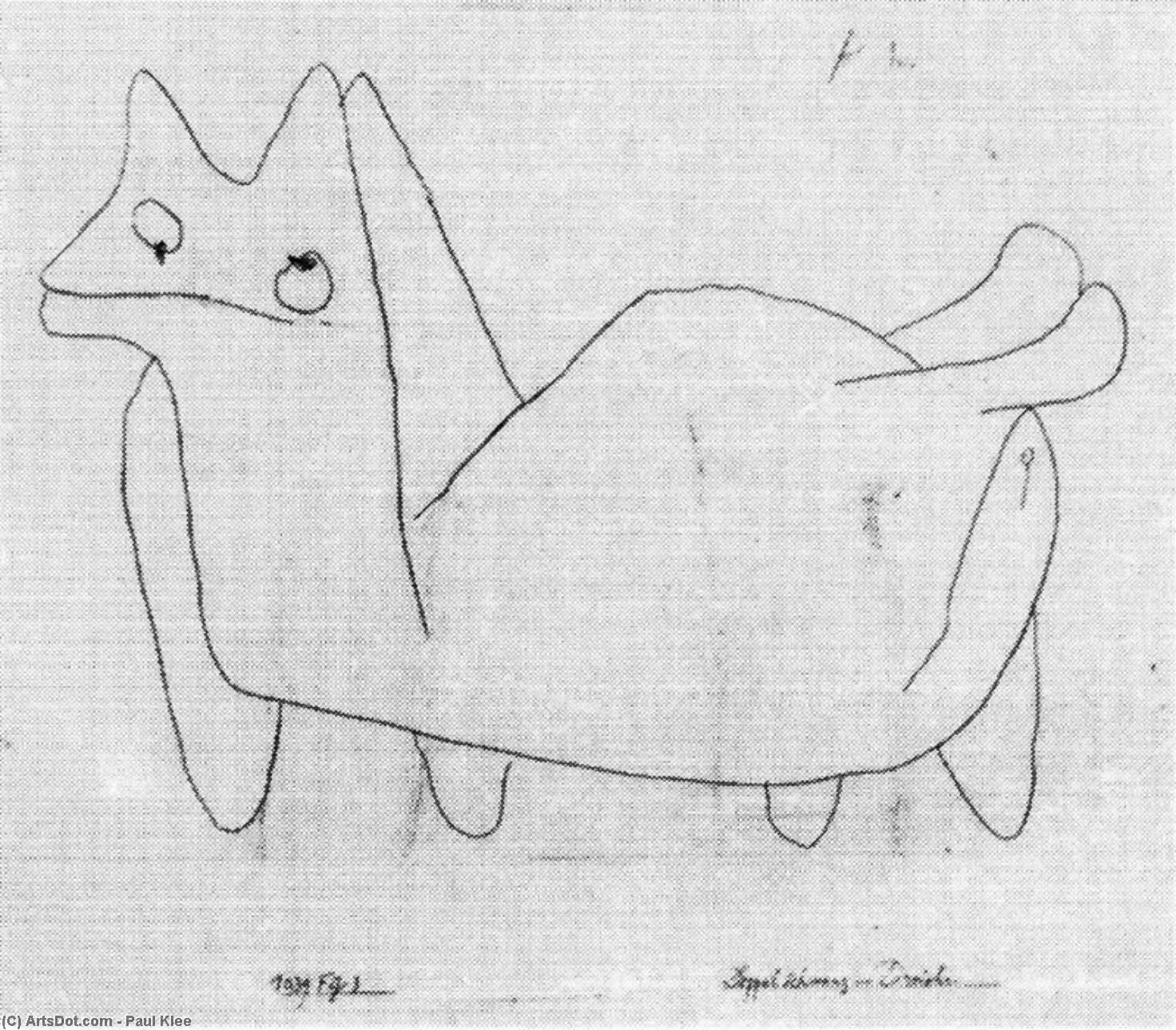
Paul Klee's “Doblecola-Tripleoreja,” a deceptively simple monochrome drawing, embodies the core tenets of his artistic philosophy – an unwavering commitment to abstraction coupled with profound emotional resonance. Created sometime between 1937 and 1940 during his prolific period in Murnau, Bavaria, this piece exemplifies Klee’s masterful manipulation of form and line to convey a sense of childlike wonder and subconscious exploration. It's not merely an image; it’s an invitation to contemplate the essence of visual expression itself.
- Subject Matter: The artwork presents a stylized depiction of an animal—likely a cat or similar creature—rendered in grayscale tones. Its deliberate lack of specificity underscores Klee’s belief that form transcends representation, prioritizing feeling and intuition over literal accuracy.
- Style & Influences: “Doblecola-Tripleoreja” firmly establishes itself within Klee's distinctive stylistic blend. Drawing heavily from Cubism’s fragmented perspectives and Expressionism’s emotive brushstrokes, it simultaneously echoes the playful spirit of children’s art—a conscious effort to recapture a primal state of imaginative freedom.
- Technique & Materials: Executed with pencil or charcoal on paper, the drawing showcases Klee's meticulous attention to texture. The grainy surface reflects his deliberate choice of medium and contributes to the artwork’s tactile quality, grounding its ethereal aesthetic in tangible materiality.
Decoding Geometric Harmony & Surrealist Resonance
Klee’s compositional strategy is characterized by geometric precision tempered with organic fluidity. Rounded forms dominate the animal's body, juxtaposed against triangular ears and simplified legs—a deliberate arrangement designed to create visual balance while simultaneously hinting at underlying structural tensions. This technique aligns seamlessly with Klee’s broader exploration of mathematical principles within art, mirroring concepts found in Piet Mondrian’s reductive grid compositions. Furthermore, the artwork possesses a subtle surrealist undertone; its dreamlike quality encourages viewers to engage in imaginative interpretation and consider alternative meanings beyond the surface level.
Symbolic Layers & Emotional Impact
The title itself—“Doblecola-Tripleoreja”—is deliberately nonsensical, reflecting Klee’s penchant for evocative naming conventions that prioritize emotional impact over rational explanation. This playful obfuscation serves as a conduit for conveying feelings of innocence and curiosity – qualities central to Klee's artistic vision. The monochrome palette amplifies these emotions, stripping away distracting color hues to focus solely on tonal variations that evoke contemplation and introspection. Like many of Klee’s works, “Doblecola-Tripleoreja” invites viewers to embark on a personal journey of discovery, prompting them to confront their own subconscious associations and appreciate the transformative power of abstract art.
Historical Context & Bauhaus Legacy
Klee's artistic output coincided with the burgeoning influence of the Bauhaus movement—a German school for design that championed functionalism and geometric abstraction. While Klee never formally enrolled at Bauhaus, he absorbed its principles of reductive form and tonal harmony, shaping his aesthetic sensibilities profoundly. “Doblecola-Tripleoreja” stands as a testament to this legacy, embodying the Bauhaus ethos’s belief in simplifying visual language to communicate essential ideas with clarity and grace—a principle that continues to resonate within contemporary art discourse.


 معاينة الحجم الحقيقي
 التحويل إلى لوحة مرسومة يدوياً
 مشاركة
 مشاركة
 التفاصيل

 تحميل الملف
 قطع مشابهة
 الأشعة السينية
 عرض شرائح
 عرض المزيد






































 خيار الزجاج متاح فقط للمقاسات التي تقل عن 110 سم



