Vorschau anzeigen
 Versenden
 Teilen
 Details anzeigen
 Leitfaden

 Herunterladen
 Ähnliche Objekte
 Röntgenaufnahme
 Diashow
 Statistiken
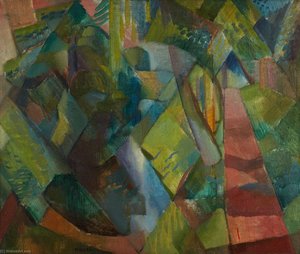
Tree Trunks
 Painting
- Cubism
 Modern
 63.0 x 76.0 cm
 Royal Scottish Academy of Art – Architektur
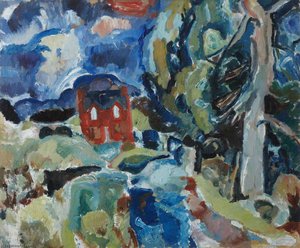
Sir William George Gillies (1898-1973) was a Scottish landscape painter celebrated for his masterful depictions of Scottish scenery, particularly trees and undergrowth. His artistic style blended Impressionism with Cubist influences, reflecting the impact of artists like Cézanne and Paul Klee.
 Weiterlesen
Erkunden Sie W.G. Gillies' schottische Landschaften und Stillleben. Entdecken Sie seine kubistischen Einflüsse, die Verbindungen zur 1922er Gruppe, das Erbe der Edinburgh College of Art und seinen tiefgreifenden Einfluss auf die Kunst des 20. Jahrhunderts.
Die auf dieser Seite dargestellten Kunstwerke sind urheberrechtlich geschützt, was bedeutet, dass wir keine identische Reproduktion rechtmäßig erstellen oder verkaufen dürfen. Dieser Schutz wird durch internationale Abkommen wie die Berner Übereinkunft und durch nationale Gesetze, einschließlich derer, die von den US-Urheberrecht – Titel 17.
Diese Methode entspricht vollumfänglich den Urheberrechtsbestimmungen, da sie keine Kopie oder Vervielfältigung des geschützten Kunstwerks darstellt. Stattdessen handelt es sich um eine kreative Neuinterpretation – ein neues Gemälde, das vom Original inspiriert, aber nicht identisch mit ihm ist.
Giclée / Kunstdruck
Giclée- oder Leinwanddruck in Museumsqualität mit schneller Produktion und flexiblen Veredelungsoptionen. ( Handgemalte Reproduktion bestellen Zum digitalen Bild wechseln)




P118B €10

P118H €10

P118W €10

P438Z €10

P508JH €12

P508YH €12

P805H €10

P805Z €10

P919BZ €10

P919G €10

P919XJ €10

P959ZH €10

P968JZ €12

W106C €8

W218G €10

W218JH €8

W218Y €10

W307PJ €10

W316G €10

W316PJ €8

W316Y €10

W398PJ €8

W4111J €10

W500HY €15

W500JH €15

W692G €12

W849H €8

W940BG €15

W953PJ €8




Standardformat
individuell anpassbar
CM
INCH
Wählen Sie aus unseren vordefinierten Formaten, die den ursprünglichen Proportionen des Kunstwerks entsprechen.
Loading sizes...

Breite
Höhe
Geben Sie die benötigte Breite und Höhe an, damit der Druck perfekt in Ihren Rahmen oder an Ihre Wand passt. Ein Druck kann nur beschnitten, aber niemals größer als das Originalbild angefertigt werden; daher verliert ein Format mit anderen Proportionen einen Teil des Bildes. Wir senden Ihnen ein digitales Mockup zur Freigabe, bevor wir den Druck ausführen. Das auf dieser Seite gezeigte Bild zeigt nicht den tatsächlichen Beschnitt – dies ist nur im Mockup ersichtlich.
Weltweiter Versand () innerhalb von 2 Wochen statt der üblichen 4/5 Wochen. (26 Oktober)

Kostenloser weltweiter Expressversand

Hochwertige Leinenleinwand

Umfassender Versicherungsschutz beim Versand

Zollgebühren-Rückerstattungsgarantie

Garantie für exakte Farbtreue

100 Tage Rückgaberecht (nur bei Mängeln)

100% Geld-zurück-Garantie

Mengenrabatt verfügbar
 Die Glasoption ist nur für Größen unter 110 cm verfügbar.

Tree Trunks
Giclée / Kunstdruck
Format der Reproduktion
-


Endpreis
€ 61
A Quiet Encounter in the Scottish Wilds
In the evocative monochrome of Tree Trunks, Sir William George Gillies invites us into a moment of profound stillness. The painting presents a hauntingly beautiful encounter between humanity and the natural world, capturing a solitary figure standing before the rugged texture of a tree trunk. With their back turned to the viewer, the individual becomes an anonymous vessel for our own emotions, allowing us to step into the scene and share in the quiet contemplation of the woods. The composition is masterfully balanced, using the verticality of the surrounding trees to create a sense of deep, immersive space that draws the eye inward, much like a whispered secret shared between the observer and the landscape.
The atmosphere of the piece is one of melancholic beauty, where the absence of color serves to heighten our focus on form, light, and shadow. This black and white palette strips away the distractions of the vibrant world, leaving behind a skeletal, structural elegance that emphasizes the raw textures of bark and the soft silhouettes of the forest. For the discerning collector or interior designer, this work offers a sophisticated focal point that brings a sense of timelessness and organic calm to any space, acting as a window into a serene, primordial realm.
The Intersection of Cubism and Impressionism
To understand the technical brilliance of Tree Trunks, one must look toward the rich artistic lineage of Sir William George Gillies. Having studied under André Lhote in Paris, Gillies brought a sophisticated understanding of Cubist structure to his Scottish landscapes. In this particular work, we see the subtle influence of that movement through the way he organizes the forest; the trees are not merely botanical subjects but architectural elements that build a complex, layered composition. There is a rhythmic quality to the arrangement of the trunks, creating a sense of depth and dimension that feels both grounded and dreamlike.
Yet, despite this structural rigor, the painting breathes with an Impressionistic soul. The way light filters through the unseen canopy to touch the figure and the bark suggests a fleeting moment captured in time. Gillies’ ability to blend the geometric precision of his early training with a more emotive, atmospheric approach allows the painting to transcend simple documentation. It becomes an exploration of texture and tone, where the interplay of light and dark creates a tactile experience that makes the viewer feel the coolness of the shade and the rough skin of the ancient trees.
A Timeless Addition to the Modern Interior
For those seeking to curate an environment of reflection and elegance, Tree Trunks serves as an incomparable inspiration. Its monochromatic depth makes it a versatile masterpiece, capable of complementing both minimalist contemporary settings and more traditional, classic interiors. The painting does not merely decorate a wall; it anchors a room with its quiet strength and historical weight. It evokes the spirit of the Scottish Highlands—a landscape of rugged endurance and silent beauty—making it an ideal choice for those who value art that tells a story of connection to the earth.
Owning a high-quality reproduction of this work allows one to bring the contemplative essence of Gillies' vision into the home. It is a piece that rewards repeated viewing, revealing new nuances in its shadows and compositions each time the light changes in the room. Whether placed in a quiet study or a grand living area, Tree Trunks remains a powerful testament to the enduring dialogue between the human spirit and the enduring majesty of nature.
Fragen & Antworten
Welche Größe wird für "Tree Trunks" in einem Living Room empfohlen?
Für einen Living Room ist die empfohlene Druckgröße von "Tree Trunks" von Sir William George Gillies Medium.
Kann "Tree Trunks" in Augmented Reality vorab betrachtet werden?
Auf der AR-Vorschau-Seite von "Tree Trunks" von Sir William George Gillies können Sie das Kunstwerk mithilfe von Augmented Reality auf einem kompatiblen Gerät direkt in Ihren eigenen Räumlichkeiten erleben.
Welcher Kunstrichtung lässt sich "Tree Trunks" von Sir William George Gillies zuordnen?
Die mit "Tree Trunks" von Sir William George Gillies verbundene Stilrichtung ist Cubism. Diese Klassifizierung ordnet das Werk in den Kontext verwandter Künstler und Kunstwerke ein.
Ähnliche Kunstwerke


Künstlerbiografie
Sir William George Gillies: Ein Leben in der schottischen Kunst
Frühes Leben und Ausbildung
- Geboren: Haddington, East Lothian, Vereinigtes Königreich, 1898.
- Gillies begann sein Studium an der Edinburgh College of Art, wurde aber durch seinen Dienst im Ersten Weltkrieg bei den Royal Engineers unterbrochen.
- Nach dem Krieg kehrte er zurück und setzte seine Ausbildung am Edinburgh College of Art fort, schloss sie ab und arbeitete anschließend über 40 Jahre als engagierter Lehrer dort.
Künstlerische Entwicklung und Einflüsse
- Gillies’ künstlerischer Weg begann mit einer Erkundung des Kubismus, nachdem er unter André Lhote in Paris (1923) studiert hatte und Italien (1924) bereist hatte.
- Frühe Werke wie „Two Pots, Saucer and Fruit“ (1933) zeigen diese Einflüsse und präsentieren eine Cézanne-inspirierte Anordnung mit den unaufdringlichen Farbpaletten von Braque und Picasso.
- Ein entscheidender Moment kam 1934, als er die Werke von Paul Klee entdeckte und sich dadurch inspirieren ließ, eine imaginative Verwendung von Farbe und kindliche Qualitäten in seinen Kompositionen einzusetzen.
- Er entwickelte allmählich einen eigenen Stil, der in schottischen Landschaftsbildern und Stillleben Traditionen verwurzelt ist.
Die 1922er Gruppe und kollaborativer Geist
- Im Jahr 1922 gründete Gillies zusammen mit anderen Künstlern wie William Crozier, William Geissler und William MacTaggart die „1922er Gruppe“.
- Diese Ausstellungsgruppe bot einer Plattform für aufstrebende schottische Künstler, um ihre Werke über ein Jahrzehnt im New Gallery in Edinburgh auszustellen.
- Die Gruppe förderte ein Gefühl von Gemeinschaft und Innovation innerhalb der schottischen Kunstszene.
Themen und Gegenstände
- Landschaften: Gillies ist bekannt für seine Darstellungen der Lothian-, Fife- und Borderregionen Schottlands. Er erfasste den Charakter dieser Landschaften mit einem feinfühligen Blick.
- Stillleben: Stillleben waren ein weiteres wichtiges Thema, oft mit Keramiken, die von seiner jüngeren Schwester Emma Smith Gillies geschaffen wurden, deren frühes Ableben 1936 ihn tief betraf, dargestellt.
- Porträts: Obwohl er in seiner frühen Karriere mit Porträts experimentierte, blieben Landschaften und Stillleben seine Hauptthemen.
Wichtige Leistungen und Anerkennung
- Gillies war von 1959 bis zu seinem Ruhestand im Jahr 1966 Direktor der Edinburgh College of Art.
- Seine produktive Arbeit und sein Engagement für die Lehre hatten einen tiefgreifenden Einfluss auf Generationen schottischer Maler.
- Er wurde zum Royal Academician (RA) ernannt, was eine bedeutende Anerkennung in der Kunstwelt darstellte.
Historische Bedeutung und Vermächtnis
- Sir William George Gillies gilt als einer der wichtigsten schottischen Maler des 20. Jahrhunderts.
- Seine Werke verbinden den frühen Modernismus mit einer eigenständigen schottischen künstlerischen Identität.
- Vermächtnis: Sein Einfluss erstreckt sich über seine Gemälde hinaus und prägt die Richtung der schottischen Kunst durch sein Unterrichten und Mentoring.
- Er starb 1973 und hinterließ ein reiches Œuvre, das bis heute für seine Schönheit, Sensibilität und zeitlose Relevanz gefeiert wird.

Sir William George Gillies
1898 - 1973 , Vereinigtes Königreich
Kurzinfos
- Artistic Movement Or Style: Kubismus
- Artists Or Movements Influenced By This Artist: ['Scottish Colourists']
- Artists Who Influenced This Artist:
- André Lhote
- Paul Klee
- Cézanne
- Braque
- Picasso
- Date Of Birth: 1898
- Full Name: Sir William George Gillies
- Nationality: Schottisch
- Notable Artworks:
- Young Boy with a Teapot
- Mediterranean Landscape mit Überdachung
- Stillleben – Gelbes Krug und gestreifte Leinwand
- Place Of Birth: Haddington, Vereinigtes Königreich
Ähnliche Artikel

Arboreal Echoes: A Historical & Artistic Exploration of Trees in Painting
Explore the rich history of trees in painting! Discover symbolism, Romantic masterpieces by Caspar David Friedrich & beyond. A curated journey for art enthusiasts.

Sir William George Gillies: Ein schottischer Farbist und seine Reise durch Landschaft und Abstraktion
Entdecken Sie das faszinierende Werk von Sir William George Gillies! Erfahren Sie mehr über seine Entwicklung vom schottischen Realismus zur Abstraktion und die Bedeutung seiner Landschaftsmalerei für die moderne Kunst. Jetzt lesen!

Romantische Landschaften: Die 10 Meisterwerke, die eine Epoche prägten | TopImpressionists
Entdecken Sie die 10 Meisterwerke der Romantischen Landschaftsmalerei! Von Caspar David Friedrich bis Turner – erleben Sie die Kunst, Emotion & Natur. Hochwertige Reproduktionen auf TopImpressionists.com

Arboreal Echoes: A Historical & Artistic Exploration of Trees in Painting
Explore the rich history of trees in painting! Discover symbolism, Romantic masterpieces by Caspar David Friedrich & beyond. A curated journey for art enthusiasts.

John Constable: Die 25 Meisterwerke des englischen Landschaftsgenies – TopImpressionists
Entdecken Sie die 25 Meisterwerke von John Constable! Erleben Sie englische Landschaftsmalerei vom Hay Wain bis zur Stour Valley. Hochwertige Reproduktionen & Kunst für Ihr Zuhause auf TopImpressionists.com.
Entdecken Sie Kunstwerke, die nach Themen, Stilen und Merkmalen sortiert sind.