Preview
 Send
Send Share
Share
 Details
 Guide
Guide

 Download
 Similars
 X-Ray
X-Ray Diaporama
 Stats
StatsMontreal


Explore Arthur B. Davies's ethereal landscapes and portraits—a masterful blend of Impressionism and Symbolism capturing the serene beauty of Montreal and reflecting his profound spiritual vision.
 Read More
Arthur B. Davies (1862-1928): A key figure in American modernism & the Ashcan School, celebrated for his ethereal paintings and pivotal role in organizing the groundbreaking 1913 Armory Show.
Giclée / Art Print
Museum-quality giclée or canvas print with fast production and flexible finish options. ( Buy Hand Made Painting Switch to Digital Image)




P118B $10

P118H $10

P118W $10

P438Z $10

P508JH $12

P508YH $12

P805H $10

P805Z $10

P919BZ $10

P919G $10

P919XJ $10

P959ZH $10

P968JZ $12

W106C $8

W218G $10

W218JH $8

W218Y $10

W307PJ $10

W316G $10

W316PJ $8

W316Y $10

W398PJ $8

W4111J $10

W500HY $15

W500JH $15

W692G $12

W849H $8

W940BG $15

W953PJ $8




Standard
custom
CM
INCH
Pick from our preset sizes that match the artwork's original proportions.
Loading sizes...

width
height
Type the width and the height you need, to fit your frame or your wall. A print can only be cut, never made bigger than the picture, so a size with a different shape loses a part of the image. We send you a digital mockup to approve before we print anything. The picture shown on this page does not show the real cut — only the mockup does.
Worldwide Delivery () in 2 weeks instead of standard 4/5 weeks. (17 October)

Free Worldwide Express Shipping

High-Quality Linen Canvas

Full Shipping Insurance

Customs Tax Refund Guarantee

True Color Matching Guarantee

100-Day Return Policy (Defects Only)

100% Money-Back Guarantee

Bulk Discount Offer
 Glass option is only available in size under 110 CM

Montreal
Giclée / Art Print
Reproduction Size
-


Total Price
$ 70
A Portrait of Montreal’s Soul: Arthur B. Davies's Visionary Landscape
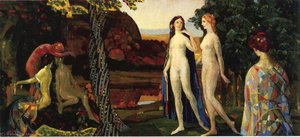
Montreal, painted in 1812 by Arthur Bowen Davies, isn’t merely a depiction of the city; it’s an embodiment of Davies’s deeply felt connection to the natural world and his unwavering belief in its ability to inspire profound contemplation. Born in Utica, New York, in 1862, Davies embarked on a remarkable artistic journey fueled by an early encounter with George Inness and the Hudson River School masters—a formative experience that instilled within him a reverence for tonalist landscapes and a meticulous attention to detail. This painting captures precisely this spirit of observation and quiet wonder.- Subject Matter: The canvas portrays Montreal nestled amidst rolling hills, dominated by Mount Royal – a landscape steeped in geological history and symbolic significance. Davies skillfully renders the cityscape as viewed from Isle St. Helena, emphasizing the interplay between urban life and the grandeur of nature.
- Style & Technique: Davies’s approach aligns seamlessly with the tonalist movement, prioritizing atmospheric perspective and subtle gradations of color over sharp delineation. He employs a delicate brushstroke technique, layering thin washes of pigment to achieve an ethereal luminescence that captures the misty beauty of dawn. The muted palette—primarily blues, greens, and browns—creates a mood of serenity and contemplation.
- Historical Context: Created during the Romantic era, Montreal reflects the prevailing artistic sensibilities of its time – a fascination with sublime landscapes and an impulse to convey emotion through visual representation. Davies’s work stands as testament to the enduring power of nature to inspire artists and viewers alike.
Symbolism Within Tranquility: The Mountain's Presence
Mount Royal itself holds considerable symbolic weight within Quebec culture, representing resilience, strength, and spiritual aspiration. Davies subtly incorporates this monumental element into his composition, elevating the painting beyond a simple topographical record. Its hazy outline serves as a visual anchor, grounding the scene in reality while simultaneously suggesting an infinite expanse of sky—a motif frequently employed by Romantic artists to convey ideas of transcendence and divine presence. The artist’s careful consideration of light and shadow further reinforces this symbolic dimension, mirroring the interplay between darkness and illumination that characterizes human experience.Davies's Legacy: Bridging Tradition and Modern Vision
Arthur Bowen Davies wasn’t simply a follower of established artistic conventions; he was an innovator who championed American modernism while retaining a deep appreciation for European influences. His involvement in organizing the groundbreaking 1913 Armory Show solidified his position as a pivotal figure in shaping the course of twentieth-century art, demonstrating his commitment to challenging conventional aesthetic boundaries and fostering dialogue between diverse artistic voices. Davies’s unwavering dedication to capturing the essence of nature—combined with his masterful technique—ensures that Montreal remains an enduring emblem of artistic beauty and contemplative reflection.Dimensions & Reproduction Considerations
The painting measures 34 x 52 cm (approximately 13.4 x 20.5 inches). Reproductions crafted by TopImpressionists.com utilize archival-quality pigments and printing methods to faithfully recreate Davies’s luminous palette and textural subtleties, allowing collectors and interior designers alike to experience the profound emotional impact of this iconic landscape.Questions & Answers
Are the colors of "Montreal" by Arthur B. Davies saturated or muted?
"Montreal" by Arthur B. Davies is recorded with a subtle color saturation.
What level of contrast does "Montreal" by Arthur B. Davies show?
"Montreal" by Arthur B. Davies shows a gentle contrast between its light and dark areas.
Can I see "Montreal" by Arthur B. Davies on my own wall before buying?
The AR Preview page of "Montreal" by Arthur B. Davies uses augmented reality to show the artwork in your own space, on a compatible device.


Artist Biography
A Mystic in the Modern Age: The Life and Art of Arthur B. Davies
Arthur Bowen Davies, born in Utica, New York, in 1862, occupies a uniquely complex position within the narrative of American art. He wasn’t simply *of* his time—the tumultuous era bridging the 19th and 20th centuries—but actively shaped it, serving as both a conduit for European modernism and a champion of distinctly American artistic voices. His journey began with an early fascination for landscape painting, sparked by a touring exhibition that showcased the works of George Inness and the Hudson River School masters. This initial exposure instilled in him a reverence for nature’s beauty and a technical proficiency that would remain hallmarks of his style throughout his career. However, Davies wasn't destined to become merely another practitioner of traditional landscape; he possessed an inner vision, a yearning to express something beyond the purely representational. After studies at the Chicago Academy of Design and the Art Students League in New York, he began to forge a path that blended romantic sensibilities with emerging modernist ideals. His early career involved illustration work, but his true calling lay in painting—in creating worlds imbued with symbolism and emotional resonance.The Ashcan School & The Armory Show: A Catalyst for Change
Davies’s artistic development unfolded against a backdrop of significant social and cultural shifts. He became associated with “The Eight,” a group of artists who challenged the conservative norms of the National Academy of Design in 1908. While often linked to the Ashcan School—a movement known for its gritty depictions of urban life—Davies stood somewhat apart. Where artists like John Sloan focused on the raw realities of city streets, Davies sought refuge in a more ethereal realm. His paintings weren't about documenting the visible world; they were about evoking moods, dreams, and spiritual longings. Nevertheless, his involvement with The Eight demonstrated his commitment to artistic independence and his willingness to challenge established conventions. This spirit of rebellion culminated in his pivotal role as one of the organizers of the 1913 Armory Show—a watershed moment that introduced European modernism (Cubism, Fauvism, Futurism) to a largely unsuspecting American public. The show was met with both outrage and excitement, irrevocably altering the course of American art history. Davies’s contribution wasn't merely logistical; he possessed an exceptional understanding of contemporary artistic trends and a keen eye for talent, making him instrumental in selecting the works exhibited. He understood that art needed to reflect the changing world, even if that meant embracing radical new forms.A Language of Symbolism & Ethereal Visions
Davies’s mature style is characterized by its lyrical quality, delicate brushwork, and evocative use of color. His paintings often feature figures—often women or mythological beings—immersed in dreamlike landscapes. These aren't portraits in the traditional sense; they are archetypal representations of human emotions and spiritual states. Unicorns: Legend, Sea Calm, perhaps his most famous work, exemplifies this approach. The painting depicts a group of ethereal figures frolicking with unicorns on a tranquil shore—a scene that is both enchanting and deeply symbolic. His works frequently explore themes of longing, loss, and the search for transcendence. He wasn’t interested in depicting reality as it *is*, but rather as it *feels*. This emphasis on subjective experience aligns him with Symbolist painters like Odilon Redon and Pierre Puvis de Chavannes, artists who sought to express inner truths through evocative imagery. Davies's palette is often muted and harmonious, creating a sense of atmosphere and mystery. He masterfully employed techniques such as glazing and scumbling to achieve luminous effects and subtle gradations of tone. His art invites contemplation, urging viewers to look beyond the surface and delve into the realm of the imagination.Contradictions & Legacy
The life of Arthur B. Davies was marked by contradictions. While publicly advocating for artistic freedom and innovation, he maintained a relatively conservative personal life—at least, the one presented to the world. The revelation after his death in Florence, Italy, in 1928, that he had lived a double life with two families—Virginia Meriwether Davies, whom he married in 1892, and Edna—shocked the art community. This hidden aspect of his biography adds another layer of complexity to his artistic persona. Despite this personal turmoil, or perhaps because of it, Davies left an indelible mark on American art. He was a pivotal figure in the development of American modernism, bridging the gap between traditional aesthetics and avant-garde experimentation. His influence can be seen in the work of subsequent generations of artists who continued to explore themes of spirituality, symbolism, and emotional expression.- He remains a testament to the power of art to transcend boundaries—both artistic and personal.
- His paintings continue to resonate with viewers seeking beauty, mystery, and a glimpse into the hidden depths of the human soul.

Arthur B. Davies
1862 - 1928 , United States of America
Quick Facts
- Full Name: Arthur Bowen Davies
- Nationality: American
- Date Of Birth: 1862
- Date Of Death: 1928
- Place Of Birth: Utica, United States of America
- Notable Artworks: ['Unicorns: Legend, Sea Calm']
- Artistic Movement Or Style: Modernism, Symbolism
- Artists Who Influenced This Artist:
- George Inness
- Corot
- Millet
- Artists Or Movements Influenced By This Artist:
- American Modernism
- Ashcan School
Related Articles

Arthur B. Davies: Pioneering American Modernism & the Cosmopolitan Spirit
Explore the life & work of Arthur B. Davies, a pivotal figure in American Modernism. Discover his unique style, role in the 1913 Armory Show, and lasting influence on art history. Learn about collecting Davies' works.

Impressionistic Landscapes: 10 Masterpieces That Changed Art & Decor
Journey into the heart of Impressionism! Explore 10 masterpieces by Monet, Renoir & Degas that revolutionized landscape art. Discover their stories, techniques & find museum-quality reproductions to elevate your home decor on TopImpressionists.com.

Evocations of Place: A Historical Journey Through Landscape Art
Explore the rich history of landscape art with TopImpressionists. Discover renowned artists, movements like Impressionism & tonalism, and expert guidance for collecting timeless pieces. Find your perfect serene escape today!

Evocations of Place: A Historical Journey Through Landscape Art
Explore the rich history of landscape art with TopImpressionists. Discover renowned artists, movements like Impressionism & Romanticism, and expert guidance for collecting timeless pieces. Find your perfect serene escape today!

Cézanne's Masterpieces: 25 Iconic Artworks to Transform Your Space
Journey through 25 iconic artworks by Paul Cézanne – a master of Impressionism and Post-Impressionism. Explore his landscapes, still lifes, and the stories behind these timeless masterpieces. Discover museum-quality reproductions & curated decor at TopImpressionists.com.
Explore artworks organized by themes, styles, and characteristics.