

 Preview
 Send
Send Share
Share
 Details
 Guide
Guide

 Download
 Similars
 X-Ray
X-Ray Diaporama
 Stats
StatsSt Barbara
 Acrylic On Canvas
- WallArt
- Early Netherlandish Painting
 1437
1437- Renaissance
 31.0 x 18.0 cm
 Koninklijk Museum voor Schone Kunsten
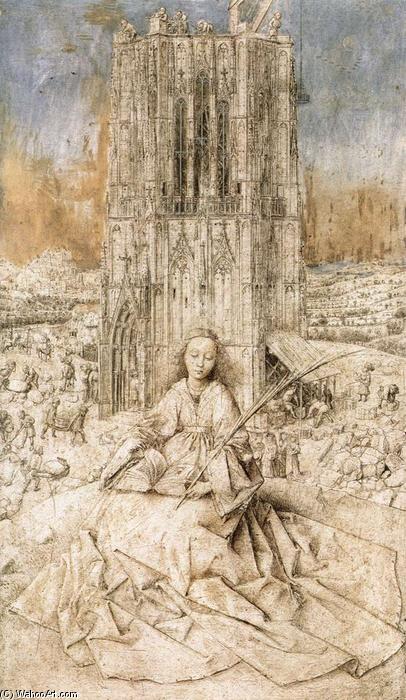
Jan van Eyck's St Barbara (1437), housed in Antwerp’s Koninklijk Museum voor Schone Kunsten, showcases grisaille technique & meticulous detail—a masterpiece reflecting Renaissance artistry.
 Read More
A pioneer of Early Netherlandish painting and the Arnolfini Portrait. Discover his revolutionary oil techniques and masterpieces today.
Purchase a high-resolution, enhanced digital image, far superior to the online preview.
Each file is meticulously prepared by our in-house specialists using advanced tools and expert manual retouching. We ensure every image has exceptional clarity, precise color accuracy, and fine detail.
The final file is delivered via email within 72 hours, optimized for immediate use in professional, editorial, and print environments. This is the same quality trusted by top-tier design studios, publishers, and galleries.
Digital Image
Download a high-resolution file for personal display, printing, and creative projects. ( Switch to Print Buy Hand Made Painting)
Included in Every Digital Image Order
Expert Digital Delivery, Guaranteed
When you choose TopImpressionists.com, you're not just getting an image - you're receiving a professionally enhanced digital artwork, crafted with precision and backed by a satisfaction guarantee. Here's everything that comes with your order, automatically:

Fast Email Delivery
Your high-resolution digital image file will be emailed to you within 72 hours of ordering - ready for immediate use.

AI-Enhanced Digital File
Your artwork is professionally optimized using advanced AI tools and manual editing, ensuring maximum detail, clarity, and color accuracy.

Free Lifetime Re-Delivery
Accidentally deleted or lost your file? No worries - we'll resend it to you anytime, free of charge.

No Import Fees - Ever
Enjoy your artwork instantly with zero customs, duties, or delivery fees - digital downloads are always tax-free.

Color Accuracy Guarantee
We ensure your digital image reflects the original colors as closely as possible using professional tools and color management.

100-Day Satisfaction Guarantee
If you're not satisfied with your digital image, we'll revise it or refund 100% within 100 days - no questions asked.

100% Money-Back Guarantee
Not satisfied? Get a full refund within 100 days of receiving your digital file - no questions asked.

Bulk Order Discounts
Buy 3 images, save 10% - Buy 5, save 15% - Buy 10+, save 20%. Great for creative projects, galleries, and agencies.
Jan Van Eyck: A Masterpiece of Grisaille
Jan van Eyck, arguably the most celebrated artist of the Northern Renaissance, gifted us with St Barbara—a painting that transcends time and continues to captivate viewers centuries later. Executed in 1437, this artwork resides within the hallowed halls of Koninklijk Museum voor Schone Kunsten (Royal Museum of Fine Arts) in Antwerp, Belgium—a testament to Flemish artistic prowess.
The painting’s distinctive monochrome palette—grisaille—immediately distinguishes it from vibrant color palettes prevalent during the period. This technique, favored by Van Eyck and his contemporaries, involved painstakingly layering shades of gray onto a wooden panel, achieving remarkable realism through subtle tonal variations. Measuring just 31 x 18 cm, St Barbara embodies Van Eyck’s meticulous attention to detail and unwavering commitment to capturing the essence of his subject.
The Painting: A Grisaille Masterpiece
At its core lies Saint Barbara—a figure venerated for her steadfast faith and martyrdom. Depicted seated upon the ground, her hands folded in prayerful repose convey a profound sense of serenity and devotion. Adorned with a crown symbolizing her sanctity and sainthood, she wears a simple dress reflecting the austerity of monastic life.
The scene is populated by several figures—men standing and others seated—adding depth and narrative complexity to the composition. Dominating the artwork are two swords prominently displayed: one positioned near the center-left side and another towards the right frame, serving as potent symbols of sacrifice and spiritual fortitude.
Behind Saint Barbara rises a towering edifice—a Gothic cathedral—representing divine majesty and architectural grandeur. The intricate tracery windows illuminate the interior space with diffused light, enhancing the ethereal atmosphere of the painting.
Artistic Significance
Jan van Eyck’s masterful use of grisaille represents an innovative approach to artistic representation during his era. It demanded exceptional skill in blending tonal shades and achieving textural nuances—a feat accomplished with unparalleled precision. Beyond its technical brilliance, St Barbara speaks to the humanist ideals of the Renaissance, emphasizing human dignity and spiritual contemplation.
Collection at Koninklijk Museum voor Schone Kunsten
The Koninklijk Museum voor Schone Kunsten in Antwerp stands as a beacon of European art heritage—a repository of masterpieces spanning centuries. Its holdings reflect the artistic tastes and intellectual currents of Antwerp’s elite during the fifteenth and sixteenth centuries.
Alongside Paul Bril's Landscape, Jan Siberechts' The Ford and Jacob Grimmer's View of Kiel, St Barbara exemplifies Van Eyck’s artistic legacy—a timeless symbol of faith and devotion.
For those eager to delve deeper into the artistry of Jan van Eyck and his contemporaries, explore Discover the Masterpieces of Koninklijk Museum voor Schone Kunsten (Belgium) on TopImpressionists.
Questions & Answers
Is "St Barbara" by Jan van Eyck in the public domain, and why?
"St Barbara" by Jan van Eyck is in the public domain - its copyright has expired. Copyright duration runs from the artist's death, which occurred in 1441.
What feeling does "St Barbara" by Jan van Eyck convey?
The recorded mood of "St Barbara" by Jan van Eyck is dramatic, and its emotional tone is mysterious.
When and with what materials was "St Barbara" made?
"St Barbara" was created in 1437 using the acrylic on canvas technique. Material and date describe how and when the original was made.
Artist Biography
The Alchemist of Light
To look at a Jan van Eyck painting is to witness the moment Western art stopped pretending and started observing. We often hear the myth that he invented oil paint, but the truth is more grounded and far more impressive: he mastered it. By applying thin, translucent glazes of pigment over one another, he achieved a depth of color and a precision of texture that tempera simply could not sustain. He did not just paint surfaces; he captured how light interacts with them. When you see the gleam of a single candle or the heavy weight of a velvet robe in his work, you are seeing the result of a technical revolution that changed the visual language of Europe.
His career was built on more than just brushwork. Van Eyck operated within the high-stakes environment of the Burgundian court, serving Philip the Good. This position required him to be much more than a craftsman; he functioned as a diplomat, traveling to places like Portugal and Spain on official missions. This access to power provided the financial stability necessary for his technical experiments. He was a man of intellect and discretion, qualities that allowed him to move between the worlds of high politics and fine art with ease.
The Precision of the Northern Eye
The work of Van Eyck is defined by an almost obsessive attention to the minute details of the physical world. In his portraits, he does not merely record a face; he records the texture of skin, the individual strands of hair, and the specific way light hits a turban. This level of realism was driven by a shift in focus toward the individual and the tangible. His ability to render atmospheric perspective—the way distant landscapes soften into a blue haze—showed a sophisticated understanding of how the human eye perceives depth.
His most significant technical achievements can be seen in several key works:
- The Ghent Altarpiece: A massive twelve-panel polyptych that demonstrates his ability to manage complex religious symbolism alongside realistic figures.
- The Arnolfini Portrait: A 1434 work where every object, from the dog representing fidelity to the discarded shoes on holy ground, carries specific weight. The mirror in the background reflects a whole other layer of reality.
- Portrait of a Man (Self Portrait?): A 1433 oil painting that features his personal motto, "Als ich kan" (As well as I can), etched directly onto the frame.
A Lasting Technical Standard
The influence of Jan van Eyck is not found in a vague sense of inspiration, but in the concrete standards he set for the medium. He moved the needle from the matte, flat surfaces of the medieval era toward a luminous, three-dimensional reality. His signature, "JOHANNES DE EYCK," and his frequent use of his motto served as a direct challenge to his contemporaries. He was not interested in the anonymity common to many medieval painters; he wanted his technical prowess to be recognized and attributed.
Even after his death in Bruges in 1441, the methods he perfected continued to dictate how artists approached light and texture for generations. His work remains a benchmark because it represents the successful marriage of scientific observation and artistic skill. He transformed pigments into something that feels alive, leaving behind a body of work that remains as sharp and clear today as it was in the fifteenth century.

Jan van Eyck
1390 - 1441 , Netherlands
Quick Facts
- Artistic Movement Or Style: Early Netherlandish painting
- Artists Or Movements Influenced By This Artist:
- Early Netherlandish painting
- Generations of painters
- Full Name: Jan van Eyck
- Nationality: Flemish
- Notable Artworks:
- Ghent Altarpiece
- Arnolfini Portrait
- Dresden Triptych
- Man in a Blue Turban
- Place Of Birth: Maastricht, Netherlands
- Date Of Birth: 1390
- Date Of Death: 1441